
Exchange Traded Funds (ETFs)

Search documents
2 Tech Leadership ETFs I Like Much Better Than the SPY
247Wallst· 2026-01-05 15:19
Core Viewpoint - The tech sector is experiencing increased volatility, particularly in software stocks, and while risks of correction are present, major tech leaders are still considered long-term investments [1][2]. Group 1: Market Trends - The tech sector has faced significant fluctuations recently, with software stocks notably declining on the first trading day of the year [1]. - There is a possibility of a bear market or sharp declines, but the long-term potential of AI is highlighted as a reason to remain invested [2]. Group 2: Investment Opportunities - Two tech leadership ETFs are discussed as potential outperformers compared to the S&P 500, particularly if AI monetization is successful [3]. - The JPMorgan U.S. Tech Leaders ETF has seen a remarkable rise of over 77% since its inception in 2023, indicating strong performance [4]. - The ETF focuses on major players in the American tech sector and may benefit from stock-picking strategies in 2026 [5]. - The iShares Future Exponential Technologies ETF targets global innovation leaders, with over 70% of its investments in U.S. companies, making it suitable for investors seeking growth beyond traditional indices [8]. Group 3: ETF Characteristics - The JPMorgan U.S. Tech Leaders ETF has a net expense ratio of 0.65%, which is considered reasonable for active management [6]. - The ETF includes exposure to smaller firms with market caps under $120 billion, such as Robinhood Markets and Snowflake, providing a balanced portfolio [7]. - The iShares Future Exponential Technologies ETF has a modest expense ratio of 0.46% and maintains a balanced weighting, with no single holding exceeding 5% of the fund [9].


Trump Media’s “America-First” ETFs Just Launched. Will They Be a Hit?
Yahoo Finance· 2026-01-05 14:21
Core Viewpoint - Trump Media & Technology Group has launched a new series of "America-first" ETFs under the Truth Social brand, which may appeal to patriotic investors despite the competitive ETF market and higher expense ratios [1][5]. Group 1: ETF Launch and Market Reaction - Trump Media launched five America-first themed ETFs with expense ratios around 0.65%, covering sectors such as defense, innovation, brands, energy, and real estate [5]. - Initial market reaction to DJT stock was negative, but shares have since recovered [5]. Group 2: Investment Methodology and Target Market - Thematic ETFs, like those from Truth Social, often come with higher gross expense ratios and may not always align with traditional investment strategies [2]. - The new ETFs are positioned as values-based investments, targeting a market segment that prioritizes personal values over conventional financial metrics [2]. Group 3: Competitive Landscape - The ETF market has become increasingly crowded, with a variety of firms launching products that cater to specific investor preferences [4]. - As expense ratios continue to decline in a competitive environment, launching new ETFs may not guarantee success, especially against established providers like Vanguard [4][3].
One Avantis ETF Beat Vanguard’s Biggest Funds in 2025 and Could Keep Running in 2026
Yahoo Finance· 2025-12-27 15:08
Core Viewpoint - The Avantis Emerging Markets Equity ETF (AVEM) achieved a 35% return in 2025, significantly outperforming major Vanguard funds, indicating a potential resurgence for emerging markets [1][2]. Group 1: Performance and Assets - AVEM holds $15.1 billion in assets and has a concentrated investment in Asian technology and financial sectors, particularly with 6.35% allocated to Taiwan Semiconductor [1][2]. - The fund outperformed the Vanguard S&P 500 ETF (VOO) and Vanguard Total Stock Market ETF (VTI) by approximately 17 percentage points in 2025 [1][2]. Group 2: Macro Factors - A key macroeconomic factor for AVEM in 2026 is the strength of the U.S. dollar; a 9% decline in the dollar during 2025 enhanced the attractiveness of emerging market assets [4]. - Continued dollar weakness is expected to provide tailwinds for AVEM, while monitoring the Federal Reserve's rate decisions and global growth expectations is crucial [5]. Group 3: China’s Economic Influence - AVEM's performance is heavily influenced by China's economic policies, with significant investments in Chinese tech giants and banks; supportive government measures in 2025 contributed to the fund's gains [6]. - If China's support for the private sector continues or accelerates in 2026, AVEM stands to benefit, but tightening policies or geopolitical tensions could pose risks [6]. Group 4: Sector Concentration and Risks - The fund's largest holding is Taiwan Semiconductor, and its returns are significantly driven by semiconductor stocks, which performed well due to increased AI chip demand in 2025 [7]. - This concentration in semiconductors creates vulnerability; any downturn in the semiconductor cycle or supply chain disruptions could adversely affect AVEM [7].
Is Xtrackers Russell US Multifactor ETF (DEUS) a Strong ETF Right Now?
ZACKS· 2025-12-24 12:21
Core Insights - The Xtrackers Russell US Multifactor ETF (DEUS) is designed to provide broad exposure to the Style Box - Large Cap Blend category and was launched on November 24, 2015 [1] Fund Overview - DEUS is sponsored by Deutsche Bank Ag and has accumulated assets exceeding $214.55 million, positioning it as an average-sized ETF in its category [5] - The fund aims to match the performance of the Russell 1000 Comprehensive Factor Index, which is based on five factors: Quality, Value, Momentum, Low Volatility, and Size [5] Cost Structure - The ETF has an annual operating expense ratio of 0.17%, making it one of the more affordable options in the market [6] - Its 12-month trailing dividend yield is reported at 1.58% [6] Holdings and Sector Exposure - Cardinal Health Inc (CAH) constitutes approximately 1.7% of total assets, followed by Amerisourcebergen Corp (ABC) and McKesson Corp (MCK) [7] - The top 10 holdings represent about 8.96% of the total assets under management [8] Performance Metrics - DEUS has experienced a gain of approximately 11.07% year-to-date and a 10.17% increase over the past year as of December 24, 2025 [9] - The ETF has traded between $48.13 and $59.15 in the past 52 weeks [9] - It has a beta of 0.93 and a standard deviation of 13.42% over the trailing three-year period, indicating a medium risk profile [10] Alternatives - Investors may consider alternatives such as iShares Core S&P 500 ETF (IVV) and Vanguard S&P 500 ETF (VOO), which track the S&P 500 Index and have significantly larger asset bases of $766.01 billion and $829.11 billion respectively [11] - Both IVV and VOO have a lower expense ratio of 0.03% [11]

JEPI Is Great For Monthly Income, Buy Little Known KBWD Actually Pays More
247Wallst· 2025-12-10 15:07
Core Insights - The JPMorgan Equity Premium Income ETF (JEPI) is popular for its substantial yield, while the Invesco KBW High Dividend Yield Financial ETF (KBWD) offers an even higher yield by focusing on financial sector dividend payers [1][2] - Investors should analyze KBWD's concentrated holdings and expense structure before investing [1] Group 1: Fund Characteristics - KBWD generates income through dividend distributions from its holdings, unlike JEPI, which uses options strategies [2] - The fund has a concentrated focus on financial sector equities, particularly mortgage REITs and business development companies, which presents both opportunities and risks [2][8] Group 2: Top Holdings and Performance - ARMOUR Residential REIT (ARR) declared a $0.24 monthly dividend, with a book value of $19.02 per share, reporting $194.5 million in revenue and $159.3 million in net income for Q3 2025 [3] - AGNC Investment Corp (AGNC) announced a $0.36 quarterly dividend, yielding 13.70% annually, with a $90.8 billion agency MBS portfolio and $903 million in revenue for Q3 [4] - Annaly Capital Management (NLY) paid a $0.70 per share dividend, managing a $97.8 billion portfolio and reporting $1.79 billion in revenue for Q3 [5] Group 3: Risk Factors - Mortgage REITs operate with significant leverage, making them sensitive to interest rate movements and yield curve dynamics [6] - KBWD's concentration in financial sector holdings exposes investors to interest rate sensitivity and leverage risks [8][11] Group 4: Alternative Options - The JPMorgan Nasdaq Equity Premium Income ETF (JEPQ) offers a diversified alternative by employing a covered call strategy on Nasdaq-100 stocks, generating income through option premiums [12]





Nasdaq Seeks 4X Options Limit Jump For IBIT — Will Bitcoin ETFs Benefit? - Apple (NASDAQ:AAPL), ARK 21Shares Bitcoin ETF (BATS:ARKB)
Benzinga· 2025-11-28 17:38
Core Viewpoint - Nasdaq's International Securities Exchange is seeking to elevate BlackRock's iShares Bitcoin Trust (IBIT) to the same status as major equities and ETFs by increasing its options position limits from 250,000 contracts to 1 million, reflecting a shift in Bitcoin's role from a speculative asset to a core institutional investment [1][2]. Group 1: Institutional Demand and Market Impact - The current cap on IBIT options is seen as a restriction that limits traders' ability to implement effective hedging and risk management strategies, and an increase in limits would enhance liquidity and reduce spreads [3]. - The request for expanded limits indicates a growing demand for Bitcoin derivatives, suggesting that institutions are increasingly interested in structured products related to IBIT [4]. - Nasdaq is also seeking to eliminate limits on customized physically delivered FLEX options, which could shift trading from opaque over-the-counter markets to more transparent exchange-based venues [5]. Group 2: Broader Implications for Bitcoin ETFs - The proposal is expected to benefit the overall spot Bitcoin ETF market, as increased derivatives capacity around IBIT may enhance usability for allocation-focused investors [6]. - Other Bitcoin ETFs, such as Grayscale Bitcoin Trust (GBTC), ARK 21Shares Bitcoin ETF (ARKB), and Bitwise Bitcoin ETF (BITB), could experience increased flows as institutional interest in a derivatives-supported ETF ecosystem grows [7]. - The expansion of IBIT options may encourage other issuers and exchanges to adopt similar frameworks for their own ETFs over time [8].


Did You Need VTI Instead of VOO? What History Says About the Differences
Yahoo Finance· 2025-11-04 16:17
Core Insights - The rise of exchange-traded funds (ETFs) has transformed the investment landscape, providing low-cost diversification options for investors [2][3] - The article highlights two prominent ETFs: Vanguard Total Stock Market Index Fund (VTI) and Vanguard S&P 500 ETF (VOO), emphasizing their differences [4][8] Group 1: Vanguard Total Stock Market Index Fund (VTI) - VTI offers broad market exposure by tracking the entire U.S. stock market, including small and mid-cap companies, making it suitable for investors seeking comprehensive market access [5][6] - The fund has a low expense ratio of 0.03%, which is among the lowest in the industry, allowing investors to gain exposure to a high-quality portfolio at a minimal cost [6][8] - VTI maintains a low turnover ratio of 2.1%, aligning with the buy-and-hold strategy favored by long-term investors [7] Group 2: Vanguard S&P 500 ETF (VOO) - VOO focuses on the 500 largest U.S. companies, resulting in greater concentration in mega-cap and technology stocks compared to VTI [8] - Both VTI and VOO charge identical expense ratios of 0.03% and employ low turnover strategies, catering to long-term passive investors [8]
More retirement investors opting for 'good enough' stock portfolio strategy to protect their market money
CNBC· 2025-10-31 12:30
Core Insights - Retirees and investors nearing retirement face challenges in achieving growth from their stock portfolios to combat inflation and rising healthcare costs, while also being wary of potential market downturns [1] - The current investment strategy suggests that recent retirees should maintain over half of their portfolios in stocks, but concerns arise due to the concentration of the U.S. stock market in a few large tech companies and the potential for an AI bubble [2] - Chip sales have significantly contributed to GDP growth, accounting for approximately 92% in the first half of the year, highlighting the importance of AI as a growth driver for the U.S. economy, though it poses short-term risks for investors [3] Investment Trends - Many retirees are shifting their investments towards equity income-generating ETFs to reduce stock exposure while still aiming for growth [4] - Buffered ETFs, which protect against losses while allowing for some upside, have seen substantial growth since the pandemic, with assets exceeding $30 billion and an average return of about 11% per year over five years [5] - There is a notable shift in investor mindset, with retirees now prioritizing steady and predictable returns over outperforming the S&P 500, seeking "performance that's good enough" [6] Cost Considerations - Buffered ETFs typically charge higher fees (0.75% to 0.85%) compared to standard equity index ETFs (around 0.03%), but the added cost may be justified for retirees focused on capital preservation and risk management [7] - Major buffered equity ETFs include FT Vest Laddered Buffer ETF (BUFR) with $7.9 billion in assets and a 0.95% expense ratio, Innovator Defined Wealth Shield ETF (BALT) with $1.9 billion and a 0.69% expense ratio, among others [8]

多只资产配置产品发行,黄金ETF流入明显 ——海外创新产品周报20251020
申万宏源金工· 2025-10-21 08:01
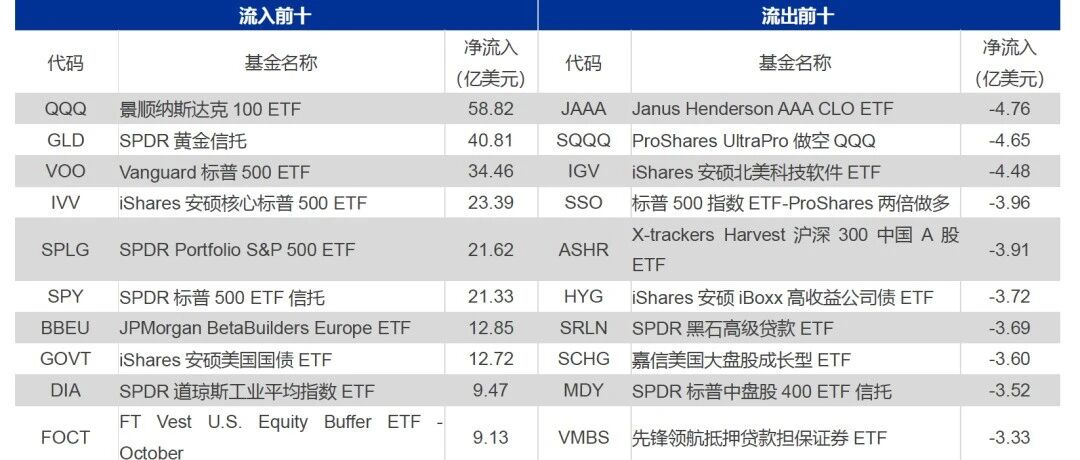
Group 1: New ETF Products in the US - A total of 22 new ETF products were launched in the US last week, including various types such as downside protection, leverage, thematic, allocation, and rotation products [1][2] - Seven new downside protection products were introduced, including Calamos' structured products linked to Bitcoin, which offer varying levels of protection (80%, 90%, 100%) [1] - Arrow Funds launched a Bitcoin strategy product that adjusts its allocation between Bitcoin and gold or cash based on market risk appetite [1] Group 2: ETF Fund Flows - US ETFs experienced significant inflows of nearly $50 billion last week, with domestic equities attracting over $25 billion, and commodity ETFs, particularly gold, also seeing substantial inflows [3][5] - The SPDR Gold Trust (GLD) was the second highest inflow product, with $40.81 billion, while the Invesco QQQ Trust (QQQ) led with $58.82 billion [5] Group 3: ETF Performance - Precious metal stocks have outperformed precious metal ETFs this year, with several mining-related ETFs showing gains around 150% [6][7] - The SPDR Gold Shares (GLD) and iShares Gold Trust (IAU) have both seen returns of approximately 63.73% and 63.91% respectively this year [7] Group 4: Mutual Fund Flows - As of August 2025, the total amount of non-money market mutual funds in the US reached $22.98 trillion, reflecting an increase of $0.41 trillion from July 2025 [8] - Domestic equity funds experienced outflows of around $20 billion, while bond products saw stable inflows exceeding $10 billion [8]
5x leveraged single stock ETFs could be coming
Yahoo Finance· 2025-10-16 15:07
Core Insights - A new suite of leveraged ETFs proposing to deliver 5x daily returns on single stocks and cryptocurrencies is being filed for approval, which would set a new benchmark for risk in the ETF market [1][3] - The potential upside of these 5x leveraged ETFs is significant, but the associated risks are unprecedented, making them extremely volatile investment products [2][3] ETF Market Context - Currently, the maximum leverage approved for ETFs by the SEC is 3x, primarily for sector or theme-targeted ETFs, while single stock ETFs are capped at 2x [4][5] - Volatility Shares is attempting to secure approval for 27 new leveraged ETFs that would offer 500% exposure to highly volatile assets like Tesla, Nvidia, and cryptocurrencies [3][6] Regulatory Landscape - The SEC's previous stance on leverage has been conservative, with the chances of approving 5x leveraged ETFs previously considered nearly impossible, but the current environment may be more favorable [6][7] - The Trump administration and the SEC have shown increased openness to cryptocurrencies, as evidenced by the approval of spot bitcoin ETFs [7]