
Autonomous Driving

Search documents
上交OmniNWM:突破三维驾驶仿真极限的「全知」世界模型
自动驾驶之心· 2025-10-24 16:03
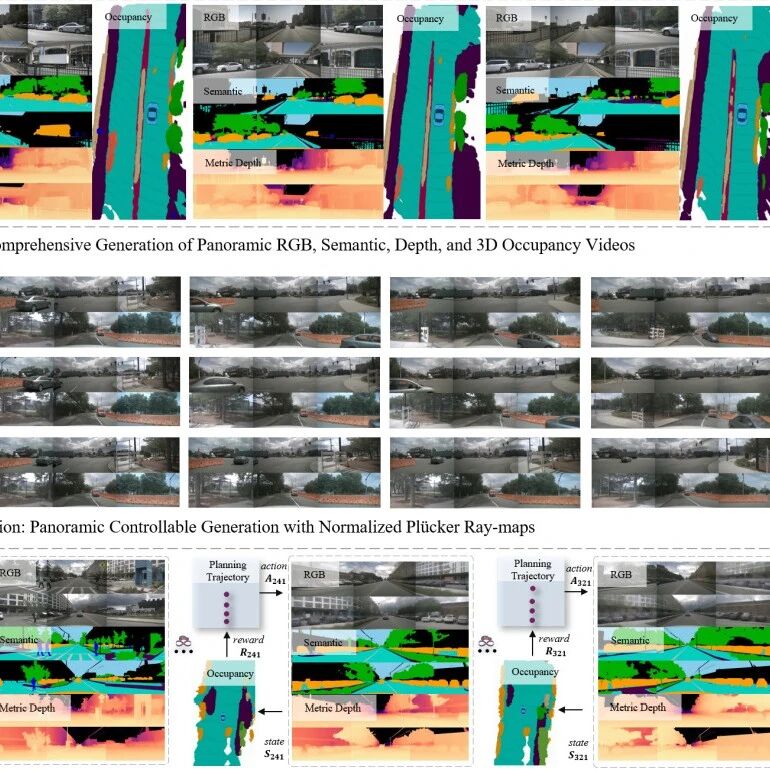
Core Insights - The article discusses the OmniNWM research, which proposes a panoramic, multi-modal driving navigation world model that significantly surpasses existing state-of-the-art (SOTA) models in terms of generation quality, control precision, and long-term stability, setting a new benchmark for simulation training and closed-loop evaluation in autonomous driving [2][58]. Group 1: OmniNWM Features - OmniNWM integrates state generation, action control, and reward evaluation into a unified framework, addressing the limitations of existing models that rely on single-modal RGB video and sparse action encoding [10][11]. - The model utilizes a Panoramic Diffusion Transformer (PDiT) to jointly generate pixel-aligned outputs across four modalities: RGB, semantic, depth, and 3D occupancy [12][11]. - OmniNWM introduces a normalized Plücker Ray-map for action control, allowing for pixel-level guidance and improved generalization across out-of-distribution (OOD) trajectories [18][22]. Group 2: Challenges and Solutions - The article identifies three core challenges in current autonomous driving world models: limitations in state representation, ambiguity in action control, and lack of integrated reward mechanisms [8][10]. - OmniNWM's approach to state generation overcomes the limitations of existing models by capturing the full geometric and semantic complexity of real-world driving scenarios [10][11]. - The model's reward system is based on the generated 3D occupancy, providing a dense and integrated reward function that enhances the evaluation of driving behavior [35][36]. Group 3: Performance Metrics - OmniNWM supports the generation of long video sequences, exceeding the ground truth length with stable outputs, demonstrating its capability to generate over 321 frames [31][29]. - The model achieves significant improvements in video generation quality, outperforming existing models in metrics such as FID and FVD [51][52]. - The integration of a Vision-Language-Action (VLA) planner enhances the model's ability to understand multi-modal environments and output high-precision trajectories [43][50].

Jim Cramer on Aurora Innovation: “It Can’t Seem to Make Money”
Yahoo Finance· 2025-10-24 12:12
Core Viewpoint - Aurora Innovation, Inc. is struggling to generate profits, leading to skepticism about its investment potential [1] Company Overview - Aurora Innovation, Inc. focuses on developing autonomous driving technology through its Aurora Driver platform, which combines hardware, software, and data systems for self-driving capabilities [1] Market Sentiment - Jim Cramer expressed caution regarding Aurora's stock, indicating that he cannot recommend stocks that are not making money, despite acknowledging the speculative nature of the stock [1] - Cramer noted that while Aurora's stock could potentially double due to market headlines, he still views it as too speculative for a strong recommendation [1] Investment Alternatives - The article suggests that there are other AI stocks with greater upside potential and less downside risk compared to Aurora Innovation [1] - A mention of a report on undervalued AI stocks that could benefit from current market trends, including tariffs and onshoring, is included as an alternative investment opportunity [1]

Mobileye Q3业绩超预期 上调全年营收指引的下限
Ge Long Hui A P P· 2025-10-23 13:15
Core Insights - Mobileye Global reported Q3 revenue of $504 million, exceeding analyst expectations of $484.9 million [1] - Adjusted earnings per share were $0.09, slightly above the expected $0.08 [1] - The company experienced a surge in demand for its autonomous driving systems as clients cleared inventory after a prolonged downturn [1] - Mobileye raised the lower end of its full-year revenue guidance, now expecting revenue between $1.85 billion and $1.89 billion, up from a previous range of $1.77 billion to $1.89 billion [1]

Mobileye (MBLY) - 2025 Q3 - Earnings Call Transcript
2025-10-23 13:02
Financial Data and Key Metrics Changes - Q3 revenue reached $504 million, a 4% year-over-year increase, driven by an 8% growth in IQ volume, significantly outpacing the 1% growth in overall vehicle production among the top 10 customers [4][5] - Operating cash flow for Q3 was $167 million, with year-to-date cash flow nearly $500 million, reflecting a 150% year-over-year increase [4][17] - The company raised its full-year revenue outlook midpoint by 2% and adjusted operating income midpoint by 11%, with expected volumes about 2 million units higher than original guidance [5][17] Business Line Data and Key Metrics Changes - The core ADAS business is performing well, with volumes in a healthy range for the last five quarters, and expected to continue in Q4 [4] - SuperVision volumes exceeded expectations, with a revised full-year estimate of around 50,000 units, significantly higher than initial projections [15][19] - Gross margin declined by over 100 basis points year-over-year, primarily due to increased volumes from Chinese OEMs and higher costs associated with IQ5 programs [15] Market Data and Key Metrics Changes - Stronger-than-expected results in China contributed to overall performance, with better-than-expected shipments to Chinese OEMs and performance from Western OEM customers in China [5] - The company expects to outperform the production of top 10 OEM customers globally by about 5 percentage points in 2025 [6] Company Strategy and Development Direction - Mobileye is focusing on execution and innovation in its SuperVision and Chauffeur programs, with significant software updates expected in the coming months [9][44] - The company is positioning itself as an OEM-neutral platform with a credible technology path to eyes-off autonomy, targeting both privately owned vehicles and robotaxis [7][10] - The growth potential in India is becoming increasingly clear, supported by adoption trends and regulatory environments [7] Management's Comments on Operating Environment and Future Outlook - Management expressed confidence in the company's growth trajectory, highlighting that the opportunity set is larger and more urgent than when the company went public in 2022 [11] - The focus for 2026 is on execution rather than acquiring new business, with expectations to be production-ready for SuperVision and Chauffeur platforms in the first half of 2026 [44] Other Important Information - The company is actively working on multiple advanced product lines, including surround ADAS, SuperVision, Chauffeur, and Drive, all sharing common technological foundations [8] - The IQ6 High chip is positioned as a cost-effective solution for high-volume vehicles, with significant traction among OEMs [85] Q&A Session Summary Question: Can you clarify the recent design win with a Western OEM? - The recent nomination is for a second surround ADAS program from a leading Western OEM, expected to be a significant portion of their vehicle lineup [23] Question: How do you anticipate gross margin changes with IQ6 ramping up? - The profitability of IQ6 is expected to be higher than IQ5, with no significant headwinds anticipated from the transition [25][28] Question: What factors are influencing Q4 expectations? - The company expects Q4 volume to align with full-year guidance, with no material impact from recent chip issues anticipated [34] Question: Can you provide details on the Lyft robotaxi program? - The program is in advanced testing stages, with the first city launch planned for Dallas-Fort Worth, and further details will be disclosed soon [36] Question: How does the competitive landscape look for surround ADAS? - Mobileye has a first-mover advantage in surround ADAS, focusing on cost optimization and efficient design to meet OEM needs [84][85]
上交OccScene:3D OCC生成新框架(TPAMI)
自动驾驶之心· 2025-10-23 00:04
Core Insights - The article discusses the integration of generative models with autonomous driving systems, emphasizing the need for high-quality, large-scale annotated data for training perception models, which is often costly and time-consuming [2] - OccScene is introduced as a solution that combines 3D scene generation with semantic occupancy perception through a novel joint diffusion framework, achieving a synergistic effect where the two tasks enhance each other [3] Innovation and Contributions - A unified perception-generation framework is proposed, where the perception model provides detailed geometric and semantic priors to the generator, creating a beneficial feedback loop [5] - The Mamba-based dual alignment module (MDA) is designed to efficiently align camera trajectories, semantic occupancy, and diffusion features, ensuring cross-view consistency and geometric accuracy in generated content [5] - OccScene demonstrates state-of-the-art (SOTA) performance, generating high-quality images/videos and corresponding 3D semantic occupancy information with just text prompts, significantly enhancing existing SOTA perception models [5] - The mutual learning mechanism promotes the model to find broader and more stable loss minima, avoiding local minima stagnation issues seen in independent learning [5] Comparison with Traditional Methods - OccScene employs a joint learning framework that promotes bidirectional enhancement, unlike traditional methods that treat generation and perception separately [7] - It requires only text prompts for flexible scene generation, contrasting with traditional methods that rely on real annotated data [7] - OccScene provides fine-grained semantic occupancy guidance for more precise geometry, moving away from the coarse geometric control of traditional approaches [7] - The generation process is driven by perception tasks, ensuring the practical utility of generated data [7] Technical Framework - The core of OccScene is the joint perception-generation diffusion framework, integrating semantic occupancy prediction with text-driven generation into a single diffusion process [8] - The training strategy consists of two phases: first, tuning the generator to understand occupancy constraints, and second, mutual learning to achieve bidirectional enhancement [9][10] - A dynamic weighted loss function is designed to balance the two tasks during joint optimization, ensuring stability in training [11][13] Experimental Results - OccScene achieves SOTA performance in 3D scene generation across various tasks, with significantly lower FID scores compared to traditional methods, indicating better quality [20][21] - The generated scenes exhibit more reasonable geometry and clearer details, maintaining high logical consistency in cross-view videos [20][23] - Using OccScene as a data augmentation strategy significantly improves the performance of existing SOTA perception models, demonstrating the high quality and information richness of the synthetic data [24][25] Applications and Value - OccScene is positioned as a critical tool for autonomous driving simulation, generating high-fidelity, diverse driving scenarios, particularly for corner cases, enhancing system robustness at a low cost [32] - It provides controllable and editable virtual environments for navigation and interaction in robotics and AR/VR applications [32] - As a plug-and-play data generator, OccScene addresses data scarcity issues for various downstream 3D vision tasks [32]

Avride Secures Strategic Investment of up to $375M
Vcnewsdaily· 2025-10-22 19:37
Core Insights - Avride has secured strategic investments totaling up to $375 million from Uber Technologies, Inc. and Nebius Group, enhancing its financial backing for future growth [2]. Group 1: Investment and Partnerships - The investment builds on Avride's existing commercial partnership with Uber, which includes a multi-year strategic agreement signed in 2024 [2]. - The funding will support the acceleration of Avride's fleet growth, AI-driven product development, and expansion into new geographical markets [2]. Group 2: Product Development and Services - Avride plans to launch its robotaxi service on the Uber platform in Dallas by the end of 2025 [2]. - Currently, Avride's delivery robots are operational through the Uber Eats platform, servicing hundreds of restaurants in Jersey City, Austin, and Dallas [2].


Avride Secures Strategic Investment and Other Commitments of up to $375 Million, Backed by Uber and Nebius
Businesswire· 2025-10-22 11:28
Core Insights - Avride has secured strategic investments and commercial commitments totaling up to $375 million from Uber Technologies, Inc. and Nebius Group [1] - This transaction builds on Avride's existing commercial partnership with Uber, following a multi-year strategic agreement signed in 2024 [1] - Avride plans to launch its robotaxi service on the Uber platform in Dallas by the end of 2025 [1]
Baidu’s Apollo Go Teams with PostBus to Launch Autonomous Driving in Switzerland
Pandaily· 2025-10-22 09:00
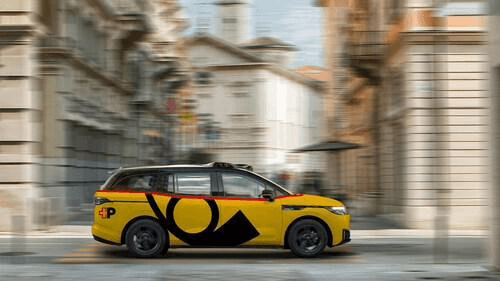
Core Insights - Baidu's Apollo Go has launched an autonomous mobility service named AmiGo in partnership with Swiss Post's PostBus, marking the entry of China's Level 4 autonomous driving technology into Europe [1][4] Company Overview - Baidu, founded in 2000, is a leading AI company with a strong internet foundation, trading on NASDAQ under "BIDU" and HKEX under "9888" [5] Service Details - AmiGo will complement Switzerland's public transit system, starting in St. Gallen and two other eastern cantons, with a phased rollout including test fleet trials in December 2025, limited user access in mid-2026, unmanned trials by late 2026, and regular operations by Q1 2027 [2] - Users will be able to book private or shared rides through an app, which aims to optimize fleet efficiency [2] Vehicle Specifications - Baidu is providing its latest-generation Level 4 RT6 autonomous electric vehicle, which can seat four passengers and features a detachable steering wheel for full autonomy [3] Operational Scale - Apollo Go operates over 1,000 unmanned vehicles across 16 cities, having driven over 200 million kilometers and provided 14 million public rides [4]

What’s Brewing? — UK Tech Round-up: Mid October
Medium· 2025-10-21 21:17
Autonomous Vehicles - Waymo, owned by Alphabet Inc., plans to launch a driverless taxi experiment in London in early 2026, making it the first European city to host such technology [1] - The UK government accelerated the approval for the Automated Vehicles Act in 2024, providing a legal framework for autonomous vehicles to operate across UK cities, enhancing competition with the US and China [2] - Wayve, a British autonomous driving AI company and competitor to Waymo, is in talks with SoftBank and Microsoft for a $2 billion fundraise, which would increase its valuation to $8 billion [6][7] - Wayve's approach utilizes 'Embodied Artificial Intelligence' to adapt to new roads, potentially accelerating expansion into new cities [7] - Uber is partnering with Wayve to launch a driverless ride-hailing program in London around the same time as Waymo's launch [3][7] Ride-Hailing Competition - The introduction of Waymo's driverless taxis is expected to intensify competition among London ride-hailing services, particularly with Uber and Bolt [3] - The announcement has reignited tensions between Uber and London black cabs, with criticism from the Licensed Taxi Driver Association [4] Financial Technology - GoCardless, a UK FinTech unicorn, reported its first positive EBITDA quarter, signaling a shift towards profitability and strategic scaling [8][9] - GoCardless operates as a bank-to-bank payment processor, avoiding high payment card fees and benefiting from regulatory approval from the FCA [9] Start-Up Funding - Sitehop, a cybersecurity start-up, raised £7.5 million to develop defenses against quantum threats, bringing its total funding to £13.5 million [12][14] - Clove, a financial advice start-up, secured $14 million in pre-seed funding to address the financial advice gap in the UK [15][16] - Wild Bioscience, a University of Oxford spin-out, raised $60 million in Series A funding to develop climate-resistant crops [18][19] Market Activity - The Beauty Tech Group has successfully IPO-ed on the London Stock Exchange Main Market, raising $106.5 million and achieving a market cap of £315.5 million, targeting the $600 billion beauty industry [20]

Waymo's Global Expansion Strengthens the Case for GOOGL Stock
MarketBeat· 2025-10-20 12:43
Core Insights - Alphabet has experienced significant growth in the second half of the year, transitioning from headwinds to tailwinds, particularly in AI and cloud computing [1] - Concerns regarding AI competition and regulatory issues have diminished, allowing Alphabet's core business to strengthen [1] Google Services and Cloud - Profitability is improving across Google Services and Google Cloud, indicating a robust performance in these segments [2] Other Bets Segment - Alphabet's "Other Bets" segment includes innovative projects like Waymo, Verily, and Wing, which are aimed at long-term growth despite current losses [3][4] - In Q2 2025, Other Bets generated $373 million in revenue but incurred a loss of $1.25 billion, highlighting Alphabet's commitment to disruptive innovation [4] Waymo's Developments - Waymo operates fully driverless ride-hailing services in several U.S. cities and has logged millions of autonomous miles, providing over 10 million paid rides [5] - The company has announced its expansion into Europe, starting with testing in London, which is a significant milestone for its global credibility [6][8] - Waymo is also expanding in the U.S., with plans to launch services in Miami and Washington, D.C., and has secured permits for testing in New York City [9] Long-term Potential - While Waymo's current contribution to Alphabet's overall financial picture is minor, its long-term potential is significant if it can secure regulatory approvals and develop a scalable model [10][11] - Alphabet's core strengths remain in AI, cloud computing, and advertising, supported by a robust balance sheet [12]
