
Battery

Search documents
SES AI Appoints Investment Veteran Andrew Boyd to Board of Directors
Yahoo Finance· 2025-09-22 07:19
Core Insights - SES AI Corporation is recognized as a promising small-cap AI stock, particularly favored by hedge funds [1] - The company has appointed Andrew Boyd to its Board of Directors, replacing Michael Noonen [1][3] - SES AI is pioneering the use of superintelligent AI in battery technology across various stages of production and monitoring [3] Company Overview - SES AI Corporation specializes in developing AI-enhanced lithium metal and lithium-ion rechargeable battery technologies for various applications, including electric vehicles (EVs), urban air mobility, drones, robotics, and energy storage systems [4] - The company is noted for being the first battery manufacturer to integrate superintelligent AI throughout its business processes, from R&D to manufacturing and safety monitoring [3] Leadership Background - Andrew Boyd, the newly appointed board member, has extensive experience in the investment community, currently serving as a Partner at Bramalea Partners, a technology-focused fund he founded [2] - Prior to Bramalea, Boyd had a significant 15-year tenure at Fidelity Management & Research Company, culminating in the role of Global Head of Equity Capital Markets [2]

中国电池行业_2025 年 1 - 8 月中国电池出口数据要点_非美国市场支撑储能系统(BESS)需求强劲-China Battery Sector_ Takeaways from 8M25 China battery export data_ Non-US market underpins BESS demand strengths
2025-09-22 02:02
Summary of China Battery Sector Conference Call Industry Overview - The conference call focused on the **China Battery Sector**, particularly the export trends and demand for Battery Energy Storage Systems (BESS) in non-US markets [1][4][9]. Key Points Export Trends - Total battery exports (including consumer batteries and BESS systems) increased by **45% year-over-year (YoY)** in August 2025 and **67% YoY** in the first eight months of 2025, reaching **37 GWh** and **254 GWh**, respectively [4][12]. - The contribution to export volume in 8M25 was as follows: - **US**: 21% (+28% YoY) - **Europe**: 36% (+65% YoY) - **Rest of the World (RoW)**: 42% (+99% YoY) [4][12]. Regional Performance - **US Market**: Export volume to the US decreased by **60% month-over-month (MoM)** in August 2025, with total shipments of approximately **53 GWh** in 8M25, which is below the overall export growth rate [4][12]. - **European Market**: Strong growth in Europe continued with a **65% YoY** increase in August 2025, reaching an estimated **15 GWh** in exports, driven by both electric vehicle (EV) and energy storage system (ESS) demands [4][5]. - **RoW Market**: The RoW contributed approximately **107 GWh** in 8M25, with notable demand from the Middle East (Saudi Arabia and UAE), Chile, and Australia, which accounted for nearly **50%** of the net increase in exports [5][9]. Demand Drivers - The demand for BESS is emerging as a key contributor to growth, particularly in Europe, where the BEV market saw a **25% YoY** sales growth in the first half of 2025 [4][5]. - Countries with limited EV production but high solar installation percentages, such as the Netherlands, Bulgaria, and Greece, are increasing their imports of batteries from China [4][5]. Company Insights Key Players - **CATL**: - Major contributor to China battery exports, supplying approximately **70%** of Europe's battery imports and significant volumes to the US [7][38]. - Target price raised to **Rmb420** for CATL-A, reflecting strong positioning in Europe and RoW [32][38]. - **Gotion**: - Positive outlook due to cooperation with Volkswagen and established supply relationships in Southeast Asia [7][40]. - **Hunan Yuneng**: - Leading LFP cathode maker with a **34%** market share, expected to benefit from strong LFP penetration and BESS demand [7][41]. Investment Ratings - **CATL-A**: Buy - **Gotion**: Buy - **Hunan Yuneng**: Buy - **EVE Energy**: Neutral, with a focus on ESS [7][41][42]. Additional Insights - The report highlighted the importance of BESS in addressing challenges posed by renewable energy installations, particularly the mid-day surplus in power grids [4][5]. - The overall export volume from China is expected to continue growing, driven by increasing global demand for batteries, especially in the context of energy transition and sustainability [4][38]. Conclusion - The China Battery Sector is experiencing robust growth, particularly in non-US markets, with significant contributions from Europe and RoW. The demand for BESS is a critical driver of this growth, and key players like CATL and Gotion are well-positioned to capitalize on these trends.

全球电池供应链 美国储能系统(BESS)政策 12 个常见问题-Global Battery Supply Chain U.S. BESS Policy 12 FAQs
2025-09-22 01:00
Summary of Key Points from the Conference Call Industry Overview - The report focuses on the **Global Battery Supply Chain** and specifically addresses the **Battery Energy Storage System (BESS)** policies in the U.S. Core Points and Arguments 1. **Production Tax Credit (PTC) and Investment Tax Credit (ITC)** - The PTC remains at **$35/kWh** for cells and **$10/kWh** for modules through **2032**. Eligibility requires limiting material assistance from Prohibited Foreign Entities (PFE) to **40% by 2026**, phasing down to **15% by 2030** [1][2] - The ITC for BESS remains unchanged through **2035**, requiring system developers to limit PFE material assistance to **45% by 2026**, phasing down to **25% by 2030** [1][2] 2. **Chinese Ownership and Tax Credits** - U.S. battery capacity with Chinese ownership is **excluded** from claiming or transferring PTC [1] - U.S. battery capacity under licensing agreements with Chinese entities can receive PTC if the agreement was made before **July 4, 2025** [1][2] 3. **Material Imports and Compliance** - U.S. battery capacities can import materials from China if contracts were signed before **June 16, 2025**, or if they can prove compliance with PFE content thresholds [2][6] - Contracts signed before **June 16, 2025**, and produced before **2030** are exempt from PFE rules [6] 4. **Safe Harbor Rules** - ESS projects starting construction before **December 31, 2025**, could be exempt from PFE requirements for **four years** if operational within that timeframe [7] 5. **Tariff Levels on Chinese Imports** - Tariffs on Chinese battery energy storage imports are set at **41% by the end of 2025**, increasing to **58% in 2026 and beyond** [7] 6. **Material Assistance Cost Ratio (MACR)** - The MACR thresholds for battery components require a minimum of **60% non-PFE sources** by **2026**, decreasing the maximum PFE content to **40%** [9] - For energy storage technology, the minimum non-PFE content starts at **55% in 2026**, with a maximum PFE content of **45%** [10] Additional Important Information - **Safety Issues**: The battery industry faces safety concerns that could negatively impact demand and profitability, particularly in recall scenarios [11] - **Government Policy Sensitivity**: Battery profitability and market share are sensitive to government policies, including tariffs, sourcing rules, and export controls [11] This summary encapsulates the critical aspects of the conference call, highlighting the regulatory landscape affecting the battery supply chain and the implications for U.S. companies involved in energy storage systems.
QuantumScape Shares Surge Over 5% After Hours Amid Insider Stock Sales - QuantumScape (NYSE:QS)
Benzinga· 2025-09-19 06:19
Core Insights - QuantumScape Corp. shares have seen significant price movements, with a 5.77% after-hours increase to $12.83 following an 18.23% rise during regular trading on Thursday [1][2] - The stock closed at $12.13 on Thursday, indicating strong market interest [1] Insider Trading Activity - Notable insider trading was reported on September 12, with Director Jeffrey B. Straubel exercising 130,067 stock options at $2.377 each and selling 157,180 shares at an average price of $9.1997, as part of a trading plan established in June under Rule 10b5-1 [2] - The total transactions amounted to approximately $1.75 million in sales [3] Technical Performance - QuantumScape has achieved a remarkable 104.55% gain over the past year, with stock trading within a 52-week range of $3.40 to $15.03, currently nearing the upper end of this range [4] - The company has a market capitalization of $6.87 billion and an average daily trading volume of 26.01 million shares [4] Momentum and Stock Rankings - The stock is in the 94th percentile for momentum, indicating a positive price trend across all time frames according to Benzinga's Edge Stock Rankings [5]


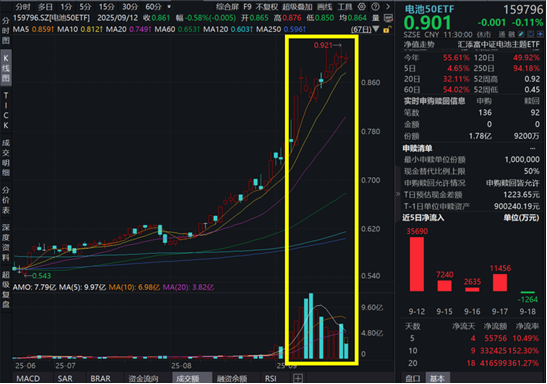
先导智能大涨超4%,打通全固态电池量产的全线工艺环节!电池50ETF(159796)微跌,资金重手增仓8500万份!固态电池0-1产业化加速
Xin Lang Cai Jing· 2025-09-19 05:01
Core Viewpoint - The battery sector is experiencing fluctuations, with the Battery 50 ETF (159796) showing a slight decline but significant investment interest, indicating strong market engagement and potential growth opportunities in the sector [1][2]. Group 1: Market Performance - As of September 19, the Battery 50 ETF (159796) saw a minor drop of 0.11%, but it gained 86 million shares during the day, pushing its total scale beyond 6 billion yuan, leading its peers significantly [1]. - The China Securities Battery Theme Index (931719) increased by 0.1%, with notable gains from companies like Xian Dao Intelligent (over 4%) and Yiwei Lithium Energy (over 3%), while companies like Sanhua Intelligent Control experienced a significant drop of over 8% [2][3]. Group 2: Key Stocks and Components - The top ten components of the Battery 50 ETF include: - Sungrow Power (14.38%, -1.87%) - CATL (8.22%, +0.66%) - Sanhua Intelligent Control (7.15%, -8.30%) - Yiwei Lithium Energy (6.32%, +3.33%) - Xian Dao Intelligent (4.45%, +4.20%) [4]. - The ETF's index has a high storage content of 24%, significantly benefiting from the storage sub-sector's growth, while solid-state battery content stands at 37%, indicating strong potential for future growth [7]. Group 3: Industry Developments - The 2025 Suining International Lithium Battery Industry Conference emphasized the need for innovation in lithium battery technology, focusing on solid-state batteries, sodium-ion batteries, and fast-charging batteries [4]. - Xian Dao Intelligent announced advancements in solid-state battery production, having achieved multiple technological breakthroughs and successfully delivered equipment to various battery manufacturers [5]. - The solid-state battery industry is projected to see significant growth, with a potential market space of 2.5 billion yuan by 2027, growing at a CAGR of 122% to reach 27.3 billion yuan by 2030 [6].





X @Bloomberg
Bloomberg· 2025-09-19 00:44
CATL stock has surged nearly 75% since this year’s low in early April, adding $110 billion to its market value. But it still has the lowest valuation among pure battery makers on a Bloomberg Intelligence gauge of the sector. https://t.co/osy7jE7mme ...
早盘直击|今日行情关注
申万宏源证券上海北京西路营业部· 2025-09-18 05:44
Core Viewpoint - The current market is in a strong oscillation state, with indices near their highest points and a notable structural differentiation where leading stocks, particularly in technology sectors like semiconductors, telecommunications, and consumer electronics, are driving the market upward [1][1][1] Market Conditions - The market is characterized by strong performance in sectors such as optical electronics, batteries, and motors, which continue to attract capital inflow [1][1] - Wind power equipment has also shown performance due to favorable internal factors, although there is a disparity between individual stock movements and overall index performance [1][1] Influencing Factors - The fundamental logic driving the market remains unchanged, supported by loose liquidity, a low interest rate environment, and adjustments in the real estate sector, which enhance the attractiveness of the capital market [1][1][1] - The recent 25 basis point interest rate cut by the Federal Reserve is seen as an indirect positive for the A-share market [1][1] Future Outlook - The market is expected to continue its strong oscillation in the short term, with potential upward breakthroughs supported by favorable internal and external conditions [1][1] - A bullish mindset is encouraged, with optimism regarding future market performance [1][1]

X @Bloomberg
Bloomberg· 2025-09-17 16:19
A massive immigration raid on a battery plant in Georgia earlier this month continues to reverberate across the region with workers staying home and delays mounting. https://t.co/dVminHt09B ...
A股午评:创业板指涨1.74%,光刻机、多元金融板块涨
Nan Fang Du Shi Bao· 2025-09-17 04:41
Market Overview - The three major A-share indices collectively rose in early trading on the 17th, with the Shanghai Composite Index up by 0.41%, the Shenzhen Component Index up by 1.02%, and the ChiNext Index up by 1.74%. The North Star 50 Index decreased by 0.1% [2] - The total trading volume in the Shanghai and Shenzhen markets reached 15,619 billion yuan, an increase of 638 billion yuan compared to the previous day [2] - Over 2,900 stocks in the market experienced gains [2] Sector Performance - The sectors with the highest gains included photolithography machines, diversified finance, foldable screens, robotics, and batteries [2] - Conversely, sectors that saw declines included precious metals, film and television, liquor, and pork stocks [2] Notable Stocks - Photolithography concept stocks surged at the beginning of the session, with Wave Optoelectronics, Yongxin Optics, and Kaimete Gas reaching the daily limit [2] - Robotics concept stocks remained active, with Wanxiang Qianchao achieving three consecutive limit-ups, and Junsheng Electronics achieving two consecutive limit-ups, along with significant gains in Haoen Automotive and Yian Technology [2] - The battery sector saw notable upward movement, with CATL's A-shares and H-shares both reaching historical highs [2] - Other sectors such as securities and diversified finance also showed fluctuations during the session [2] - Most gold stocks adjusted downwards, with Western Gold falling over 4%, and several other stocks like Chifeng Gold, Hunan Gold, and Xiaocheng Technology also declining [2]


宁德时代-实地考察:复杂性与智能化
2025-09-17 01:51
Summary of Contemporary Amperex Technology Co. Ltd. Conference Call Company Overview - **Company**: Contemporary Amperex Technology Co. Ltd. (CATL) - **Industry**: Energy & Chemicals - **Stock Ticker**: 300750.SZ, 3750.HK - **Market Cap**: Rmb1,613,992 million [6] Key Points Manufacturing and Capacity - CATL's manufacturing lines are characterized by high complexity and intelligence, which create significant barriers to entry and enhance cost competitiveness [1][2] - The factory produces over 2.2 million cells per day, with more than 6,800 real-time quality control points ensuring high yield rates [2] - The company is targeting a total capacity of 1TWh for the next year, with current utilization rates exceeding 90% [3] Capacity Expansion Plans - CATL is constructing 250GWh of new capacity, aiming for 800GWh in 2025 and 1TWh in 2026 [3] - New overseas capacity is being developed in Hungary, Indonesia (2026), and Spain (2027), with expected profitability comparable to the domestic market [3] Energy Storage Systems (ESS) - The company's ESS products are designed to enhance project economics, yielding an internal rate of return (IRR) premium of approximately 14 percentage points over competitors globally and 7-8 percentage points in China [4] - CATL plans to shift its ESS product mix towards higher-margin AC system products in the coming years [4] Financial Performance and Projections - Revenue projections for the fiscal years ending December 2024, 2025, 2026, and 2027 are Rmb362,013 million, Rmb415,608 million, Rmb499,075 million, and Rmb603,807 million, respectively [6] - Expected EBITDA for the same years is Rmb79,515 million, Rmb91,475 million, Rmb113,544 million, and Rmb136,351 million [6] - The company anticipates a basic EPS of Rmb11.55 for 2024, increasing to Rmb22.22 by 2027 [6] Risks and Market Dynamics - Upside risks include faster-than-expected EV penetration, lower geopolitical risks, and better-than-expected margins [14] - Downside risks involve potential threats from other battery manufacturers and geopolitical risks affecting the battery supply chain [14] Valuation - The stock is rated as "Overweight" with a price target of Rmb425.00, indicating a potential upside of 20% from the closing price of Rmb354.70 on September 15, 2025 [6] Competitive Advantage - CATL's production lines consist of over 25,000 components, making it difficult for competitors to replicate their manufacturing capabilities [9] Additional Insights - The company is expected to produce a small batch of solid-state batteries by 2027, indicating a move towards advanced battery technologies [3] - The average daily trading value of CATL's stock is Rmb7,201 million, reflecting strong market interest [6] This summary encapsulates the key insights from the conference call, highlighting CATL's strategic initiatives, financial outlook, and competitive positioning within the energy and chemicals industry.