
乡村旅游业

Search documents
强农兴业 沃野生金
He Nan Ri Bao· 2025-05-21 23:33
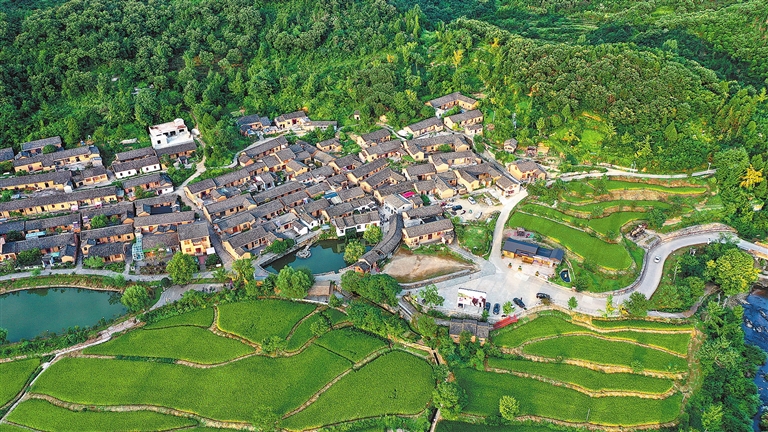
Group 1: Agricultural Development - The importance of strengthening farmland protection and construction to ensure food security is emphasized, with a focus on extending modern agricultural industrial chains to promote rural revitalization and common prosperity [4][5] - Nanyang has designated 13.09 million acres of permanent basic farmland, the largest area in the province, and plans to build 324,000 acres of high-standard farmland by 2024, with a total grain output of 13.36 billion pounds [4] - The coverage rate of quality seeds for major crops in Nanyang has reached 100%, ensuring stable grain production and supply of major agricultural products [4] Group 2: Hybrid Wheat Industry - Nanyang aims to become an international hub for hybrid wheat industrialization, with a focus on innovation and commercialization of hybrid wheat breeding [4] - The National Hybrid Wheat Project Industrialization Base in Dengzhou has significantly increased wheat yield per acre and expanded the area suitable for wheat cultivation [3][4] Group 3: Rural Tourism - The development of rural tourism in Tianpu Village has transformed it into a popular destination, with over 40 homestays and farmhouses established, significantly improving local residents' incomes [8][9] - The local government promotes tourism by leveraging rich cultural and ecological resources, creating a brand for comprehensive tourism in Xinxian County [8][9] Group 4: Oil Tea Industry - The oil tea industry in Guangshan has expanded to cover over 323,700 acres, with significant economic benefits for local farmers through a model of "company + base + farmers" [10][11] - The annual comprehensive output value of the oil tea industry in Xinyang has reached 4.862 billion yuan, a 345.24% increase since 2019 [11] Group 5: Mugwort Industry - The establishment of a digital platform for the mugwort industry by Yaoyi Bao Company enhances the efficiency of the supply chain, allowing real-time sharing of market data [12][13] - The company has seen its annual sales revenue double, with a focus on product innovation and quality assurance in the mugwort sector [13][15]

新农人返乡 高科技下田(青年观察·乡村和青年双向奔赴①)
Ren Min Ri Bao· 2025-05-17 21:52
Core Viewpoint - The article emphasizes the importance of modernizing agriculture and the role of young people in driving rural revitalization, showcasing various success stories of young farmers who leverage technology and innovative practices to enhance productivity and income in rural areas [7][8][11][15]. Group 1: Agricultural Modernization - The modernization of agriculture is crucial for rural revitalization, with young individuals integrating personal aspirations into the agricultural sector [7]. - Young farmers are adopting new technologies and practices to improve agricultural productivity, such as integrating small plots into larger, more efficient farming units [8][9]. - The use of drones and other technological advancements is being promoted to reduce costs and increase efficiency in agricultural practices [9]. Group 2: Success Stories of Young Farmers - A young farmer, Guo Yu, has transformed 230 acres of abandoned terraced fields into productive land, yielding 27.6 million jin of rice and generating an economic value of 400,000 yuan in the first year [8]. - The establishment of a cooperative by Guo Yu has led to a 28% reduction in fertilizer costs and an increase in rice purchase prices by 0.3 yuan per jin, benefiting over 2,000 households [9]. - A doctoral team in Guizhou is working to enhance vegetable production through scientific research, leading to improved crop quality and increased farmer incomes [11][12]. Group 3: Community and Economic Impact - The initiatives led by young farmers are creating job opportunities and increasing income for local communities, with Guo Yu's company managing over 60,000 acres and raising household incomes by an average of 15,000 yuan [9]. - In Zhejiang, Wang Yuanyuan's agricultural tourism project has attracted over 900,000 visitors annually, significantly boosting local economic activity and leading to a 25% increase in fruit production [15][18]. - The establishment of new farmer alliances is fostering collaboration among young entrepreneurs, enhancing the overall agricultural landscape and promoting brand development for local products [18][19].
关于进一步深化农村改革扎实推进乡村全面振兴的实施意见
Guang Xi Ri Bao· 2025-04-30 02:15
Group 1 - The core viewpoint emphasizes the implementation of policies to enhance agricultural productivity and ensure food security in Guangxi, aligning with national directives on rural revitalization [1] Group 2 - Continuous enhancement of grain and important agricultural product supply capabilities is prioritized, with a target to stabilize total grain production at approximately 14.1 million tons [2] - A multi-faceted food supply system is being constructed, ensuring the breeding stock of sows remains stable at around 2.1 million heads [3] - Strengthening farmland protection and quality improvement through strict management and monitoring of farmland usage [4] Group 3 - Agricultural technology collaboration is being promoted, focusing on smart agriculture and digital supply chain advancements [4] - Disaster risk monitoring and agricultural emergency response capabilities are being enhanced to mitigate agricultural losses [5] Group 4 - Efforts to consolidate and expand poverty alleviation achievements include a focus on employment stability for over 2.68 million people [5] - Establishing a layered and categorized assistance system to prevent poverty recurrence and support low-income rural populations [6] Group 5 - Development of modern characteristic rural industries is being pursued, with initiatives to upgrade agricultural product processing and promote e-commerce [6] - Integration of rural culture and tourism is emphasized, with plans for eco-tourism and seasonal travel routes [7] Group 6 - Channels for increasing farmers' income are being broadened, supporting stable partnerships between farmers and enterprises [7] - A focus on enhancing rural infrastructure, including water supply and transportation systems, is underway [8] Group 7 - Improvement of basic public services in rural areas is prioritized, including education and healthcare enhancements [9] - Environmental governance in rural areas is being strengthened, targeting pollution control and waste management [10] Group 8 - Strengthening rural governance systems through enhanced party organization and community engagement is a key focus [11] - Reducing bureaucratic burdens on grassroots organizations to improve efficiency and responsiveness [12] Group 9 - Mechanisms for ensuring the sustainable management of rural resources and assets are being established [14] - Innovative financing mechanisms for rural revitalization projects are being developed, including support for agricultural insurance and credit systems [15]