钻石行业

Search documents
146亿库存压垮西方钻石巨头!外媒:绝不向中国制造低头
Sou Hu Cai Jing· 2025-08-03 15:35
Core Insights - The decline of De Beers, once a dominant force in the diamond industry, is evident as it faces unprecedented challenges, including a record inventory of $2 billion (approximately 14.6 billion RMB) of unsold rough diamonds, the highest since the 2008 financial crisis [1] - De Beers' attempt to shift all rough diamond sales to an auction model was met with resistance from 50 certified dealers, leading to a projected loss of $2.5 million in 2024, a 65% drop in profit compared to the previous year [1] - Major mines are reducing production, with a forecasted one-third cut in output by 2025, indicating that the decline of De Beers is far from over [1] Industry Disruption - The rise of Chinese technology, particularly in the small county of Zhecheng, is disrupting the global diamond industry with lab-grown diamonds that offer superior quality at lower prices, rapidly gaining popularity on e-commerce platforms [3] - Domestic brands like "Zheguang" are emerging, achieving monthly sales of millions, allowing consumers to purchase high-quality lab-grown diamonds at a fraction of the cost of natural diamonds [3] - The technological advantages of lab-grown diamonds are significant, with "Zheguang" achieving 95% of its diamonds at D-F color grades, surpassing the typical H-J grades of natural diamonds [4] Consumer Behavior Shift - Young consumers are increasingly opting for lab-grown diamonds, as evidenced by social media comparisons showcasing the superior appearance of these diamonds at lower prices [6] - De Beers' attempts to market its lab-grown diamond brand, Lightbox, as "affordable jewelry" have failed, with "Zheguang" selling similar products at much lower prices and achieving significantly higher sales [8] - The diamond industry is witnessing a shift in consumer preferences, with 60% of customers now choosing Chinese lab-grown diamonds, further eroding the market share of traditional natural diamonds [9] Market Dynamics - The diamond testing industry is adapting to the changing landscape, with reports now suggesting that natural diamonds should be liquidated quickly due to declining prices [9] - De Beers is facing operational challenges, including layoffs and protests from miners, as well as competition from local brands in various markets [8] - The expansion of lab-grown diamond production facilities in China signifies a robust growth trajectory for this sector, marking the decline of De Beers' long-standing market dominance [9]

力量钻石: 第三届监事会第六次会议决议公告
Zheng Quan Zhi Xing· 2025-07-29 16:33
Group 1 - The third meeting of the third Supervisory Board of Henan Power Diamond Co., Ltd. was held on July 29, 2025, and the meeting procedures complied with relevant laws and regulations [1] - The Supervisory Board approved the proposal to increase the implementation subjects and locations for certain fundraising investment projects, stating that this decision would not adversely affect the company's operations and does not violate regulations [1][2] - The proposal to postpone fundraising investment projects was also approved, with no changes to the implementation methods, total investment, or project content, ensuring no harm to shareholder interests [2][3] Group 2 - The Supervisory Board agreed to revise the company's articles of association in accordance with relevant laws and regulations, with the proposal requiring approval from the shareholders' meeting to take effect [2][3] - The meeting results showed unanimous support for all proposals, with 3 votes in favor and no opposition or abstentions [2][3]
欧美钻石还是出事了!中方出手后破产只是开始,外媒:根本防不住
Sou Hu Cai Jing· 2025-05-28 12:37
Core Insights - De Beers has announced a complete halt in the production of lab-grown diamonds, aiming to return to the "authenticity of natural diamonds" to recover market share, but this move appears to be overshadowed by the rise of lab-grown diamonds from Zhecheng County, China [1][3] - The natural diamond inventory of De Beers has reached $2 billion by 2024, with a 21% year-on-year revenue decline in the first half of the year, indicating a more severe situation than during the 2008 financial crisis [3] - The Federal Trade Commission (FTC) in the U.S. recognized lab-grown diamonds as real diamonds in 2018, which has significantly boosted their popularity and led to a decline in the perception of natural diamonds [3][8] Market Dynamics - Zhecheng County has produced 6 million carats of lab-grown diamonds, leading to a significant impact on the market, with lab-grown diamonds priced at only 10% of natural diamonds, promoting the concept of "diamond freedom" [3][6] - The trend shows that 78% of Generation Z consumers believe that paying a premium for natural diamonds is not worth it, challenging the traditional marketing narratives of brands like De Beers [8] - Lab-grown diamond orders priced over 500,000 yuan have surged by 420% in 2024, with 80% of buyers having prior experience purchasing natural diamonds [5] Competitive Landscape - De Beers has attempted to counteract the market pressure by adjusting prices twice a year, with reductions of up to 80%, but still struggles with declining revenues [6][11] - Zhecheng's companies have innovated by offering "memorial diamonds," incorporating personal DNA information into the diamond-making process, which has resonated with consumers [6] - The competitive advantage of Zhecheng's lab-grown diamonds lies in their significant price difference compared to De Beers, with similar quality products priced at a fraction of the cost [8][9] Consumer Behavior - High-net-worth individuals from major cities in China are increasingly opting for lab-grown diamonds due to their cost-effectiveness and quality, contributing to 90% of Zhecheng's order performance [5][9] - Despite De Beers' recent efforts to promote lab-grown diamonds with the slogan "Shine Bright Spend Less," the long-term impact on consumer sentiment remains uncertain [11]

10万降至“白菜价”?天价钻石被中国河南祛魅,美巨头WD申请破产
Sou Hu Cai Jing· 2025-05-23 12:07
Group 1 - The global market for lab-grown diamonds is significantly reshaping the diamond industry, with China holding a 75% market share in production, leading to a major disruption of the traditional diamond market [1][3] - De Beers is facing over $2 billion in inventory backlog and has seen a decline in reputation, even after reducing prices by 25% twice, while American jewelry giant WD has declared bankruptcy [1][3] - The production cost of lab-grown diamonds in China is only one-tenth that of natural diamonds, allowing for mass production of high-quality diamonds [3][5] Group 2 - The sales volume of lab-grown diamonds in China has rapidly increased to a market share of 56.8%, surpassing that of natural diamonds, indicating a shift in consumer perception [7] - The U.S. jewelry associations attempted to weaken the competitiveness of Chinese products by enforcing mandatory labeling of "lab-grown diamonds," but the FTC's 2018 adjustment to diamond definitions has legitimized Chinese lab-grown diamonds [7] - Notably, Western brands like Pandora and Swarovski are now entering the lab-grown diamond market, further accelerating the transformation of the industry landscape [7]
从“恒久远”到“卖不动”:钻石行业经历了什么
Qi Lu Wan Bao Wang· 2025-05-22 11:52
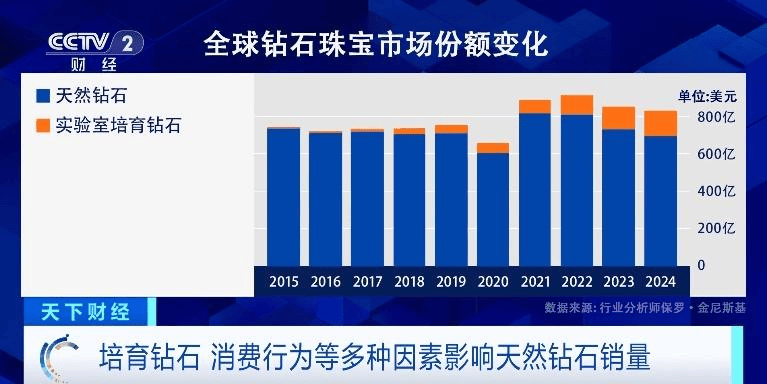
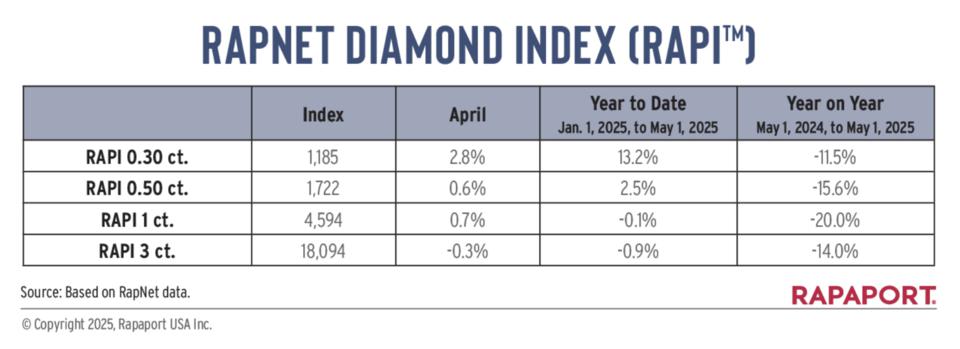
Core Insights - The diamond market is experiencing a significant downturn, contrasting with the rising prices of gold jewelry, as diamond prices continue to decline globally despite a brief increase in early 2023 [1][4][10] - De Beers Group announced the closure of its lab-grown diamond brand Lightbox and is considering divesting its diamond business due to declining performance across key financial metrics [4][6] - Consumer preferences are shifting towards lab-grown diamonds, which are significantly cheaper and meet the demand for personalized products, undermining the traditional value narrative of natural diamonds [7][8][10] Market Trends - Global natural diamond prices have shown a year-on-year decline, with specific price indices reflecting decreases of up to 20% for larger carat sizes [3][6] - The lab-grown diamond market is growing rapidly, accounting for 20% of the global diamond jewelry sales, with prices being approximately one-twentieth of natural diamonds [8][10] - Traditional jewelry brands are adjusting their strategies, with some like Chow Tai Fook optimizing their store formats while others like DR are shifting focus away from the traditional "love binding" narrative [9][10] Consumer Behavior - There is a noticeable decline in the foot traffic and sales of diamond jewelry, with consumers becoming more pragmatic and value-conscious in their purchasing decisions [5][6] - The younger generation is increasingly favoring lab-grown diamonds for their affordability and aesthetic appeal, leading to a reevaluation of the emotional value traditionally associated with natural diamonds [7][8] - The wedding market, a core driver of diamond sales, is also under pressure due to declining marriage rates, further impacting diamond consumption [6][10] Industry Challenges - The diamond industry is facing a dual challenge from both the rise of lab-grown diamonds and changing consumer attitudes towards luxury and value [10] - Continuous price wars in the lab-grown diamond sector are affecting profit margins, with significant price reductions observed in recent years [10] - The need for a redefined value proposition in the diamond market is becoming increasingly urgent as consumer preferences evolve [10]

一度领先,如今却被我们超越?欧美巨商无奈:中国技术发展力太强
Xin Lang Cai Jing· 2025-05-17 10:26
Core Viewpoint - The luxury status of natural diamonds is being challenged by the rise of lab-grown diamonds, leading to significant price drops and demand declines for natural diamonds, prompting De Beers' parent company, Anglo American, to consider selling the diamond empire [1] Group 1: Market Dynamics - Lab-grown diamonds are rapidly capturing market share, with China accounting for 50% of the global lab-grown diamond production capacity as of 2022, and Henan province contributing 80% of that output [3] - The overall market price for natural diamonds has plummeted by 33% in just two years due to the competitive pricing of lab-grown diamonds [3] - Domestic brands like "Zheguang" are emerging quickly, with sales on platforms like JD and Tmall expected to exceed 50 million by the end of 2024, attracting international customers [3] Group 2: Consumer Preferences - Consumers are increasingly favoring lab-grown diamonds due to their superior quality and lower prices, with examples like a 3-carat VVS clarity, 3EX cut, D color princess cut diamond priced under 50,000, which is significantly cheaper than natural diamonds [5] - The perception that lab-grown diamonds can appear more brilliant than natural diamonds is supported by their ability to control quality, making high-quality natural diamonds rare and expensive [7] Group 3: Industry Trends - The lab-grown diamond market is projected to grow steadily over the next five years, with global production expected to exceed 40 million carats by 2030, and China currently holding over 70% of the production capacity [14] - There is a need for increased consumer education regarding lab-grown diamonds to differentiate them from moissanite and cubic zirconia, as well as to enhance brand value and accelerate global expansion to compete internationally [15]