
Automotive Electronics

Search documents
MKDWELL Tech Inc. Reports First Half of Fiscal Year 2025 Unaudited Financial Results
Globenewswire· 2025-12-29 21:30
Core Viewpoint - MKDWELL Tech Inc. reported significant revenue growth in the first half of 2025, primarily driven by increased orders from key customers, while maintaining stable losses year-on-year [3][7]. Financial Highlights - Total revenues for the first half of 2025 were US$1.37 million, an increase of 68.3% from US$0.81 million in the same period of 2024 [7]. - Revenues from sales of manufactured electronic products rose by US$0.61 million, or 102.8%, from US$0.59 million in the first half of 2024 to US$1.20 million in the first half of 2025 [5]. - Revenues from commissioned processing services increased by US$0.09 million, or 128.9%, from US$0.07 million in the first half of 2024 to US$0.16 million in the first half of 2025 [6]. - Gross profit for the first half of 2025 was US$0.09 million with a gross profit margin of 6.5%, compared to US$0.07 million and a margin of 8.2% in the same period of 2024 [7][11]. - The net loss for the first half of 2025 was US$1.70 million, a decrease of 1.5% from US$1.73 million in the first half of 2024 [24]. Cost and Expenses - Cost of revenues increased by US$0.53 million, or 71.5%, from US$0.74 million in the first half of 2024 to US$1.28 million in the first half of 2025 [9]. - Selling expenses rose by US$0.02 million, or 15.7%, from US$0.11 million in the first half of 2024 to US$0.13 million in the first half of 2025 [12]. - General and administrative expenses decreased by US$0.09 million, or 7.8%, from US$1.15 million in the first half of 2024 to US$1.06 million in the first half of 2025 [14]. - Research and development expenses slightly increased by US$0.03 million, or 9.0%, from US$0.35 million in the first half of 2024 to US$0.38 million in the first half of 2025 [16]. Liquidity and Capital Resources - As of June 30, 2025, the company had accumulated deficits of US$15.14 million, with a working capital surplus of US$2.96 million [25]. - The company plans to finance future working capital requirements through cash generated from operations and may seek additional financing if necessary [26]. Company Overview - MKDWELL Tech Inc. is a manufacturer and supplier of automotive electronics, with operations in Mainland China and Taiwan, focusing on research, development, design, and production of automotive electronic products [31].


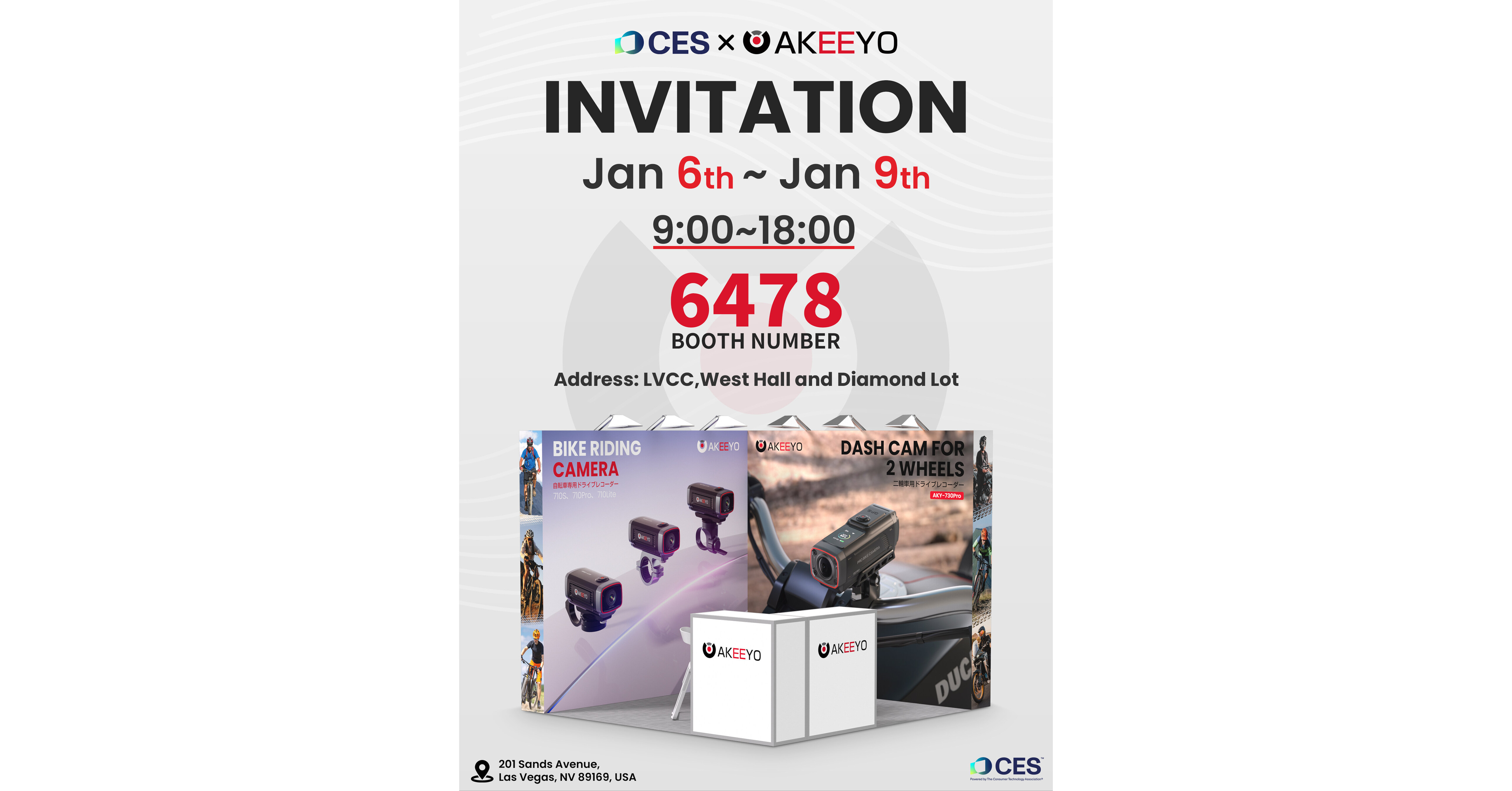
AKEEYO stellt AKY-NV-X2 und AKY-730 Pro auf der CES 2026 in Las Vegas vor
Prnewswire· 2025-12-25 23:30
Core Insights - AKEEYO is set to enhance vehicle intelligence at CES 2026 with the introduction of two innovative camera systems: the 11-inch mirror dashcam AKY-NV-X2 for drivers and the AKY-730 Pro action camera designed for motorcycle and bicycle riders [1][2]. Product Features - The AKY-NV-X2 features advanced capabilities including: - A 11-inch IPS touchscreen with sharp 1080p resolution - Sony STARVIS image sensor with an F1.0 aperture for excellent low-light performance - Dual 2K cameras with optional 1080p recording on a third channel - Night vision for both front and rear cameras for clear recordings in all lighting conditions - External GPS for accurate location tracking and route monitoring - Dual-band WiFi hotspot support (2.4 GHz & 5 GHz) and Bluetooth 5.0 with hands-free functionality - Seamless smartphone integration for remote monitoring - Super AI Blind Spot Detection (BSD) for increased driver awareness - Voice control for hands-free operation - Emergency recording feature and GPS tracking for route documentation and location verification - All-day parking monitoring [5][6]. - The AKY-730 Pro is specifically designed for two-wheeled riders, offering robust reliability and high-resolution recording capabilities: - 4K recording at 30 fps and 2K recording at 60 fps for exceptional video quality - Electronic Image Stabilization (EIS) for shake-free recordings - 1.14-inch IPS display for quick monitoring - IP66 waterproof rating for reliability in all weather conditions - Wind noise reduction technology for clear audio recordings - Integrated GPS for accurate location tracking and speed measurement - Powerful 3500 mAh battery with a waterproof USB charging station [6][7]. Company Overview - AKEEYO specializes in developing electronics for automobiles and motorcycles, including dashcams and navigation solutions. The company focuses on practical technology and user-friendly design to enable safer and better-connected driving experiences worldwide [7].
博泰车联(02889)获得某国内头部新能源汽车客户出具的首次项目定点通知
智通财经网· 2025-12-15 10:21
Core Viewpoint - The company, Botai Carlink (02889), has received a project confirmation from a leading domestic electric vehicle client to provide a smart cockpit domain controller solution for its next-generation intelligent models, marking the fourth such project since the company went public [1] Group 1: Project Details - The project involves the development of a high-end cockpit domain controller solution [1] - The project confirmation indicates the company's growing recognition in the high-performance smart cockpit sector [1] Group 2: Market Position and Strategy - The company has been enhancing its industry chain collaboration, leading to a strong ecological integration capability and broad market recognition [1] - This project is expected to strengthen the company's competitive position in the smart automotive supply chain and positively impact future business development [1] Group 3: Production and Risk Management - The company will actively advance the production preparation for the project [1] - The company acknowledges uncertainties in the research, development, and execution phases of the smart cockpit solutions and plans to enhance R&D management, supply chain collaboration, and risk control to ensure smooth project progress [1]
云意电气(300304.SZ):目前已进入机器人关节模组控制器产品的开发阶段
Ge Long Hui· 2025-12-05 01:35
Core Viewpoint - The company has been focusing on the automotive intelligent core electronic products sector for many years, showcasing strong technical strength and design development capabilities [1] Group 1 - The company leverages the technical similarities in structural design and manufacturing processes between automotive and robotics to enhance its product applications [1] - The company is actively extending its product application scenarios into the robotics field, currently developing robotic joint module controllers [1]


地平线机器人_花旗 2025 中国峰会新动态_2026 年展望
花旗· 2025-11-24 01:46
Investment Rating - The investment rating for Horizon Robotics is "Buy" with a high risk designation [7]. Core Insights - Horizon Robotics expects significant growth in shipments for 2026, projecting high-end shipments between 300,000 to 500,000 units, mid-end shipments around 3 million units, and low-end shipments approximately 2 million units. Key contributors to high-end shipments are anticipated to be Chery and Chang'an, accounting for 50% of the total [1][2]. - The company maintains its guidance to ship 4 million units of automotive-grade processing hardware in 2025, with mid-to-high end products making up 50% of this total [2]. - Horizon Robotics has secured design wins for its high-end ADAS solution from Chery and Chang'an, with mass production of the first models expected in the second half of 2025 [3]. - The average selling price (ASP) for various products is detailed as follows: HSD (J6P) at US$700, HSD (dual J6M) at US$400, mid-end ADAS at US$90-100, and low-end ADAS at US$20-30 [4]. - The gross margin for the J6P chip is around 50%, while the software component has a gross margin close to 100% [5]. - Horizon Robotics has established collaborations with overseas tier-1 suppliers such as Bosch, Continental, and Denso to enhance its competitiveness in international markets [5]. - The company aims to increase its market share with BYD's God's Eye C solution in 2026 and plans to explore additional solutions [9]. - Horizon Robotics believes its HSD offers a competitive edge over Huawei's ADAS solution due to its high value for money, making it suitable for mass-market models [10]. - The deployment of HSD is expected to facilitate the development of Robotaxi systems, with a partnership announced with Hello Inc. in September 2025 [11]. - The valuation of Horizon Robotics is based on projected strong growth in the ADAS market from 2025 to 2030, with a target price set at HK$12.30, reflecting a potential return of 49.1% [12].
X @Bloomberg
Bloomberg· 2025-11-19 21:44
Ecarx, the automotive electronics firm controlled by the founder of major Chinese automaker Geely, is aiming to distance itself from its the world’s second-largest economy https://t.co/fi45udytSN ...
Gentex Announces Acquisition of BioConnect
Globenewswire· 2025-11-17 13:00
Core Insights - Gentex Corporation has acquired BioConnect, a leader in biometric authentication solutions, enhancing its position in the security and access control industry [1][4] - The acquisition aims to leverage BioConnect's expertise in biometric technology to develop advanced solutions across various sectors including automotive, aerospace, and medical [4][5] - BioConnect serves over 1,500 customers in regulated industries, including healthcare and financial services, and is recognized for its holistic security systems [5][6] Company Overview - Gentex Corporation, founded in 1974, specializes in electro-optical products for automotive, aerospace, fire protection, and medical industries, and is expanding into smart technologies [2][7] - BioConnect, established in 2010, provides an enterprise biometric and multi-factor authentication platform aimed at enhancing identity trust and protecting valuable enterprise assets [6][5] Strategic Synergies - The acquisition is expected to create synergies with EyeLock, another biometric technology acquired by Gentex, to form a dedicated Security & Access Control team [4] - Collaboration between BioConnect and EyeLock personnel is already underway to integrate EyeLock hardware into BioConnect's platforms [4]


估值增42倍!吉利、一汽、北汽参股!
IPO日报· 2025-11-17 00:32
Core Viewpoint - Zhejing Electronics, a leading player in China's HUD (Head-Up Display) solutions, has submitted a second IPO application to the Hong Kong Stock Exchange after a previous attempt failed in May 2025. The company has shown significant growth but continues to incur losses [1][5]. Group 1: Company Overview - Zhejing Electronics was established in 2015 and focuses on the research and development of HUD solutions, being the first in China to launch self-developed HUD solutions [4]. - The company has achieved a compound annual growth rate (CAGR) of 64.3% over the past three years, with notable investors including Geely Holding, Shunwei Capital, and major automotive groups [1][5]. - As of May 31, 2025, Zhejing Electronics has served 18 automotive OEM clients and secured 94 model designations, with cumulative sales reaching 1.6 million units [5]. Group 2: Financial Performance - Zhejing Electronics reported revenues of 214 million yuan, 549 million yuan, 578 million yuan, and 262 million yuan for the years 2022 to 2024 and the first five months of 2025, respectively, with a CAGR of 64.3% during this period [5]. - The net losses for the same periods were 256 million yuan, 175 million yuan, 138 million yuan, and 240 million yuan, totaling a cumulative loss of 809 million yuan [3][5]. - Adjusted losses, excluding certain financial impacts, showed a narrowing trend, with figures of 79.1 million yuan, 13.3 million yuan, 7.1 million yuan, and 1.6 million yuan [5]. Group 3: Market Position and Growth Potential - According to market research, Zhejing Electronics holds a 16.2% market share in China's HUD solutions market, ranking second behind Huayang Group, which has a 23.3% share [4][7]. - The market for automotive HUD solutions in China is projected to grow from 1 million units in 2020 to 3.9 million units by 2024, with a CAGR of 41.2% [7]. - Globally, W-HUD remains the mainstream solution, while AR-HUD is expected to drive future growth, with sales projected to increase significantly from 200,000 units in 2024 to 760,000 units by 2029 [8]. Group 4: IPO and Future Plans - The upcoming IPO aims to raise funds for production line expansion, automation upgrades, and enhancing R&D capabilities, as well as potential strategic collaborations in related fields [8]. - The company plans to leverage its technological advantages to expand both domestically and internationally, targeting collaborations with local and overseas automotive manufacturers [8].

Jiangsu New Vision Automotive Electronics Co., Ltd.(H0134) - OC Announcement - Appointment
2025-11-11 16:00
The Stock Exchange of Hong Kong Limited and the Securities and Futures Commission take no responsibility for the contents of this announcement, make no representation as to its accuracy or completeness and expressly disclaim any liability whatsoever for any loss howsoever arising from or in reliance upon the whole or any part of the contents of this announcement. JIANGSU NEW VISION AUTOMOTIVE ELECTRONICS CO., LTD. 江蘇澤景汽車電子股份有限公司 (A joint stock company incorporated in the People's Republic of China with limi ...
Jiangsu New Vision Automotive Electronics Co., Ltd.(H0134) - Application Proof (1st submission)
2025-11-11 16:00
The Stock Exchange of Hong Kong Limited and the Securities and Futures Commission take no responsibility for the contents of this Application Proof, make no representation as to its accuracy or completeness and expressly disclaim any liability whatsoever for any loss howsoever arising from or in reliance upon the whole or any part of the contents of this Application Proof. Application Proof of Jiangsu New Vision Automotive Electronics Co., Ltd. 江蘇澤景汽車電子股份有限公司 (A joint stock company incorporated in the Peopl ...