Display Technology

Search documents
利亚德:目前Hi-Micro的需求海外相对更旺盛
Zheng Quan Ri Bao Wang· 2025-12-18 10:43
Core Viewpoint - The company Liard (300296) has introduced its new generation Hi-Micro, which represents the most advanced Micro LED packaging technology, featuring substrate-free Micro LED chips that are smaller, brighter, faster in response, and more stable and reliable [1] Group 1 - The Hi-Micro technology is widely applicable in high-end display scenarios [1] - There is a relatively higher demand for Hi-Micro technology overseas [1]

维信诺(002387.SZ):拟与参股公司股东签署《一致行动协议》
Ge Long Hui A P P· 2025-12-18 10:13
Core Viewpoint - The company, Visionox (002387.SZ), has approved an investment cooperation agreement for the construction of a 6th generation flexible active matrix organic light-emitting diode (AMOLED) module production line project, with a total investment of 11 billion RMB [1] Group 1 - The investment cooperation agreement involves collaboration with Hefei Dongxin Investment Co., Ltd. and Hefei Xincheng State-owned Assets Management Co., Ltd. [1] - The total investment for the project is set at 11 billion RMB, with registered capital of 5.5 billion RMB [1] - The shareholding structure includes Hefei Dongxin contributing 2.5 billion RMB (45.4545% stake), Hefei Xincheng contributing 500 million RMB (9.0910% stake), and the company also contributing 2.5 billion RMB (45.4545% stake) [1] Group 2 - As of now, the registered capital of the project company is 2.63 billion RMB, with Hefei Dongxin and the company each having contributed approximately 1.195 billion RMB, and Hefei Xincheng contributing about 239 million RMB [2] - Hefei Xincheng has transferred its 9.0910% stake in the project company to its wholly-owned subsidiary, Hefei Xinzhan Technology Industry Development Group Co., Ltd. [2] - The company plans to sign a concerted action agreement with Hefei Xinzhan Technology, establishing a unified action relationship to enhance control over the target company [2]

京东方A(000725.SZ):已对AI眼镜相关显示技术进行了布局
Ge Long Hui· 2025-12-16 16:01
Core Viewpoint - BOE Technology Group has announced its strategic focus on display technologies related to AI glasses, indicating a commitment to innovation in this emerging market [1] Company Summary - BOE Technology Group (000725.SZ) has made a public statement on its investor interaction platform regarding its investment in AI glasses-related display technologies [1]

Universal Display Corporation (OLED) Presents at 53rd Annual Nasdaq Investor Conference Transcript
Seeking Alpha· 2025-12-09 12:37
Company Overview - UDC has been in business for over 30 years and is a key supplier of OLED materials [2] - The company specializes in phosphorescent emitter materials, which are essential for producing light in OLED displays [2] Product Focus - UDC's materials are primarily focused on red and green phosphorescent emitters, which have been commercialized and in the market for several years [2] - The company emphasizes the importance of these materials in creating the red, green, and blue colors used in displays [2]



显示技术 正从“看得清”向“看得健康”转变
Si Chuan Ri Bao· 2025-12-07 22:04
Core Viewpoint - The display industry is shifting from "clear visibility" to "comfortable and healthy viewing" technologies, addressing visual health issues caused by traditional display methods [1] Group 1: Industry Trends - The display technology is evolving to prioritize visual comfort and health, moving away from just clarity [1] - Traditional display technologies have negatively impacted beneficial characteristics of natural light, leading to various visual health problems [1] Group 2: Company Developments - BOE (京东方) launched the "natural light" display technology in September, aiming to enhance visual comfort [1] - The company has established the 8.6-generation AMOLED production line in Chengdu, which is the first of its kind in China and among the first globally [1] - The Chengdu project has a total investment of 63 billion yuan, with a designed monthly capacity of 32,000 glass substrates, focusing on high-end touch OLED displays for laptops and tablets [1]
复旦大学博士生突破裸眼3D技术难题
Xin Hua She· 2025-12-05 02:12
Core Insights - A new seamless ultra-wide-angle naked-eye 3D display technology based on AI has been developed, marking a significant advancement in the field [2] - This technology achieves full-parallax 3D display at desktop sizes, overcoming the long-standing challenge of balancing large size and wide viewing angles [2] - The research has gained recognition from high-level peers in academia, indicating its potential impact and credibility [2] Group 1 - The technology was developed by a collaboration between Fudan University, Shanghai Artificial Intelligence Laboratory, and Shanghai Chuangzhi Academy [2] - The lead author, Ma Weijie, aims to further explore the technology for practical applications that could benefit society and transform digital experiences [2]
【人民日报】柔性屏,打开“显示”新视窗
Ren Min Ri Bao· 2025-12-01 03:29
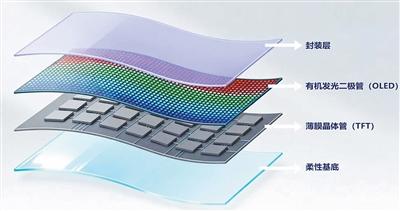
Core Insights - The article discusses the rapid advancement of flexible display technology, highlighting significant breakthroughs in materials and applications that are reshaping the industry landscape [3][4][6]. Group 1: Technological Advancements - Recent developments include the successful creation of high-performance stretchable polymer light-emitting diodes (PLED) by the Chinese Academy of Sciences, which show improved optical performance and mechanical stability [3]. - LG Display has showcased a prototype of a stretchable display capable of approximately 53% deformation, indicating significant progress in flexible display technology [3]. - The flexible display market is projected to exceed $173 billion by 2031, with a compound annual growth rate (CAGR) of 34.3% [6]. Group 2: Material and Structural Innovations - Achieving flexible displays requires a multi-layered approach, including flexible substrate materials, core electronic components, and advanced packaging technologies [4][5]. - Commonly used flexible substrate materials like polyimide and polyester can be as thin as 0.1 mm and withstand high temperatures and thousands of folds without deformation [4]. - The integration of high-performance electronic materials, such as oxide semiconductors and organic semiconductors, is crucial for ensuring rapid current flow and self-emission capabilities in flexible displays [5]. Group 3: Application Expansion - Flexible displays are increasingly being utilized across various sectors, including smart terminals, wearable devices, automotive, healthcare, and public services [6][7][8]. - In the automotive sector, flexible displays are enhancing user interaction, with companies like Mercedes and BMW integrating large OLED screens into their vehicles [7]. - The healthcare industry is adopting flexible displays for real-time monitoring, with products like flexible health patches and wearable medical devices becoming more prevalent [8]. Group 4: Future Prospects - The development of intrinsic flexible materials aims to address challenges such as fragility and resolution loss, potentially leading to new applications in smart homes and IoT [9][10]. - Intrinsic flexibility allows displays to bend and stretch without relying on external structures, enhancing durability and stability [10]. - Future flexible displays may incorporate sensors and AI algorithms for real-time data analysis and adaptive interaction, transforming user experiences and expanding the scope of applications [10].
X @TechCrunch
TechCrunch· 2025-11-20 14:20
Samsung Display, China’s BOE settle OLED patent and trade secret lawsuits https://t.co/SDwN99kPWt ...
LG Display Co. (NYSE:LPL) Shifts Focus to High-Margin OLED Technology
Financial Modeling Prep· 2025-11-20 10:04
Core Insights - LG Display Co. is transitioning from traditional LCD technology to high-margin OLED technology, which is expected to enhance profitability and competitiveness in the display technology industry [1] Financial Performance - On November 20, 2025, LG Display reported an earnings per share (EPS) of -$0.01, missing the estimated EPS of $0.07 [2][6] - The company's revenue for the period was approximately $4.93 billion, slightly below the estimated $4.99 billion, with a 25% sequential increase in revenue attributed to the focus on OLED technology [2][3] - OLED products now account for 65% of the company's total sales, indicating a successful shift in product strategy [3][6] Valuation Metrics - The company has a negative price-to-earnings (P/E) ratio of -18.70, but its forward P/E ratio for 2025 appears attractive, suggesting potential future profitability [4][6] - The price-to-sales ratio is 0.24, and the enterprise value to sales ratio is 0.69, reflecting the market's valuation of the company's sales [5] - The current ratio of 0.70 suggests potential difficulties in meeting short-term liabilities [5]
LG Display Co. (NYSE:LPL) Earnings Preview and Financial Health Analysis
Financial Modeling Prep· 2025-11-19 12:00
Core Viewpoint - LG Display Co. is transitioning from traditional LCD technology to high-margin OLED technology, which is expected to enhance profitability as OLED products now account for 65% of total sales [1][5] Financial Performance - On November 20, 2025, LG Display is expected to report an earnings per share (EPS) of $0.07 and projected revenue of approximately $4.88 billion [2][5] - In the third quarter of 2025, the company reported a 25% sequential increase in revenue and a rebound in operating profit, indicating positive effects from the focus on OLED technology [2] Valuation Metrics - The price-to-sales ratio is approximately 0.24, indicating the market values the company's sales at 24 cents for every dollar of sales, reflecting a cautious market stance [3] - The enterprise value to sales ratio is about 0.69, and the enterprise value to operating cash flow ratio is around 11.36, showing the relationship between the company's valuation, sales, and cash flow [3] Debt and Liquidity - The debt-to-equity ratio stands at about 2.00, indicating that the company has twice as much debt as equity, which could pose risks if not managed properly [4] - The current ratio is approximately 0.70, suggesting potential challenges in covering short-term liabilities with short-term assets [4]