Truck Manufacturing

Search documents
Daimler Truck North America Q3 sales slide 39%
Yahoo Finance· 2025-11-13 09:46
Core Insights - Daimler is facing a significant decline in revenue and unit sales due to a persistent freight recession, particularly impacting its North American market [3][5]. - The company reported a 33% drop in Q3 revenue, falling to 4 billion euros from 6 billion euros a year ago, and a 39% decrease in unit sales [3][4]. - Full-year sales guidance has been revised down to between 135,000 to 155,000 units, a substantial decrease from 308,000 units in 2024 [3][5]. Financial Performance - Q3 revenue decreased to 4 billion euros, reflecting a 33% decline compared to the same quarter last year [3]. - Unit sales in Q3 dropped to 30,225, down 39% from 49,346 units in the same period of 2024 [3]. - Year-to-date Class 8 truck sales reached 200,000, marking a 12% decline year-over-year, with Q3 sales specifically down 20% [4]. Market Conditions - The freight recession is leading to reduced ordering activity and margin pressure in North America, with CFO Eva Scherer noting a "sharp contraction" in the U.S. market [3][5]. - Customer sentiment in North America remains cautious, with a "wait-and-see" attitude prevailing until freight rates improve [4]. - Existing tariffs are negatively impacting profitability, with a "low triple-digit million" euro hit anticipated this year [4]. Production and Strategy - Daimler is actively engaging with the U.S. administration regarding Section 232 tariffs and exploring mitigation measures through its flexible production network [5]. - Despite current market challenges, the existing order backlog is sufficient to meet the revised sales guidance for 2025 [5][6].
Commercial Vehicle(CVGI) - 2025 Q3 - Earnings Call Presentation
2025-11-11 13:30
Financial Performance - Q3 2025 revenue was $152.5 million[6], down 11.2% year-over-year[14] - Adjusted EBITDA increased 7% year-over-year to $4.6 million[14] - Adjusted EPS was ($0.14) per diluted share[6] - Adjusted gross margin improved to 12.1%, up 10 bps sequentially from Q2 2025 and 370 bps from Q4 2024[6] - Year-to-date free cash flow was $25 million, an improvement of $14 million over the prior year[6] Segment Performance - Global Seating revenue decreased 10% year-over-year in Q3 2025 to $68.7 million[16], but adjusted operating income increased by $3.7 million[22] - Global Electrical Systems revenue increased 6% year-over-year in Q3 2025 to $49.5 million[24], and adjusted operating income increased by $1.6 million[30] - Trim Systems and Components revenue decreased 29% year-over-year in Q3 2025 to $34.3 million[32], with an adjusted operating income decline of $4.4 million[35] Outlook and Strategy - The company expects free cash flow of at least $30 million in 2025[50] - The company is targeting a $30 million improvement in working capital in 2025[48] - The company updated its fiscal 2025 outlook, projecting net sales of $640-$650 million and adjusted EBITDA of $17-$19 million[49]

Truckmakers urge EU to weaken CO₂ rules: T&E
Yahoo Finance· 2025-10-31 13:43
Core Viewpoint - Six major truck manufacturers have requested a revision of the EU's truck CO₂ Regulation, which could significantly impact the market for zero-emission trucks [1][2]. Group 1: Manufacturers' Request - The manufacturers, including Scania, MAN, Volvo Trucks, Daimler, IVECO, and Ford, are seeking an amendment to allow emissions credits, which would change how emissions reduction targets are calculated [1][2]. - This proposed change could lead to a reduction of approximately 27% in the number of zero-emission trucks sold by 2030 [2]. Group 2: Impact on Regulations - Transport & Environment (T&E) argues that the proposal would undermine the ambition of the current regulation and could delay the transition to zero-emission vehicles [3]. - T&E's freight and fleet director stated that the truckmakers' proposal, framed as a minor adjustment, would actually represent a significant rollback of Europe's decarbonization efforts [3]. Group 3: Investment Uncertainty - Altering the targets could create uncertainty for companies investing in charging infrastructure and grid capacity, as the trucking industry cites lack of infrastructure as a key bottleneck [4]. - The modeling by T&E suggests that manufacturers may use credits banked in previous years to ease compliance in 2030 and beyond, potentially affecting investment decisions [4]. Group 4: Competitive Pressure - Any delay in the transition to zero-emission trucks could increase competitive pressure from Chinese manufacturers, who are heavily investing in electric truck production [5].

Volvo Group cuts North America forecast by 10K trucks
Yahoo Finance· 2025-10-29 11:42
Core Insights - Volvo Group is facing significant challenges in its North American market due to trade tensions and a freight slowdown, impacting its outlook [3] - The company will incur a new 25% tariff on imports of heavy-duty and medium-duty trucks and parts starting November 1, adding to existing tariff-related costs of 500 million SEK in Q3 [3] - Volvo has reduced its 2025 sales outlook in North America to 265,000 trucks, a decrease of 10,000 units, due to new tariffs and weak demand [7] Market Conditions - The freight recession is negatively affecting demand, and new tariffs are expected to further slow orders into 2026 [6] - Customers are currently in a "wait-and-see mode" due to high uncertainty in the market [7] Production and Capacity - Volvo Group has a complete U.S. footprint for North American trucks but is preparing for potential tariff agreements between the U.S. and Mexico [4] - The company acknowledges a structural undercapacity in North America and recognizes the need to add capacity for both North and South American markets [4] - Despite the need for increased capacity, it is unlikely that Volvo will expand production in the near term due to ongoing demand challenges [6] Manufacturing Facilities - Volvo Trucks operates an assembly plant in Virginia and additional manufacturing facilities in Maryland and Virginia, along with seven parts distribution centers [5] - Mack Truck, a sister brand, shares a powertrain assembly facility in Maryland and has a new plant in Pennsylvania that recently began manufacturing the Mack Pioneer [5]
Volvo Trucks leads heavy-duty electrification
Globenewswire· 2025-10-28 14:00
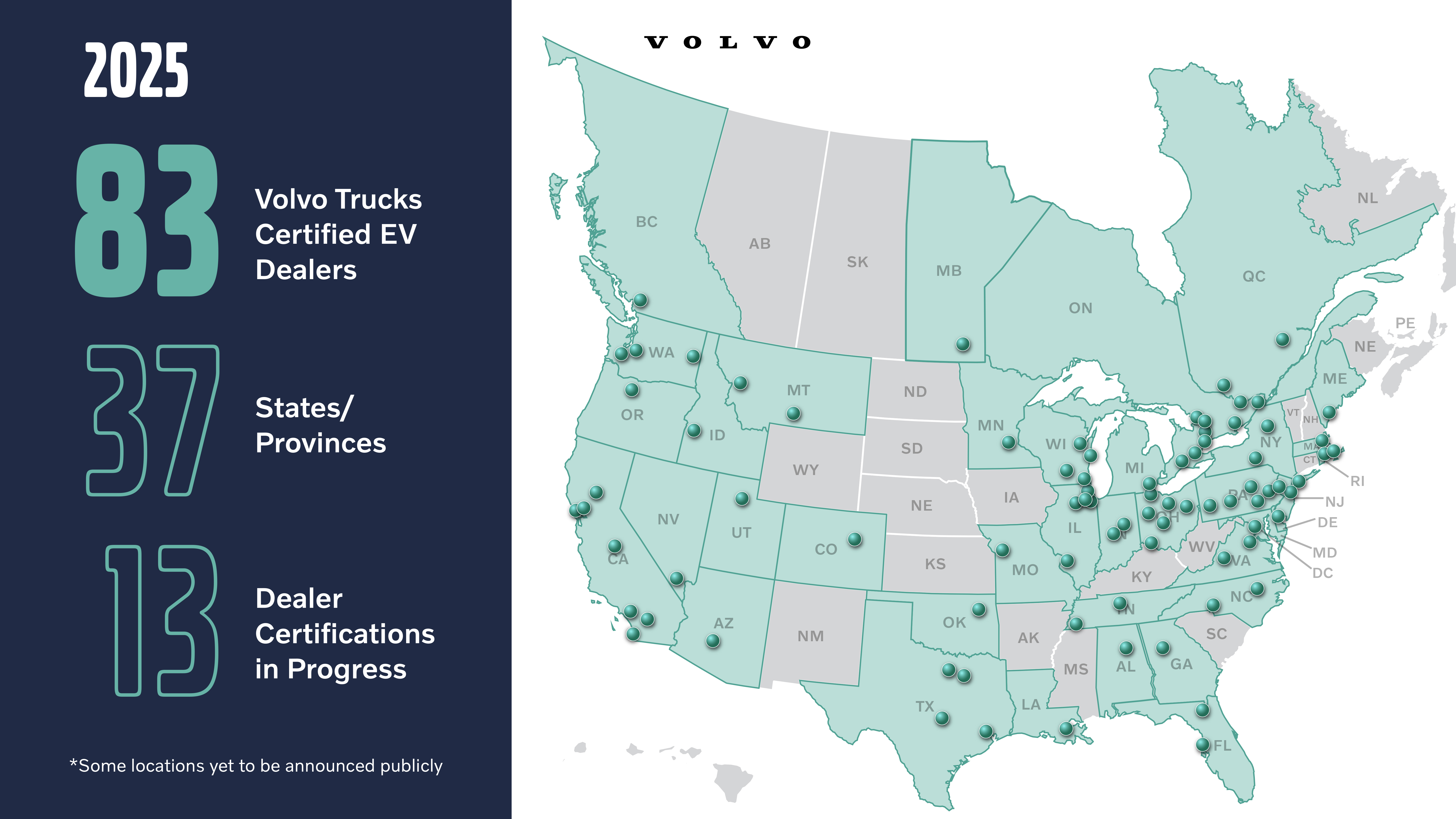
Core Insights - Volvo Trucks North America is leading the transition to electromobility with over 700 VNR Electric trucks operating in the U.S. and Canada, achieving more than 20 million zero-tailpipe-emission miles and eliminating approximately 34,000 metric tons of CO₂ [1][2] Group 1: Electrification Progress - Since the launch of its first electric trucks in 2019, Volvo has delivered over 5,700 electric vehicles across 50 countries, collectively driving 250 million kilometers (155 million miles) [2] - Volvo Trucks maintains an average market share of over 30% in the North American electric truck segment over the past five years [2] Group 2: Dealer Network Expansion - The Certified EV dealership network has expanded to 83 locations across 33 U.S. states and four Canadian provinces, with recent additions in Colorado, Louisiana, Maryland, and Nevada [4][16] - Certified dealers undergo extensive EV training and invest in facility upgrades to provide full sales and service support for battery-electric trucks [5] Group 3: Commitment to Sustainability - Volvo Trucks is advancing cleaner solutions across its product range, with the new Volvo VNL offering up to 10% better fuel efficiency than its predecessor, translating to about 1,300 fewer gallons of fuel and a reduction of roughly 30,000 pounds of CO₂ for a truck running 120,000 miles per year [6] - The company employs a three-path approach to decarbonization, incorporating fuel-efficient combustion engines, battery-electric, and fuel-cell electric trucks [7] Group 4: Global Electric Portfolio - Volvo Trucks' electric vehicles are operational in 50 countries, with strong markets in Germany, the Netherlands, Norway, Sweden, and the U.S., offering eight fully electric truck models for various applications [9] Group 5: Historical Context - The leadership in zero-tailpipe emission transportation began with the launch of the Volvo VNR Electric as part of the $90 million Volvo LIGHTS Project, which aimed to support the adoption of heavy-duty battery-electric trucks [10]

Canada opens anti‑dumping probe into truck body imports from China
Yahoo Finance· 2025-10-27 15:34
Core Viewpoint - Canada is initiating an anti-dumping investigation into truck body imports from China, prompted by a complaint from local manufacturers alleging material injury due to dumped prices and government subsidies [1][2]. Group 1: Investigation Details - The Canada Border Services Agency (CBSA) will assess whether the truck bodies are sold at dumped prices or are benefiting from subsidies [1]. - A preliminary determination by the CBSA is expected by January 22, 2026, while the Canadian International Trade Tribunal (CITT) will issue its decision by December 23, 2025 [3]. Group 2: Impact on Domestic Producers - The complainants, Morgan Canada and Morgan Transit, claim that the influx of dumped and subsidized imports has led to price undercutting, price depression, fewer bookings, and lost sales [2]. - The two companies represent the majority of Canadian truck-body production, indicating a significant impact on the domestic industry [2]. Group 3: Government Measures - Canada currently has 158 special import measures in place across various industrial and consumer products, which have reportedly protected around 45,000 jobs and contributed approximately C$18.4 billion ($13.16 million) in production last year [3][4]. - Recent government actions include reducing the number of vehicles that Stellantis and General Motors (GM) can import duty-free, following their decision to cut back manufacturing in Canada [4].
Volvo Trucks teams up with the Center for Pet Safety to protect drivers’ most loyal co-pilots
Globenewswire· 2025-10-27 14:00
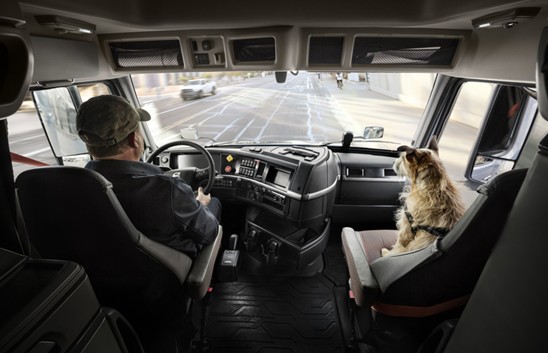
Core Insights - Volvo Trucks North America is collaborating with the Center for Pet Safety to enhance the safety and comfort of commercial drivers traveling with pets [1][5][8] - The partnership aims to provide practical guidance and resources for drivers to ensure the well-being of their pets while on the road [2][8] Company Initiatives - The collaboration will involve experts from the Center for Pet Safety reviewing the new Volvo VNL truck to assess its safety features and comfort for both drivers and pets [6] - A digital resource will be co-developed by Volvo Trucks and the Center for Pet Safety, set to launch in early 2026, offering tips on safe pet travel in commercial vehicles [8] Industry Context - Over 60% of truck drivers are pet owners, with nearly 40% bringing their pets on the road, highlighting the importance of addressing the needs of this demographic [1][2] - The Center for Pet Safety, established in 2011, focuses on consumer and companion animal safety through research and advocacy, ensuring that the partnership aligns with rigorous safety standards [9]
PACCAR(PCAR) - 2025 Q3 - Earnings Call Transcript
2025-10-21 17:02
Financial Data and Key Metrics Changes - PACCAR achieved revenues of $6.7 billion and net income of $590 million in Q3 2025, with PACCAR Parts achieving record quarterly revenues of $1.72 billion and pre-tax income of $410 million, reflecting a 4% growth in parts revenue compared to the same period last year [4][5][9] - Gross margins for PACCAR's trucks, parts, and other segments were 12.5% in Q3, affected by tariff increases on steel and aluminum, with expectations for fourth quarter margins to be around 12% as tariffs peak [7][8] Business Line Data and Key Metrics Changes - PACCAR Parts reported gross margins of 29.5% and continued to grow by investing in capacity and services, with a new parts distribution center opening in Calgary next year [9][10] - PACCAR Financial Services achieved pre-tax income of $126 million, an 18% increase from the previous year, supported by a high-quality portfolio and improving used truck results [10] Market Data and Key Metrics Changes - The U.S. and Canadian Class 8 market is estimated to be between 238,000 to 245,000 trucks this year, with expectations for next year to range from 230,000 to 270,000 [5][6] - The European above 16-ton market is projected to be between 275,000 to 295,000 vehicles this year, with expectations for 2026 to be in the range of 270,000 to 300,000 [6][7] Company Strategy and Development Direction - PACCAR is focused on long-term growth through investments in truck and engine factories, advanced technology, and expanding its parts business [10][11] - The company aims to improve its competitive position with the implementation of Section 232 tariffs, which are expected to reduce costs for customers and enhance market clarity [8][14] Management's Comments on Operating Environment and Future Outlook - Management expressed optimism about improving market conditions and the potential for increased demand in the truckload sector as customers begin to replace aging equipment [17][25] - The company anticipates that clarity around tariffs and emissions standards will encourage capital allocation towards truck purchases in the upcoming quarters [25][52] Other Important Information - PACCAR plans to invest between $725 to $775 million in capital projects and $450 to $500 million in research and development expenses next year, focusing on clean diesel technology and advanced driver assistance systems [10][11] - The company is also expanding its used truck centers globally to support the sale of premium used trucks [10] Q&A Session Summary Question: Impact of Section 232 tariffs on competitive position - Management indicated that Section 232 tariffs will improve PACCAR's competitive position as most trucks are manufactured in the U.S., and the full benefits will be realized gradually [14][15] Question: Pricing strategy in light of tariffs - Management noted that while tariffs peaked in Q4, they expect to integrate pricing discussions without the need for tariff surcharges, focusing on the value of their trucks [89][100] Question: North American growth outlook and customer conversations - Management highlighted mixed customer sentiments, with positive conditions in vocational and less-than-truckload markets driving orders, while truckload sector challenges persist [25][26] Question: Inventory levels and demand outlook - Management reported healthy inventory levels, with 2.8 months of inventory for PACCAR, and expressed confidence in demand for the first half of next year as customers prepare for potential regulatory changes [85][86] Question: Parts business growth and margin expansion - Management acknowledged challenges in the parts business due to tariffs but emphasized ongoing investments and opportunities for growth in the future [45][80]

PACCAR Posts Downbeat Earnings, Joins Neuphoria Therapeutics, Citius Pharmaceuticals And Other Big Stocks Moving Lower In Tuesday's Pre-Market Session - Coeur Mining (NYSE:CDE), First Majestic Silver
Benzinga· 2025-10-21 12:16
Core Insights - U.S. stock futures showed slight gains, with Dow futures up approximately 0.1% [1] Company Performance - PACCAR Inc reported a significant decline in shares, falling 18.3% to $7.64 in pre-market trading after disappointing third-quarter results [1] - The company's quarterly earnings were $1.12 per share, missing the analyst consensus estimate of $1.17 per share [1] - PACCAR's quarterly sales were reported at $6.107 billion, also below the analyst consensus estimate of $6.371 billion [1] Other Stocks Movement - Neuphoria Therapeutics Inc shares plummeted 65.3% to $5.35 after its AFFIRM-1 trial for social anxiety failed to meet endpoints [4] - Citius Pharmaceuticals Inc shares fell 18.2% to $1.48 following a $6 million registered direct offering announcement [4] - Galapagos NV shares declined 15.4% to $28.99 as the company plans to wind down its Cell Therapy Business [4] - Silvercorp Metals Inc shares decreased by 9.9% to $6.35 in pre-market trading [4] - Other notable declines included Theravance Biopharma Inc down 8.6% to $13.07 and Pacira Biosciences Inc down 8.3% to $21.10 [4]

AB Volvo (publ) Earnings Report Analysis
Financial Modeling Prep· 2025-10-17 22:00
Core Insights - AB Volvo (publ), trading under the symbol VOLAF, is a significant player in the global truck manufacturing industry, producing trucks, buses, and construction equipment while facing competition from major manufacturers like Daimler and Scania [1] Financial Performance - On October 17, 2025, VOLAF reported an earnings per share (EPS) of $0.39, which was below the estimated EPS of $0.43, indicating lower profitability than anticipated [2][6] - The actual revenue for the period was approximately $11.72 billion, slightly under the estimated revenue of about $11.77 billion, suggesting challenges in meeting market expectations, particularly due to weaker demand in key regions like North and South America [3][6] Valuation Metrics - VOLAF maintains a price-to-earnings (P/E) ratio of approximately 14.85, reflecting the market's valuation of its earnings, and a price-to-sales ratio of about 1.13, indicating how the market values its revenue [4] Financial Health - The company's financial health is illustrated by a debt-to-equity ratio of approximately 1.62, highlighting its financial leverage, and a current ratio of around 1.11, showcasing its ability to cover short-term liabilities with short-term assets [5][6]