
水利工程

Search documents
润泽京西生新韵 一渠清水映古今
Bei Jing Wan Bao· 2025-10-28 08:21
Core Viewpoint - The ancient irrigation system along the Yongding River in Beijing, consisting of five ancient canals, has been modernized and continues to play a crucial role in agricultural development and water management in the region, recently recognized as a World Irrigation Heritage site [13]. Group 1: Historical Context - The Yongding River has a history of flooding, prompting local residents to construct five ancient canals to manage water flow and irrigation [1]. - The irrigation system includes the ancient canals of Fujia Tai, Dingjia Tan, Gongyi Gully, Sanjiadian, and Chenglong, which have been preserved and modernized over time [13][27]. Group 2: Agricultural Impact - Fujia Tai village has seen a significant increase in apple production, with larger fruit sizes and higher yields attributed to the irrigation provided by the ancient canal [14][16]. - The village now has over 500 acres of orchards benefiting from the ancient irrigation system, with farmers earning substantial incomes from high-value crops [16]. Group 3: Modern Developments - The ancient canals have undergone modernization, including the construction of concrete structures and regular maintenance to ensure their functionality [16][19]. - The Chenglong canal is being upgraded to enhance water supply to five rivers in the region, aiming to improve water resource management [23]. Group 4: Cultural Significance - The irrigation heritage is intertwined with local culture, as seen in the continuation of the Yongding River Culture Festival, which promotes water culture and local traditions [27]. - The ancient canals and associated structures are recognized as important cultural and historical assets, contributing to the region's identity and agricultural practices [26].


机构风向标 | 大禹节水(300021)2025年三季度已披露持仓机构仅4家
Sou Hu Cai Jing· 2025-10-28 01:09
Core Insights - Dayu Water-saving (300021.SZ) released its Q3 2025 report on October 28, 2025, indicating a total of 27.54 million A-shares held by four institutional investors, representing 2.69% of the company's total share capital [1] Institutional Holdings - The total institutional holding increased by 1.16 percentage points compared to the previous quarter [1] - The institutional investors include Dayu Water-saving Group's repurchase special securities account, Sichuan Development Securities Investment Fund Management Co., Ltd., China Institute of Water Resources and Hydropower Research, and UBS AG [1] Public Fund and Social Security Fund - Thirteen public funds were disclosed this period, including names like China Merchants CSI 2000 Index Enhanced A and Huashang Dual-Drive Preferred Mixed Fund [1] - One new social security fund was disclosed, namely the National Social Security Fund 103 Portfolio [1] Foreign Investment - One new foreign institutional investor was disclosed this quarter, which is UBS AG [1]

*ST围海:预中标约3.13亿元河道工程项目
Zheng Quan Shi Bao Wang· 2025-10-27 10:00
人民财讯10月27日电,*ST围海(002586)10月27日公告,公司于近日收到《中标通知书》,已确定公 司为"淮河入海水道二期工程(淮安市境内)河道工程施工14标"的中标单位,项目中标金额约为3.13亿 元。 ...

大禹节水:2025年前三季度净利润约1108万元
Mei Ri Jing Ji Xin Wen· 2025-10-27 08:55
Group 1 - The core viewpoint of the article highlights Dayu Water's financial performance in Q3 2025, showing a revenue increase but a significant decline in net profit and earnings per share [1] Group 2 - Dayu Water reported a revenue of approximately 2.067 billion yuan for the first three quarters of 2025, representing a year-on-year increase of 9.73% [1] - The net profit attributable to shareholders was about 11.08 million yuan, reflecting a year-on-year decrease of 62.92% [1] - Basic earnings per share were 0.0127 yuan, down 63.61% compared to the previous year [1] - As of the report date, Dayu Water's market capitalization stood at 5 billion yuan [2]
除了“解渴”,南水北调还带来了什么?
Ren Min Wang· 2025-10-26 03:07
Core Insights - The South-to-North Water Diversion Project has significantly improved water supply and quality in northern regions, transforming areas like Liangshan Port into vital logistics hubs [1][2][7] - The project has led to a comprehensive improvement in regional water resource management, enhancing agricultural productivity and urban water supply reliability [2][9] Group 1: Project Overview - The South-to-North Water Diversion Project was initiated in the 1950s and officially approved in 2002, consisting of three main routes to connect major river basins [2] - The Eastern Route specifically addresses water shortages in cities along the Tianjin-Pukou Railway and the Jiaodong Peninsula, improving water supply reliability from below 80% to over 97% [2] Group 2: Coordination and Management - A precise coordination mechanism has been established for efficient water resource management across regions, involving multiple agencies for unified water volume scheduling [3][4] - Monthly meetings and dynamic planning ensure effective water distribution and timely response to any issues that arise [4] Group 3: Environmental Improvements - Significant pollution control measures have been implemented in Jiangsu and Shandong provinces, resulting in a dramatic increase in water quality compliance from 3% to 100% [6] - The South Four Lake, previously known for poor water quality, has seen its standards improve to Class III surface water, showcasing a successful environmental restoration [6] Group 4: Socioeconomic Impact - The project has enhanced the quality of life for millions, transitioning from merely providing water to ensuring safe and clean drinking water [7][8] - Economic benefits are evident, with agricultural practices improving and new income sources emerging for local communities, such as increased revenue from oil sunflower cultivation [9]
河南水利投资集团拟发行11亿元中票
Sou Hu Cai Jing· 2025-10-24 07:32
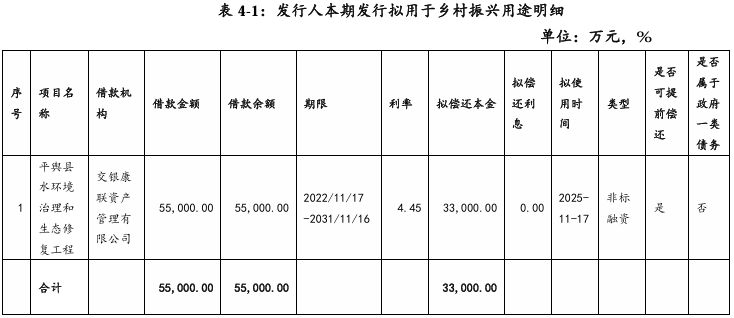
【大河财立方消息】10月24日,河南水利投资集团有限公司披露2025年度第二期中期票据(乡村振兴)发行相 关文件。 本期债券发行规模11亿元,期限3年,其中3.3亿元用于乡村振兴领域,具体为偿还发行人本部平舆县水环境 治理和生态修复工程产生的借款本金;7.7亿元用于偿还发行人本部金融机构借款、应付债务融资工具等本 息。 | 序 를 | 借款机构/ 债券简称 | 借款全额 | 借款余额 | 期限 | 利率 | 拟偿还本金 | 拟偿还利 .5 | 拟使 用时 间 | 美型 | 是否 可提 前偿 | 是否 属于 政府 一英 | 用途 | | --- | --- | --- | --- | --- | --- | --- | --- | --- | --- | --- | --- | --- | | | | | | | | | | | | रूर | 债务 | | | 1 | 兴业银行股 | 3. 917. 10 | 3, 917. 10 | 2024/5/6 | 3.90 | 195. 86 | 0.00 | 2025- | 银行 | 联 | 중 | 补流 | | | 份有限公司 | | | -2031/5/6 | ...
水利部发布9项水利行业标准
Zheng Quan Shi Bao Wang· 2025-10-24 06:47
Core Viewpoint - The Ministry of Water Resources has approved the release of nine industry standards related to water conservancy and hydropower engineering, which will take effect on December 29, 2025 [1] Group 1: Industry Standards - The announcement includes the approval of the "In-situ Permeability Test Procedures for Water Conservancy and Hydropower Engineering Part 1: Borehole Water Pressure Test" among other standards [1] - A total of nine standards have been approved for implementation, indicating a regulatory update in the water conservancy sector [1]
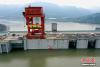
三峡水库蓄至175米 流域水库群蓄水量创新高
Zhong Guo Xin Wen Wang· 2025-10-24 03:36
Core Points - The Three Gorges Reservoir has reached its normal water level of 175 meters, with the total water storage in the Yangtze River basin reaching a historical high of 108.1 billion cubic meters [1][4][6] - This achievement marks the successful completion of the annual water storage task for the Yangtze River upstream reservoir group, ensuring comprehensive benefits for water supply, irrigation, power generation, navigation, and ecology for the upcoming winter and spring [1][4][6] Group 1 - The Three Gorges Reservoir began its water storage process on September 10, 2023, with the starting water level being 7.2 meters higher than the average of the past five years [2] - The Yangtze River basin experienced a complex situation of "drought followed by flooding," with significantly reduced water inflow during the main flood season, prompting the Three Gorges Reservoir to implement three irrigation support water releases [2][4] - The coordinated operation of 58 control reservoirs in the Yangtze River basin has resulted in a total water storage of 108.1 billion cubic meters, surpassing the previous record of 106.9 billion cubic meters in 2023 [4][6] Group 2 - The high water storage level will provide sufficient water supply for urban living, agricultural irrigation, industrial production, and ecological replenishment from late November to April of the following year [6] - The water level in the reservoir is expected to maintain around 155 meters until May 2024, ensuring stable navigation conditions for the section from Yichang to Chongqing [6] - The mature scheduling of the reservoir group will enhance the comprehensive benefits in flood control, power generation, navigation, and water resource utilization, supporting the high-quality development of the Yangtze River Economic Belt [6]
水利部公布母亲河复苏行动三年成效 我省4条省管河道高质量完成贯通复苏任务
Da Zhong Ri Bao· 2025-10-24 01:04
Core Insights - The Ministry of Water Resources has reported significant achievements in the Mother River Revival Action over the past three years, with 88 rivers and lakes across the country showing remarkable recovery [1] - The province has successfully achieved full connectivity in key river sections, enhancing the ecological landscape [1] Summary by Sections River Connectivity Achievements - The province's major rivers, including the Dawen River, Sih River, Dagu River, and Xiaoqing River, have achieved full connectivity multiple times [1] - Specific connectivity data includes: - Dawen River: 3 instances of water flow connectivity from Laiwu Hydrological Station to Daicun Dam, totaling 280 days [1] - Sih River: 2 instances of connectivity from Shuyuan Hydrological Station to Yuzhuang Rubber Dam, totaling 208 days [1] - Dagu River: 3 instances of connectivity from Suijia Hydrological Station to Nancun Hydrological Station, totaling 46 days [1] - Xiaoqing River: Continuous connectivity from the beginning of the year to the present [1] Ecological and Economic Benefits - The revival of the Mother River has led to both ecological and economic benefits, transforming green water and mountains into gold and silver mountains [1] - Local areas have developed waterfront leisure corridors and ecological tourism based on the restored rivers [1] - The construction of wetland parks and ecological buffer zones along the rivers acts as natural water purifiers, filtering non-point source pollution and providing habitats for birds and amphibians [1]
南水北调东中线累计调水超830亿立方米
Ren Min Ri Bao· 2025-10-23 22:42
Core Insights - The South-to-North Water Diversion Project has successfully transferred over 83 billion cubic meters of water to northern regions, benefiting 195 million people across 48 large and medium-sized cities [1] - The project is expanding its benefits from urban areas to rural regions as supporting infrastructure improves [1] - The water loss rate in the main canal of the Middle Route has been significantly reduced from the designed 10% to approximately 3% in actual operation [1] Water Quality Management - The South-to-North Water Diversion Group has established a comprehensive water quality safety assurance system that includes monitoring, protection, prevention, emergency response, and research [1] - The number of water quality monitoring parameters at the Taocha monitoring station has increased from 101 to 197 [1] - The water quality of the Middle Route project has stabilized at or above Class II surface water standards, while the Eastern Route maintains Class III surface water standards [1]