
日用品

Search documents
ISS建议股东支持金佰利收购泰诺生产商Kenvue的计划
Ge Long Hui A P P· 2026-01-19 02:29
Group 1 - The core viewpoint of the article is that ISS recommends shareholders support Kimberly-Clark's acquisition of Kenvue, suggesting that the partnership could enhance financial metrics [1] - Kimberly-Clark proposed to acquire Kenvue for over $40 billion to create a global consumer health company [1] - Shareholders are set to vote on the transaction on January 29, with ISS acknowledging concerns regarding ongoing negative market reactions and uncertainties related to lawsuits surrounding Kenvue's products [1]


2025年上海市一次性用品定量包装商品净含量监督抽查结果公布
Zhong Guo Zhi Liang Xin Wen Wang· 2026-01-16 08:51
Core Viewpoint - The Shanghai Municipal Market Supervision Administration conducted a quality inspection of disposable products' net content in 2025, finding no non-compliant products among the 10 batches tested [1] Group 1: Inspection Overview - The inspection was based on the JJF 1070-2023 "Measurement Inspection Rules for Net Content of Quantitative Packaged Goods" and included checks on net content labeling and actual net content [1] - All sampled products met the relevant standards, indicating compliance in the market for disposable goods [1] Group 2: Sampled Products - The inspection included various products such as: - "Heart to Heart" facial tissues, 150 sheets per pack, produced by Hunan Hengan Paper Industry Co., Ltd. [1] - "Purple Ding" disposable gloves, 40 pieces, produced by Sichuan Hongchang Plastic Industry Co., Ltd. [1] - "Sofy" ultra-sleeping pants, 5 pieces, produced by Unicharm Life Products (China) Co., Ltd. [1] - "Pampers" adult diapers, 10 pieces, produced by Vinda Trading Co., Ltd. [1] - "Mingchuang" disposable dental floss sticks, 180 pieces per box, produced by Mingchuang (Guangzhou) Co., Ltd. [1]

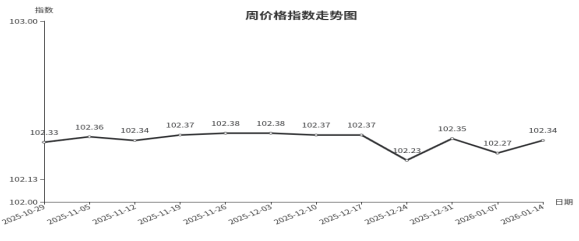
临沂商城周价格总指数为102.34点,环比上涨0.07点
Zhong Guo Fa Zhan Wang· 2026-01-16 06:33
Core Insights - The overall price index of Linyi Mall increased to 102.34 points this week, reflecting a slight week-on-week rise of 0.07 points, but a year-on-year decline of 1.50 points [1] Price Index Summary - Among 14 categories of goods, 5 categories saw price increases, 7 remained stable, and 2 categories experienced price declines. The top three categories with price increases were building decoration materials, steel, and household appliances and audio-visual equipment [3] Building Decoration Materials - The weekly price index for building decoration materials reached 107.49 points, with a week-on-week increase of 0.81 points. The largest increase was in the decorative materials subcategory, driven by rising aluminum prices, which increased production costs [5][7] Steel - The weekly price index for steel rose to 95.25 points, with a week-on-week increase of 0.18 points. Various subcategories, including profiles, pipes, and construction steel, saw price increases, while plate prices slightly declined. The market remains in a seasonal downturn with limited demand [8] Household Appliances and Audio-Visual Equipment - The weekly price index for household appliances and audio-visual equipment increased to 103.03 points, with a week-on-week rise of 0.07 points. The price of audio-visual equipment and refrigeration appliances increased, while prices for water heaters and purification appliances saw minor declines [10] Daily Necessities - The weekly price index for daily necessities decreased to 102.68 points, with a week-on-week decline of 0.02 points. Prices for bags, crafts, toys, and beauty products fell, influenced by seasonal demand reduction and e-commerce price competition [13] Clothing and Accessories - The weekly price index for clothing and accessories fell to 103.51 points, with a week-on-week decrease of 0.02 points. The decline was driven by clearance promotions for winter inventory, particularly in footwear, while clothing prices remained stable overall [16] Price Index Table - A detailed table shows the price index changes for various categories, highlighting the overall index increase and specific category movements [17]
局势突变催生机遇 消费品巨头宝洁(PG.US)还会重返委内瑞拉吗?
Zhi Tong Cai Jing· 2026-01-06 10:20
Core Viewpoint - The geopolitical shift in Venezuela following the U.S. military operation in January 2026 presents new uncertainties for Procter & Gamble (P&G), which has been navigating its operations in the country for decades [2][5]. Group 1: Historical Context - P&G entered the Venezuelan market in 1947, establishing its first office in 1950 and building its first factory in 1952, making Venezuela a key growth hub in South America [3]. - By 2013, P&G operated two factories in Venezuela with over a thousand employees, covering essential product categories like laundry and baby care [3]. - Political turmoil and economic crises during the Maduro administration led to significant losses, totaling over $600 million from 2013 to 2015, prompting P&G to write off all local assets and cease manufacturing operations [3]. Group 2: Current Operations - Currently, P&G has no factories, research centers, or employees in Venezuela, relying solely on third-party distributors to maintain product supply [4]. - The company has undergone a global restructuring, announcing plans to cut 7,000 non-manufacturing jobs by mid-2027 and exit markets like Bangladesh and Pakistan [4]. - Despite the limited market size in Venezuela, it remains strategically significant for P&G's South American operations [4]. Group 3: Future Opportunities and Risks - The recent geopolitical changes in Venezuela may create potential opportunities for P&G to return, especially with U.S. government support for American companies to re-enter the market [5]. - If a political transition led by the U.S. occurs, easing sanctions and economic normalization could provide mid-term benefits for P&G, potentially allowing for selective reinvestment [5]. - However, P&G has not publicly commented on the possibility of returning to Venezuela, indicating that decisions will depend on the evolving local situation and global strategic priorities [5].

受害规模存在争议,政府担负事故责任,韩国加湿器杀菌剂事件被定为“社会惨案”
Huan Qiu Shi Bao· 2025-12-25 22:54
Group 1 - The South Korean government has officially classified the humidifier disinfectant incident as a "social disaster" and is pushing for legal amendments to hold the government accountable as one of the responsible parties [1] - The new policy will change the terminology in the existing Humidifier Disinfectant Victims Relief Act from "incident" to "social disaster," shifting from an administrative relief system to a liability-based compensation system [1] - President Yoon Suk-yeol has issued an apology to the victims' families, marking the second time a South Korean president has formally apologized for this case since 2017 [1] Group 2 - The humidifier disinfectant was introduced in South Korea in 1994, with approximately 50 related products circulating in the market, totaling nearly 10 million units sold by 2016 [1] - Initial health issues related to the disinfectant were reported as "unknown causes of lung disease," particularly affecting vulnerable groups such as children and pregnant women [1] - In 2011, a significant number of postpartum women were hospitalized with severe lung injuries, leading to an epidemiological investigation that confirmed the disinfectant as a major health risk [2] Group 3 - By November 2025, 5,942 victims had been officially recognized under the relief law, but compensation efforts have been slow, with the actual death toll potentially reaching 14,000 according to a special committee [2] - Approximately 6.3 million South Koreans used the disinfectant between 1994 and 2011, with around 670,000 experiencing health issues such as asthma and lung diseases [3] - Legal accountability has been pursued against several companies, including Reckitt Benckiser, which was found to have serious issues in product testing and documentation [3] Group 4 - In February 2024, the Seoul High Court ruled that the government should bear compensation responsibility, citing inadequate reviews of the harmfulness of chemical substances [3] - Following this ruling, the South Korean government is implementing a systematic solution to expand compensation responsibilities to both companies and the state, with plans to establish a dedicated compensation review committee [3] - Starting in 2026, the government will fully transition the relief method and plans to collaborate with victims' families to establish a memorial day and hold formal commemorative events [3]
110亿,强生爽身粉致癌案判了
Guan Cha Zhe Wang· 2025-12-25 09:45
Core Viewpoint - Johnson & Johnson faces significant legal challenges and financial liabilities due to claims that its baby powder products contain asbestos, leading to cancer diagnoses among users, with a recent jury awarding $1.56 billion in damages to a plaintiff [1][4]. Group 1: Legal Challenges and Financial Liabilities - A Maryland jury ruled that Johnson & Johnson must pay approximately $1.56 billion to a woman who developed mesothelioma after using its baby powder, marking the highest compensation awarded to a single plaintiff in the company's history [1]. - The company has faced multiple lawsuits over the years, with previous rulings including $72 million in 2016 for an ovarian cancer patient and $417 million in 2017 for another plaintiff [2]. - Johnson & Johnson's subsidiary, Red River Talc, filed for prepackaged bankruptcy in 2024 to address ongoing litigation related to talc claims, proposing a settlement plan worth approximately $8 billion over 25 years [4]. Group 2: Product Safety and Corporate Actions - Johnson & Johnson has historically denied that its products contain asbestos, asserting that extensive testing confirms their safety [2]. - In response to declining sales due to the cancer allegations, the company ceased production of talc-based baby powder in the U.S. and Canada in 2020, later expanding this decision globally in 2023 [3]. - The company has attempted to mitigate litigation risks through settlements, including a $8.9 billion agreement to resolve claims over 25 years and a $700 million settlement with 42 states in 2024 [4]. Group 3: Industry Implications - The ongoing legal battles and substantial financial penalties serve as a warning to global companies about the consequences of prioritizing commercial interests over public health [5]. - The situation highlights the potential risks associated with product safety and the importance of transparency in corporate practices [5].


柬埔寨下调多项进口商品税率 助力产业升级与民生改善
Shang Wu Bu Wang Zhan· 2025-12-24 12:30
Core Insights - Cambodia's government is implementing strategic adjustments to import tariffs and special taxes on certain goods, effective January 1, 2026, aimed at reducing import costs for key materials and enhancing the business environment [1] Group 1: Tax Adjustments - Multiple goods will see a "zero tariff" policy, including live poultry, computers and related peripherals, antenna equipment, laboratory instruments, and related testing equipment, with tariffs reduced from 15% or 7% to 0% [1] - Significant reductions in tariffs for daily consumer and industrial goods, such as sanitary napkins, diapers, rice cookers, fruit blenders, and luxury cars, with tariffs dropping from 15% to 7% and from 35% to 7% respectively [1] Group 2: Green Energy and Technology Incentives - Special tax reductions for electric vehicle (EV) components, with the special tax rate for electric vehicle motors, vacuum cleaners, and audio equipment reduced from 10% to 0%, and for electric vehicle batteries from 10% to 5% [1] Group 3: Economic Impact - The tax reforms reflect the Cambodian government's policy direction of benefiting the public, promoting production, and advocating for environmental protection, which is expected to lower retail prices, alleviate inflation, and improve living standards [2] - The zero tariff policy on computers and laboratory equipment will significantly lower the barriers for corporate research and digital transformation [2] - The reduction in tax rates for core components of electric vehicles will accelerate the green transition of transportation in Cambodia and attract more investments in the new energy sector [2]
三分钱买一个饼的国家,中国企业去了能干嘛?
创业邦· 2025-12-23 10:51
Core Viewpoint - The article discusses the economic situation in Egypt, focusing on the significance of the inexpensive staple food, "baladi bread," as a reflection of the country's broader economic challenges and opportunities for foreign investment, particularly from Chinese companies [8][10][86]. Group 1: Economic Context - The price of "baladi bread" has increased from 0.05 EGP to 0.2 EGP, which seems minimal but represents a significant burden for many families in Egypt [12][14]. - The average Egyptian household spends a substantial portion of their income on bread, with some families potentially spending 10% of their income just to meet basic food needs [15][14]. - The economic landscape is characterized by limited job opportunities and low income levels, leading many Egyptians to seek work abroad, particularly in wealthier Gulf countries [16][17]. Group 2: Talent and Human Capital - Despite low GDP per capita, Egypt is referred to as the "brain warehouse" of the Middle East, with many Egyptians holding high positions in various sectors across the region [20][22]. - The cultural and linguistic advantages of Egyptians make them valuable in the Arab world, as they are often preferred for roles in management and legal professions [25][30]. - Companies looking to invest in Egypt can benefit from the local talent pool, which is often well-educated and skilled, particularly in sectors like law and education [20][24]. Group 3: Investment Opportunities - Egypt offers 100% permanent land ownership to foreign companies, which is a significant incentive for long-term investment [40][46]. - The rental policies in Egypt typically range from 30 to 50 years, but the option for permanent ownership encourages companies to invest in infrastructure and local talent development [41][47]. - Companies like ElSewedy are taking proactive steps to address the skills gap by establishing technical schools to train local talent, ensuring a workforce that meets industry needs [51][54]. Group 4: Cultural Considerations - Understanding and respecting local customs, such as the five daily prayers of Muslims, is crucial for foreign companies operating in Egypt [56][61]. - Successful companies in Egypt integrate cultural practices into their operations, such as accommodating prayer times in work schedules, which fosters employee loyalty and respect [64][66]. - The article emphasizes that cross-cultural management and respect for local traditions can lead to better business outcomes and stronger relationships with local employees [66][68]. Group 5: Strategic Approach for Companies - The article outlines three stages of international expansion for companies: selling products, building systems, and integrating into the local economy [69][70]. - Companies that merely sell products are seen as temporary players, while those that build systems become essential tools for local development [81]. - The ultimate goal for companies should be to become integral parts of the local economy, contributing to social and economic stability while ensuring their own long-term success [78][82].

首届进博优品交易会在沪举办 700多家企业参展
Ren Min Ri Bao· 2025-12-20 21:57
Core Viewpoint - The first "Mini Import Expo" is held from December 19 to 21 at the National Exhibition and Convention Center in Shanghai, aimed at showcasing high-quality products in specific fields and enhancing consumer experience [1] Group 1: Event Overview - The "Mini Import Expo" is a significant extension of the China International Import Expo (CIIE), focusing on consumer-oriented exhibitions and attracting various stakeholders such as buyers, service providers, and distributors [1] - The event features over 700 enterprises from more than 60 countries and regions, offering products closely related to daily life, including food, daily necessities, and health products [1] Group 2: Objectives and Benefits - The event aims to further expand imports, amplify the spillover effects of the CIIE, promote consumption upgrades, and meet consumer demands for quality living [1] - It provides a platform for consumers to purchase "imported New Year goods" in a one-stop shopping experience, facilitating the transformation of exhibits into commodities and bringing global quality products to households [1]
今年1-11月青海省经济运行稳中有进
Xin Lang Cai Jing· 2025-12-19 20:27
Economic Overview - The overall economic operation in Qinghai Province is stable and progressing steadily as of November 2023, with efforts focused on high-quality development [1] Industrial Production - The industrial added value above designated size increased by 7.1% year-on-year from January to November, with a 0.2 percentage point increase compared to the previous period [2] - The manufacturing sector showed significant contributions, with a 10.4% increase in added value, driving a 6.4 percentage point growth in industrial added value [2] - Key industries performed well, with 18 out of 35 industrial categories experiencing growth, resulting in a growth rate of 51.4% [2] - Notable growth in specific sectors includes non-ferrous metal smelting and rolling processing at 23.5%, and chemical raw materials and products manufacturing at 8.8% [2] - Major product outputs saw rapid increases, including lithium iron phosphate (74.9%), lithium-ion batteries (46.0%), and carbonates (22.1%) [2] Investment Trends - Fixed asset investment (excluding rural households) decreased by 9.6% year-on-year, but the decline rate narrowed by 2.1 percentage points compared to the previous period [3] - High-tech service industry investment grew by 20.2%, with a notable increase in information transmission and IT services at 52.4% [3] - Industrial technological transformation project investments surged by 23.7%, reflecting a 10.0 percentage point increase from the previous period [3] - Infrastructure investment, accounting for 33.8% of total fixed asset investment, grew by 19.4%, maintaining the same growth rate as the previous period [3] Consumer Market - The total retail sales of social consumer goods reached 948.9 billion yuan, with a year-on-year growth of 2.4% [4] - Among 19 categories of goods, 12 categories experienced retail sales growth, including hardware and electrical materials (44.3%) and household appliances (21.8%) [4] - Other categories with notable growth include beverages (21.0%), books and magazines (14.4%), and construction materials (10.3%) [4]