Internet of Things

Search documents
智能体互联网引发物联网的重新定位,如何完成从"智联万物"到"可编程世界"的惊险一跃?
3 6 Ke· 2025-12-10 09:28
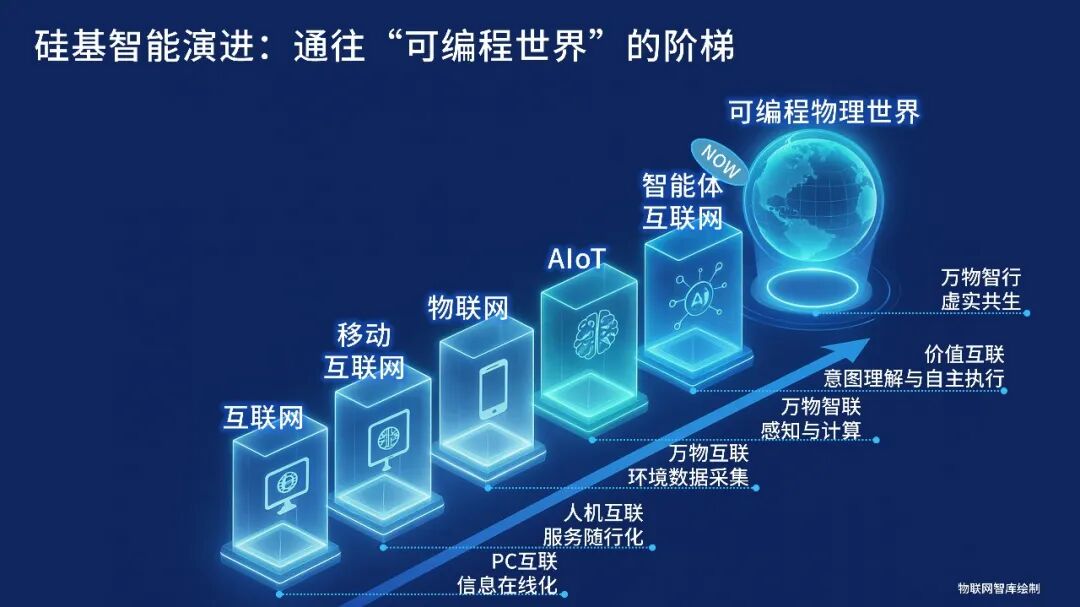
Core Insights - The rise of AI does not threaten the Internet of Things (IoT); instead, it emphasizes the importance of IoT as a foundational infrastructure for AI applications [1] - The concept of "intelligent agent internet" is emerging, where IoT devices evolve from passive data terminals to active intelligent partners that can collaborate and deliver results [1][8] - The evolution of digital technology over the past 30 years has been marked by five key phases, each addressing limitations of the previous one, ultimately aiming to dissolve the boundaries between the digital and physical worlds [2][4][5][6][7] Evolution of Digital Technology - The 1990s saw the digitalization of information through the internet, allowing access to knowledge previously limited by physical location [4] - The launch of the iPhone in 2007 marked the beginning of mobile internet, connecting people and enabling services to be accessed anytime, anywhere [5] - The development of IoT in the mid-2000s allowed physical objects to communicate through data, creating a digital twin of the physical world [6] - The AIoT era began in 2016, where AI enhanced IoT devices with cognitive capabilities, although they remained largely reactive [7] - By 2025, the intelligent agent internet will enable devices to understand intent and collaborate autonomously, marking a significant shift in how technology interacts with users [8] The Future of IoT - IoT is predicted to further sink into the background, becoming the digital foundation for AI applications, akin to how electricity operates invisibly yet fundamentally [13][16] - By 2025, global data volume is expected to reach 213.56 ZB, with a significant portion generated by IoT devices, highlighting their role as data supply bases for AI [14] - The value of IoT is increasingly realized through AI, with B2B applications contributing approximately 65% of its total value, often hidden beneath the surface [15] - IoT is transitioning from a connection layer to a foundational layer, becoming integral to AI's functionality and data processing [16] Intelligent Agent Economy - The concept of "liquid physical capabilities" suggests that services will no longer be confined to specific applications but will be modular and combinable based on user intent [21] - Companies must adapt to a new competitive landscape where interoperability and open protocols are crucial for being recognized and utilized by intelligent agents [22] - The focus for IoT companies is shifting from controlling user entry points to enhancing their infrastructure and ensuring their devices are easily accessible to intelligent agents [23] Conclusion - The ultimate success of IoT will be its seamless integration into the digital ecosystem, functioning as an invisible yet essential infrastructure, much like the electrical grid today [24]

宜丰朗卓科技有限公司成立 注册资本10万人民币
Sou Hu Cai Jing· 2025-12-10 03:33
Group 1 - The core point of the article is the establishment of Yifeng Langzhuo Technology Co., Ltd., which focuses on various aspects of the Internet of Things (IoT) [1] - The legal representative of the company is Liu Taofeng [1] - The registered capital of the company is 100,000 RMB [1] Group 2 - The business scope includes sales of IoT devices, IoT application services, and IoT technology research and development [1] - The company also offers internet data services, technical services, and professional design services [1] - Additional services include technology development, consulting, communication, transfer, promotion, and sales of electronic special materials [1]
Samsara Reports Better-Than-Expected Q3 Results: Details
Benzinga· 2025-12-04 22:16
Core Insights - Samsara, Inc. reported third-quarter earnings of 15 cents per share, exceeding analyst expectations of 12 cents [2] - The company achieved quarterly revenue of $415.98 million, surpassing the Street estimate of $398.47 million and showing a significant increase from $321.98 million in the same period last year [2] Financial Performance - Samsara ended Q3 with an Annual Recurring Revenue (ARR) of $1.75 billion, reflecting a 29% year-over-year growth in actuals and in constant currency [4] - The company has 2,990 customers with ARR over $100,000, which includes an increase of 219 customers in the third quarter [4] - There are 164 customers with ARR over $1,000,000, with an increase of 17 customers in the third quarter [4] - The company achieved its first quarter of GAAP profitability [4] Management Commentary - CEO Sanjit Biswas highlighted the strong quarter of durable and efficient growth, attributing the momentum to partnerships with major physical operations organizations [3]


唐山潘硕科技有限公司成立 注册资本5万人民币
Sou Hu Cai Jing· 2025-12-02 21:11
Core Insights - Tangshan Panshuo Technology Co., Ltd. has been established with a registered capital of 50,000 RMB and is represented by Liu Zhihui [1] Company Overview - The company operates in various sectors including new material technology promotion, IoT technology research and development, sales of graphite and carbon products, and sales of electronic components and electromechanical equipment [1] - Additional business activities include sales of electrical instruments, micro motors and components, power electronic components, smart manufacturing equipment, and artificial intelligence application system integration services [1] - The company is also involved in the sales of refrigeration and air conditioning equipment, mechanical equipment, and parts, as well as providing installation services for general mechanical equipment [1] - It has the capability for import and export of goods and technology, except for projects that require approval by law [1]
物联网企业拟从OTC转板到纽交所美国板块上市,计划募资1500万美元
Sou Hu Cai Jing· 2025-12-01 08:52
提供物联网硬件、软件和连接解决方案的Direct Communication Solutions于上周五(11月28日)向美国 证券交易委员会(SEC)提交文件,计划通过首次公开募股(IPO)筹集至多1500万美元。该公司目前 在OTC市场、CSE和法兰克福证券交易所上市,股票代码分别为"DCSX"、"DCSI"和"7QU0"。该公司此 前曾于2022年7月提交在纽约证券交易所美国板(NYSE American)上市的申请,但于2023年10月撤回 了招股说明书。 定价条款未予披露。 Direct Communication Solutions为车队管理、零售POS、能源和公用事业等多个行业提供4G/5G物联网传 感器硬件、基于SaaS的平台和托管连接解决方案。该公司与Verizon、United States Cellular、Synnex和 Hyperion Partners等公司建立了设备部署合作伙伴关系,并提供包括MiFleet、MiSensors和视频远程信息 处理在内的平台。其解决方案为庞大的客户群提供实时数据洞察、预测性维护和全球连接。 这家总部位于加州圣地亚哥的公司成立于2006年,截至202 ...

美国IPO一周回顾及前瞻:感恩节假期,上周仅有2家企业上市,5家企业递交申请
Sou Hu Cai Jing· 2025-12-01 08:52
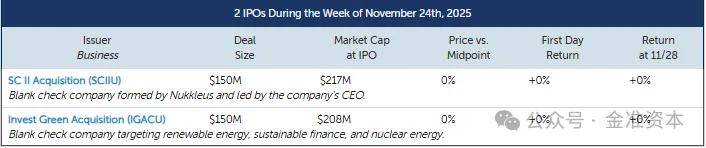
Group 1 - The US IPO market experienced a quiet week due to the Thanksgiving holiday, with two blank check companies going public and several others filing initial applications [1][3] - Soulpower Acquisition announced a merger with SWB Holdings, with a proposed valuation of $8.1 billion, marking one of the largest merger announcements of the year [1] - Two SPACs completed pricing, with Invest Green Acquisition raising $150 million and SC II Acquisition also raising $150 million, both focusing on renewable energy [1] Group 2 - Three SPACs filed for initial public offerings, including Mountain Lake Acquisition II aiming to raise $261 million, Vine Hill Capital II targeting $175 million, and Social Commerce Partners seeking $100 million [2] - Edison Oncology Holding submitted an IPO application to raise $25 million, while Direct Communications Solutions aims to raise $15 million [1][2] - The IPO market is expected to remain relatively calm at the beginning of December, with no pricing plans for the upcoming week, although some issuers may still complete pricing before year-end [3] Group 3 - Medline is anticipated to be a focal point in the IPO market, with an expected raise of $5 billion, which would be the largest IPO in the US since 2021 [3][4] - Other notable potential listings include Klook, Grayscale, and York Space Systems, which have recently submitted preliminary applications [4] - Companies like Hornbeck Offshore Services, Cardinal Infrastructure, and Andersen Group have updated their prospectuses and may go public before the end of the year [4]
Direct Communication Solutions(DCSX.US)申请转板至纽交所美交所,拟融资1500万美元
智通财经网· 2025-12-01 08:30
这家总部位于加利福尼亚州圣迭戈的公司成立于2006年,在截至2025年9月30日的12个月内录得900万美 元营收。Direct Communication Solutions曾于2022年9月9日秘密提交上市申请。公司计划以代码DCSX在 纽交所美国交易所上市。Revere Securities和Chaince Securities担任此次交易的联合簿记管理人。公司暂 未披露定价条款。 该公司目前在美国场外交易市场(OTC)、加拿大证券交易所和法兰克福证券交易所上市,股票代码分别 为"DCSX"、"DCSI"和"7QU0"。该公司曾于2022年7月申请转板至纽交所美国交易所,但随后于2023年 10月撤回了招股说明书。 智通财经APP获悉,物联网硬件、软件及连接解决方案提供商Direct Communication Solutions(DCSX.US) 于上周五向美国证券交易委员会提交文件,计划通过首次公开募股筹集至多1500万美元资金。 Direct Communication Solutions为车队管理、零售门店的智能销售与运营系统以及能源和公用事业等多 个行业提供4G/5G物联网传感器硬件、基于Sa ...
2025年度世界物联网大会万物智联数字经济优秀案例公布
Huan Qiu Wang Zi Xun· 2025-12-01 06:36
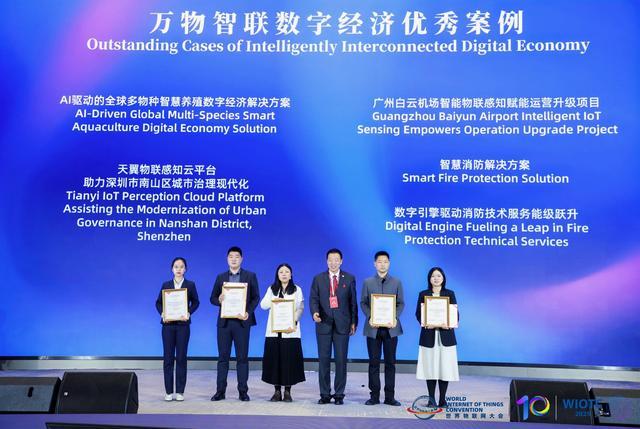
Group 1 - The "Smart Firefighting Solution" developed by the Shanghai branch of the China Quality Certification Center won the "2025 World IoT Conference Excellent Case in Digital Economy" award, recognizing innovative practices in the field [1][3] - The solution integrates system construction, standard norms, and new technology applications, creating a dynamic risk assessment system based on standardized fire management, covering the entire process from data collection to intelligent early warning and collaborative disposal [3] - The World IoT Conference is a significant international event in the IoT field, and this award signifies international recognition of the Shanghai branch's achievements in the integration of IoT and firefighting innovation [3] Group 2 - The Shanghai branch plans to leverage the technology and service network of the China Quality Certification Center to promote the digital and intelligent transformation of fire governance, contributing to high-quality industry development [3]
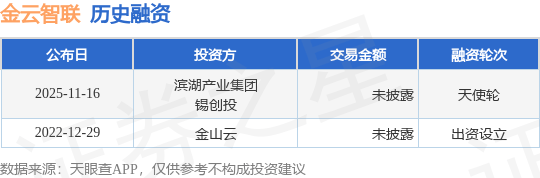
【投融资动态】金云智联天使轮融资,投资方为滨湖产业集团、锡创投等
Sou Hu Cai Jing· 2025-11-19 11:32
Group 1 - The core viewpoint of the news is the angel round financing of Wuxi Jinyun Zhiliang Technology Co., Ltd., with undisclosed financing amount and participation from Binhu Industrial Group and Xichuang Investment [1][2] - Jinyun Zhiliang was established in 2023 and is recognized as a leading AIoT-based IoT platform service provider under Kingsoft Cloud, holding over 60 invention patents [2] - The company offers comprehensive solution capabilities covering various scenarios including real estate, hotels, residential areas, parks, buildings, and offices, focusing on integrated solutions of design, technology, and ecology for enterprise clients [2]

Xiaomi's Strategic Expansion into EV and IoT Markets Fuels Financial Growth
Financial Modeling Prep· 2025-11-19 07:00
Core Insights - Xiaomi is a leading technology company based in Beijing, recognized as the world's third-largest smartphone maker, with diversification into the electric vehicle (EV) and Internet of Things (IoT) markets contributing to its financial performance [1] Financial Performance - On November 18, 2025, Xiaomi reported an earnings per share (EPS) of $0.06, exceeding the estimated EPS of $0.05, indicating higher profitability than analysts expected [2][6] - The company's actual revenue was approximately $15.89 billion, which fell short of the estimated $18.46 billion [2] - Xiaomi's net profit more than doubled to 12.27 billion yuan (about $1.73 billion), a significant increase from the previous year's net profit of 5.35 billion yuan, driven by robust EV and IoT businesses [3][6] - The third-quarter revenue saw a 22.3% increase, showcasing growth potential from the EV market [3] Financial Metrics - Xiaomi's price-to-earnings (P/E) ratio is approximately 27.43, indicating that investors are willing to pay a premium for its earnings [4] - The price-to-sales ratio and enterprise value to sales ratio both stand at about 2.31, reflecting the company's market value relative to its sales [4] - The enterprise value to operating cash flow ratio is around 15.25, indicating the company's valuation in relation to its cash flow from operations [4] Financial Health - The earnings yield is about 3.65%, providing a return on investment relative to earnings [5] - The debt-to-equity ratio is around 0.14, suggesting a relatively low level of debt compared to equity, which is favorable for financial stability [5][6] - The current ratio of approximately 1.29 indicates that Xiaomi has a reasonable level of liquidity to cover its short-term liabilities [5]