
物联网设备

Search documents
小米集团20260324
2026-03-26 13:20
Summary of Xiaomi Group Conference Call Company Overview - **Company**: Xiaomi Group - **Date**: March 24, 2026 Key Points Industry and Market Dynamics - **Storage Chip Market**: Entering a long-term price increase cycle, with significant adjustments expected by 2027 due to rising costs driven by AI demand and supply constraints. This will heavily impact smartphones, tablets, and PCs [2][3] - **Automotive Business**: Targeting 550,000 vehicle deliveries in 2026, with 60% of locked orders from iPhone users. The penetration rate of payment plans has reached 60%, with higher conversion rates among women and Apple users compared to previous models [2][4] - **IoT Business Expansion**: Plans to double overseas stores from 4,500 to 10,000 by 2026, leveraging a market potential six times larger than the domestic market [2][6] Financial and Investment Strategy - **R&D and Capital Expenditure**: A planned expenditure of 60 billion over the next three years, with approximately 16 billion allocated for R&D in 2026, focusing on AI large models, humanoid robots, and self-developed chip platforms [2][5] - **AI Strategy**: 2026 is positioned as a year of application explosion for AI, with self-developed AI entities integrated into the ecosystem. Current focus is on technology iteration without specific KPIs set [2][5] Competitive Advantages and Risk Management - **Supply Chain Management**: The company has established strong long-term partnerships with global memory suppliers, mitigating supply interruption risks. Inventory levels have been proactively increased to counteract rising memory prices [3][4] - **Product Diversification**: A diverse product portfolio helps to spread risk, with home appliances less affected by memory price increases compared to smartphones and electric vehicles [3][4] Sales and Performance Metrics - **Sales Data Disclosure**: The company has shifted to reporting locked contract orders instead of specific model data, which is seen as a more reliable measure of performance. The initial sales of new models have been strong, with over 30,000 locked orders within three days of launch [4][6] - **Profitability in IoT and Automotive**: The IoT business is expected to see significant growth, particularly in high-end markets, while the automotive sector has already achieved profitability in 2025, with optimistic projections for 2026 despite market pressures [6][7] Challenges and Strategic Responses - **Cost Pressures**: Rising storage chip prices pose challenges, particularly for smartphones and laptops. The company may need to adjust pricing if internal cost absorption is insufficient [3][7] - **Geopolitical Impact**: The recent Middle East situation has minimal direct impact on the company's overall business, although some raw material costs have been affected [7] Future Outlook - **AI and Chip Development**: Continued investment in AI and chip development is planned, with no reduction in chip business funding despite increased R&D spending. The chip business is viewed as a long-term strategic platform [8] - **Market Positioning**: The company aims to maintain its market position while balancing pricing strategies across different product categories, ensuring that strong product innovation can offset cost increases [8]

印尼电信市场新规实施,第一太平资产投产与宏观经济动向引关注
Jing Ji Guan Cha Wang· 2026-02-18 16:51
Industry Policy and Environment - The Indonesian Ministry of Communication and Information Technology issued Ministerial Regulation No. 469 on December 7, 2025, mandating that 187 types of telecommunications products must obtain DJID certification to enter the market, affecting smart appliances, IoT devices, and consumer electronics. This regulation will be enforced in 2026, impacting compliance progress and market adaptability of telecom equipment suppliers [1]. - Indonesia's GDP growth was 5.11% in 2025, with Q4 growth reaching 5.39%, exceeding expectations. Economic performance in 2026 will be influenced by the effectiveness of fiscal policies, commodity price fluctuations, and central bank monetary policies. Capital Economics predicts a potential 75 basis point rate cut by the central bank, which could enhance market liquidity [3]. - A trade agreement between Indonesia and the United States has reduced some export uncertainties, but concerns over commodity price volatility and fiscal sustainability may still affect market sentiment. Continuous monitoring is required to assess whether infrastructure investments, including telecommunications, are supported by fiscal expansion policies [5]. Company Project Progress - The Silangan copper-gold project under First Pacific is expected to commence production in Q1 2026, potentially releasing profit elasticity during a strong cycle in non-ferrous metal prices. Additionally, PLDT's fintech platform, Maya, achieved semi-annual profitability in 2025, with a focus on user growth and commercialization deepening in 2026 [2]. Industry Status - Global operators are accelerating resource allocation towards emerging fields such as computing networks and 6G research. As an emerging market in Southeast Asia, Indonesia's telecom operators need to be closely monitored for their progress in 5G coverage, green data center initiatives (e.g., PUE below 1.25), and AI computing power deployment [4].

印尼电信板块2026年初动态:基建项目与监管政策成焦点
Xin Lang Cai Jing· 2026-02-14 14:35
Company Projects - The PASELA submarine cable system construction has commenced, with China Huahai Communication Technology Co., Ltd. announced to undertake the project for Telkom Indonesia. The system spans over 1,100 kilometers, connecting South Papua and Maluku provinces, and is expected to be commercially operational by Q3 2027, significantly enhancing communication capacity and network resilience in Eastern Indonesia [2]. Policy and Regulation - The mandatory certification list for telecom products has come into effect, as announced by the Indonesian Ministry of Communication and Informatics on December 7, 2025. A total of 187 categories of telecom and telecom-enabled products, including smart appliances with Wi-Fi, IoT devices, and drones, must obtain DJID certification to enter the market. This regulation addresses a gap in the certification system and imposes new compliance requirements on equipment suppliers [3]. Industry Status - Indonesia, as the fourth most populous country in Southeast Asia with a projected population of 281 million in 2024, has a promising digital economy outlook. From January to September 2025, investments from China (including Hong Kong) in Indonesia reached $12.7 billion, accounting for 31.6% of total foreign investment, with telecom and data center infrastructure being key focus areas. Additionally, the Indonesian stock market performed strongly in 2025, with the Jakarta Composite Index showing an annual increase of nearly 22%, marking the best performance in 11 years, and a significant rise in local retail investor participation [4]. Strategic Initiatives - Global operators are deepening their local presence, exemplified by China Mobile International's leadership in the SEA-H2X international submarine cable project, which began construction on the Hong Kong segment in 2025 and is expected to be completed within the year. China Mobile International possesses over 90 submarine and terrestrial cable resources in Indonesia and surrounding regions, with international business revenue increasing by 18.4% year-on-year in the first half of 2025, reflecting strong regional interconnectivity demand. In the short term, the advancement of the PASELA submarine cable and the implementation of the DJID certification policy are direct factors influencing the Indonesian telecom supply chain and operators' capital expenditures. In the medium to long term, attention should be paid to the sustainability of foreign investment in digital infrastructure and the impact of local retail investors on market liquidity [5].
华强北,为什么能持续产生硬件创新?
虎嗅APP· 2026-02-10 14:12
Core Viewpoint - The article explores why Huaqiangbei, a district in Shenzhen, can continuously produce hardware innovations with minimal venture capital involvement, contrasting it with the Silicon Valley model that relies heavily on venture capital funding [4][6][18]. Group 1: System's Minimum Unit - Huaqiangbei is often referred to as "China's Electronics First Street," characterized by a vast network of trade, solution providers, and factories, functioning as a large API interface [10][12]. - The minimum unit in Huaqiangbei consists of sharp traders, solution companies, supporting factories, and a network of trust, allowing for a "Lego-style" survival philosophy where components can be easily assembled [13][14]. - This "physical open-source" approach lowers the hardware development barrier, enabling non-technical entrepreneurs to thrive [14][15]. Group 2: Why VC Fails Here - The business model in Huaqiangbei inherently rejects the venture capital logic due to different return cycles and exit mechanisms [18][22]. - Entrepreneurs in Huaqiangbei prioritize cash flow and quick returns, often completing product cycles in a matter of weeks or months, which does not align with the long-term investment horizon of VCs [22][24]. - A unique distributed financial system based on "familiar credit" allows entrepreneurs to leverage supplier credit and customer deposits to fund operations, bypassing traditional capital requirements [23][24]. Group 3: Innovation Funnel and Market Dynamics - Huaqiangbei's innovation logic is based on survival of the fittest, where low barriers to entry lead to a high volume of product experimentation [32][34]. - The market acts as the ultimate judge, with a rapid feedback loop that results in a high failure rate (95% of products) and a few successes that can become major hits [37][38]. - Unlike Silicon Valley, which reduces uncertainty through lab testing, Huaqiangbei eliminates it through market trials and rapid iteration [38]. Group 4: The Role of Chaos - Huaqiangbei's chaotic environment, often criticized for producing "high copies," is actually a source of its vitality, allowing for rapid innovation without stringent regulations [42][44]. - The lack of strict order fosters a low-cost environment for innovation, enabling entrepreneurs to test ideas quickly and adapt based on market response [45][46]. - This chaotic ecosystem has historically contributed to the development of a robust supply chain and skilled workforce in China, despite its controversial reputation [48]. Group 5: Future Challenges - Looking ahead to 2026, Huaqiangbei faces challenges from the hollowing out of hardware value due to the rise of AI and cloud computing, which may render traditional hardware innovation less relevant [56][57]. - The emergence of digital supply chain platforms could threaten Huaqiangbei's role as an intermediary, raising questions about the future of its business model [58][59]. - Despite these challenges, Huaqiangbei is evolving from a product-selling hub to a capability-selling entity, positioning itself as a global hardware innovation factory [60][61].


别再互怼:消费与科技从来不是二选一,而是共生共荣
Sou Hu Cai Jing· 2026-02-06 03:16
Core Argument - The article emphasizes the interdependence of technology and consumption in driving economic stability and growth, arguing against the binary opposition that pits one against the other [1][5]. Group 1: Economic Foundation - A solid economic foundation is essential for any ambitious technological blueprint, as technology development requires continuous investment in various areas such as R&D, talent cultivation, and equipment procurement [2]. - High-quality consumer brands, exemplified by Moutai, represent a stable economic base that supports local infrastructure, social investment, and industry transitions, thereby providing funding for technological research [2][4]. Group 2: Global Perspective - The article critiques the "tech-only" narrative by highlighting that successful economies, like the U.S., have a balanced structure that includes both technology giants and resilient consumer brands, which together enhance economic resilience [3]. - The U.S. technology dominance is supported by a robust consumer market and stable fiscal conditions, which enable sustained high levels of R&D investment [3]. Group 3: Domestic Context - The relationship between technology and consumption is reciprocal; advancements in technology drive consumer upgrades, while a large domestic market is necessary for the monetization of technological innovations [4]. - Traditional consumption sectors, such as the liquor industry, contribute significantly to economic stability and development, supporting agriculture, logistics, and local employment [4]. Group 4: Industry Dynamics - A healthy industrial landscape is characterized by a dual-driven approach where technology acts as a spear and consumption as a shield, ensuring economic resilience and social welfare [5]. - The article calls for a balanced view that recognizes the importance of both technology breakthroughs and consumer support in achieving long-term economic stability and growth [5].

普朗克(烟台)机器人有限公司成立,注册资本500万人民币
Sou Hu Cai Jing· 2026-02-04 06:11
Group 1 - The establishment of Plank (Yantai) Robot Co., Ltd. has been registered with a legal representative named Li Yuliang and a registered capital of 5 million RMB [1] - Beijing Plank Intelligent Equipment Co., Ltd. holds 100% ownership of Plank (Yantai) Robot Co., Ltd. [1] - The business scope includes research and development of intelligent robots, manufacturing and sales of security equipment, service consumer robots, and various technology services [1] Group 2 - The company is classified under the manufacturing industry, specifically in the specialized equipment manufacturing sector, focusing on electronic and electrical machinery [1] - The registered address of the company is located at 964 Yongda Street, Fuxin Street, Fushan District, Yantai City, Shandong Province [1] - The company is a limited liability company with a business duration until February 3, 2026, with no fixed term thereafter [1]

数据泄露不是电影情节,国安部发布公民数据安全防护全攻略
Xin Lang Cai Jing· 2026-02-03 23:55
Core Insights - The rapid advancement of technologies such as artificial intelligence, big data, and the Internet of Things is significantly transforming lifestyles, production methods, and national governance systems. However, this innovation also brings a critical risk: data breaches, which can lead to the loss of personal privacy, core assets, and business secrets, as well as expose national security to unknown risks [1] Group 1: Data Security Risks - Recent incidents highlight the urgent need for data security measures, including a March 2023 case where a backend cache vulnerability led to the exposure of sensitive user information from an AI software service [2] - In February 2025, a database leak from an IoT company resulted in the exposure of millions of records, including Wi-Fi passwords and email addresses, due to inadequate protection [2] - As of February 2025, over 2,000 phishing websites impersonating DeepSeek have emerged, misleading users to steal personal information or subscription fees [2] Group 2: Personal Data Security Checklist - Recommendations for securing network devices include changing default passwords and regularly updating firmware for smart home devices [3] - Personal information protection measures suggest avoiding inputting sensitive data into AI software and using password protection for important files [3] - Guidelines for safe online behavior emphasize verifying website security during online shopping and being cautious of suspicious messages [3] Group 3: Security Practices - Basic security practices include changing default passwords to strong ones and enabling two-step verification for accounts [4][5] - Users are advised to verify suspicious requests for money or verification codes by contacting official customer service [4] - Caution is recommended when using software, emphasizing the importance of downloading applications from official channels and using privacy modes during sensitive interactions [5]
科技便利背后的“暗礁” 数据泄露已成现实而非电影情节
Yang Shi Xin Wen· 2026-02-03 22:52
Group 1 - The core viewpoint of the articles emphasizes the rapid advancement of technology and the accompanying risks of data breaches, which can jeopardize personal privacy, core assets, and national security [1][2] - Recent incidents highlight the urgency of data security, including a significant AI service disruption in March 2023 due to a backend cache vulnerability, leading to the exposure of sensitive user information [4] - By February 2025, over 2,000 phishing websites imitating DeepSeek were reported, exploiting similar domain names to mislead users and steal personal information [4] Group 2 - A checklist for citizens regarding data security includes changing default passwords on routers and smart devices, regularly updating firmware, and protecting important files with password encryption [5][7] - Recommendations for enhancing digital security include using strong passwords, enabling two-step verification for accounts, and being cautious with online shopping and payment processes [9][10] - The importance of verifying suspicious communications and using official channels for software downloads is stressed to avoid falling victim to scams [12][13]

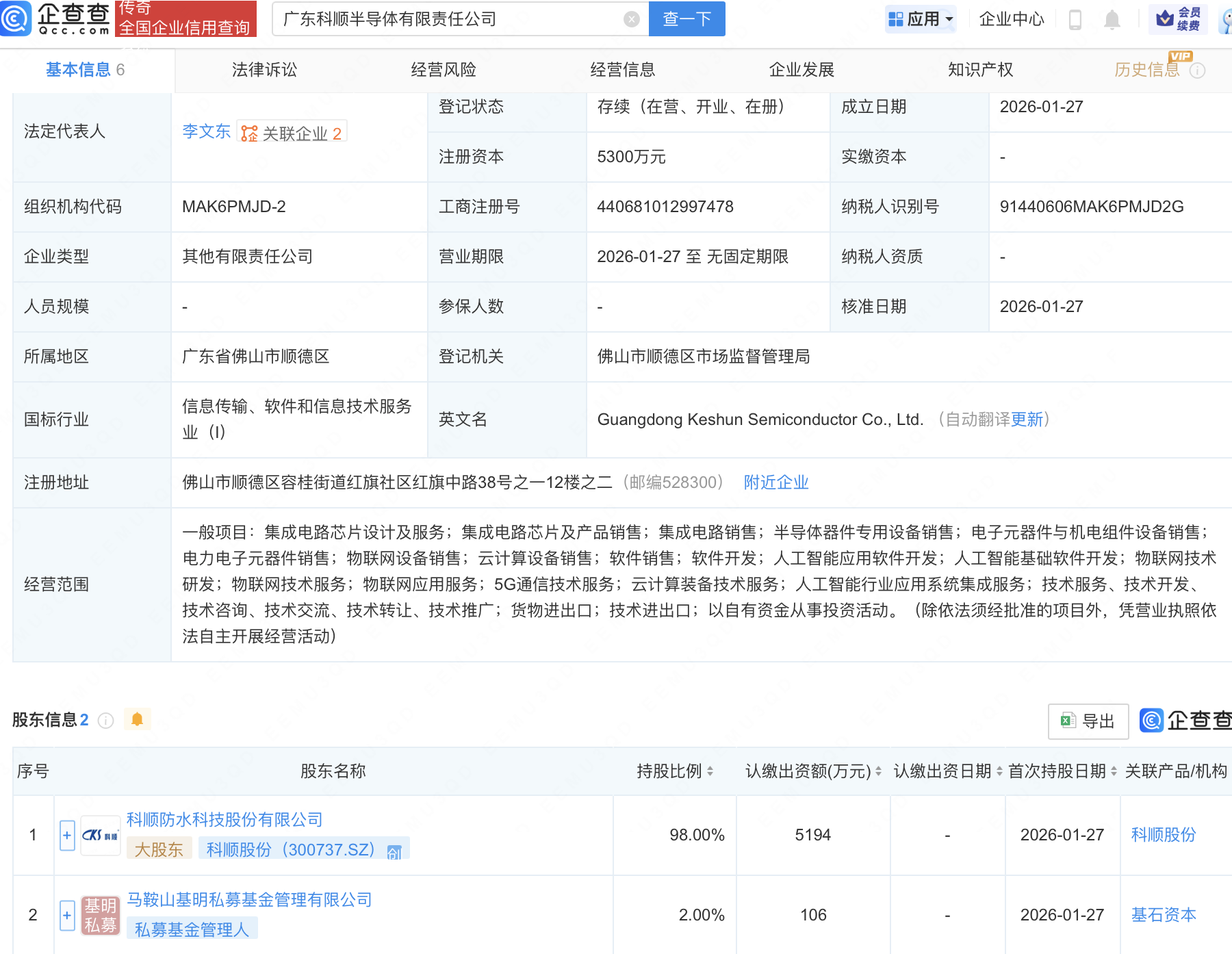
科顺股份等成立半导体公司,含AI及物联网业务
Qi Cha Cha· 2026-01-30 06:37
Group 1 - The core point of the news is the establishment of Guangdong Keshun Semiconductor Co., Ltd. with a registered capital of 53 million yuan, focusing on integrated circuit chip sales, semiconductor device sales, AI application software development, and IoT technology research and development [1][2]. - The company is co-owned by Keshun Co., Ltd. (300737) and other shareholders, with Keshun Co., Ltd. holding a significant 98% stake [3]. - The business scope includes various projects such as integrated circuit chip design and services, sales of power electronic components, and cloud computing equipment sales [2]. Group 2 - The company is registered in Shunde District, Foshan City, Guangdong Province, and is classified under the information transmission, software, and information technology services industry [2]. - The legal representative of the company is Li Wendong, and it is currently in operation with a business term extending until January 27, 2026, with no fixed end date [2]. - The company is positioned to engage in advanced technology services, including 5G communication technology services and IoT application services [2].
南京星通智联科技有限公司成立,注册资本3000万人民币
Sou Hu Cai Jing· 2026-01-27 18:30
Core Viewpoint - Nanjing Xingtong Zhiliang Technology Co., Ltd. has been established with a registered capital of 30 million RMB, fully owned by Zhejiang Xingtong Zhiliang Technology Co., Ltd. [1] Company Information - Company Name: Nanjing Xingtong Zhiliang Technology Co., Ltd. [1] - Legal Representative: Zhang Lijun [1] - Registered Capital: 30 million RMB [1] - Shareholder: Zhejiang Xingtong Zhiliang Technology Co., Ltd. (100% ownership) [1] - Company Type: Limited liability company (wholly owned by a natural person) [1] - Business Duration: Until January 27, 2026, with no fixed term thereafter [1] - Registration Authority: Nanjing Xuanwu District Market Supervision Administration [1] Business Scope - The business scope includes technology services, development, consulting, communication technology sales, artificial intelligence application software development, and data processing services [1] - Specific activities include software development, sales of computer hardware and software, IoT device sales, and artificial intelligence hardware sales [1] - The company operates in the scientific research and technical service industry, focusing on technology promotion and application services [1]