证券交易所
Search documents
London Stock Exchange Debuts Blockchain Platform for Private Funds
FinanceFeeds· 2025-09-15 14:26
Core Insights - The London Stock Exchange Group (LSEG) has launched its Digital Markets Infrastructure (DMI) platform, a blockchain-powered system for private funds, developed in collaboration with Microsoft [1][5] - The DMI platform aims to enhance liquidity and operational efficiency in the private markets, which are valued at over £1.2 trillion in the UK [4][7] Group 1: Platform Features and Clients - The DMI platform supports the entire lifecycle of digital assets, including issuance, tokenization, distribution, investment, and post-trade settlement [1] - Initial clients onboarded include MembersCap, Archax, and EJF Capital, with MembersCap's MCM Fund 1 executing the first transaction on the platform [2][5] - The platform's design integrates blockchain with traditional finance, utilizing LSEG's existing products for improved investor access [2] Group 2: Market Impact and Future Plans - The DMI platform is expected to broaden distribution, enhance capital-raising efforts, and improve liquidity for professional investors and asset managers [4][7] - LSEG plans to expand the DMI to other asset classes, with pilot transactions already in progress [8] - UK regulators have established frameworks for digital securities, facilitating secondary market liquidity and tax exemptions [8]
新交所黄耀龙:优化二次上市框架,配合中资企业走向国际市场
Sou Hu Cai Jing· 2025-09-15 11:40
Core Viewpoint - Singapore Exchange (SGX) aims to be a gateway for Chinese enterprises to globalize, with over 100 Chinese companies already utilizing SGX to access international markets [1] Group 1: SGX's Role and Strategy - SGX's Executive Vice President and Head of Equities, Loh Boon Chye, highlighted that many Chinese companies are not only pursuing IPOs on SGX but are also engaging in secondary listings to attract international investors [1] - The secondary listing framework allows companies to adhere to the rules of their primary listing location, facilitating the integration of secondary listings into their internationalization strategies [1] Group 2: Support for Chinese Companies - SGX has optimized its secondary listing framework, expanding its applicability to companies listed on Shanghai and Shenzhen stock exchanges, thereby supporting their global business development, particularly in Southeast Asia [1] - In addition to international investors, Southeast Asian institutional and family investors are significant factors driving A-share companies to choose SGX for secondary listings [1] - The funds raised in Singapore dollars or the stocks issued can be used as currency for acquiring international assets, enhancing the influence of Chinese brands in Southeast Asia [1]
纳斯达克证券代币化提案:SEC审批概率、时间线与全球资本市场重构
Sou Hu Cai Jing· 2025-09-15 11:13
Group 1 - Nasdaq's proposal to the SEC marks a significant shift from the "electronic bookkeeping era" to the "on-chain settlement era" in global capital markets [3] - The proposal aims to allow stocks and ETFs to trade in both traditional digital and tokenized forms, potentially rewriting the rules of global capital flow and efficiency [3][4] - The core objectives of the proposal include enhancing efficiency with T+0 real-time settlement, expanding trading hours to 24/7, and lowering barriers for small investors through tokenization [4] Group 2 - The technical design of the proposal focuses on compatibility with traditional systems while embedding blockchain technology, ensuring that tokenized securities share the same rights as traditional securities [5] - The regulatory framework does not break existing rules but integrates blockchain tools within the traditional system, maintaining compliance with AML and KYC processes [5] Group 3 - Institutional investors have shown positive feedback towards the proposal, with major firms like Goldman Sachs and Morgan Stanley initiating tokenized securities trading simulations [6] - A survey indicated that 62% of U.S. retail investors are willing to try tokenized stock trading, attracted by real-time settlement and 24/7 trading capabilities [6] Group 4 - The SEC's historical approval logic has shifted from risk-averse prohibition to compliance-guided openness, as evidenced by the approval of Bitcoin ETFs after a lengthy denial period [9][10] - The SEC's 2025 policy shift under new leadership has created a favorable regulatory environment for Nasdaq's proposal, emphasizing support for tokenization as a natural evolution of financial innovation [11][12] Group 5 - The approval timeline for Nasdaq's proposal is projected to conclude by mid-2026, with a high probability of approval exceeding 80% based on current policy support and market demand [15][8] - The anticipated impact on global capital markets includes a significant increase in trading volume and liquidity, with estimates suggesting a potential daily trading volume exceeding $3 billion upon launch [16][17] Group 6 - The tokenization of securities is expected to reinforce the dominance of the U.S. dollar in global capital flows, with the use of dollar-pegged stablecoins facilitating cross-border transactions [19] - Global exchanges are likely to engage in a digitalization race, with Nasdaq's initiative prompting other markets, such as Hong Kong and the EU, to accelerate their own tokenization efforts [20] Group 7 - Emerging markets may face increased capital outflow pressures as tokenization lowers barriers for investors seeking to access U.S. markets, potentially exacerbating regulatory challenges [22] - Developed countries will experience competitive pressures in their capital markets, necessitating rapid advancements in their own tokenization processes to retain investor interest [23] Group 8 - The impact on China's capital markets includes potential capital outflow risks and intensified competition for technology company listings, as U.S. tokenization may attract Chinese firms seeking better financing opportunities [24][25] - Hong Kong's capital markets may face challenges in maintaining their status as an international financial hub, with the risk of capital diversion to tokenized U.S. securities [28][29]
北交所10月9日起全面使用“920”新代码
Sou Hu Cai Jing· 2025-09-15 07:01
Core Viewpoint - The Beijing Stock Exchange (BSE) will fully implement the "920" new code for existing listed companies starting from October 9, 2025, enhancing the identification and recognition of companies listed on the exchange [1][8]. Group 1: Implementation Details - The transition to the "920" code is part of a phased approach, with preparations having been underway since November 17, 2023, and the first phase involving new listings starting from April 22, 2024 [5][6]. - The BSE has conducted multiple network tests to ensure readiness for the code switch, which is now confirmed for October 9, 2025 [7]. Group 2: Benefits of the New Code - The introduction of the "920" code aims to eliminate confusion caused by the previous codes from the New Third Board, thereby improving the recognition of BSE-listed companies and differentiating them from New Third Board entities [8][9]. - The unified "920" code is expected to strengthen the BSE's identity as a platform for innovative small and medium-sized enterprises, potentially attracting more quality companies to the exchange [1][9]. Group 3: Market Impact - The transition to the "920" code is seen as a significant step in establishing the BSE's market position, facilitating a shift from niche to mainstream trading, and enhancing brand recognition [9]. - The continuity of the identity of listed companies and investor rights will be maintained during the transition, ensuring a smooth operational process for market participants [9].
香港交易所(00388):8月跟踪:海外流动性有望进一步提升,预计港股ADT延续强劲表现
Changjiang Securities· 2025-09-14 23:31
Investment Rating - The report maintains a "Buy" rating for the company [7] Core Insights - The company's PE ratio as of the end of August is 37.02x, positioned at the 52nd percentile historically since 2016, indicating a certain level of cost-effectiveness for allocation. It is expected that with the continuous enhancement of the mutual access policy in the Hong Kong capital market, liquidity in the Hong Kong stock market will continue to rise, leading to an increase in overall market activity and valuation. The company is projected to achieve revenues and other income of 30.3 billion, 33.2 billion, and 35.6 billion HKD for 2025-2027, with net profits attributable to shareholders of 19.4 billion, 20.6 billion, and 22.3 billion HKD, corresponding to PE valuations of 29.3, 27.7, and 25.4 times respectively [2][50]. Market Environment - The Hong Kong stock market continued its upward trend in August, driven by domestic policy support and expectations of interest rate cuts by the Federal Reserve. The Hang Seng Index and Hang Seng Tech Index increased by 25.0% and 27.0% respectively compared to the end of 2024. The average daily trading (ADT) for Hong Kong stocks in August was 279.1 billion HKD, reflecting a month-on-month increase of 6.2% and a year-on-year increase of 192.1% [10][15]. Business Segments - **Spot Market**: The overall Hong Kong stock market saw significant increases in trading activity, with the ADT for northbound trading reaching 322.8 billion HKD, up 45.2% month-on-month and 204.9% year-on-year. Southbound trading ADT was 155.2 billion HKD, reflecting increases of 7.4% month-on-month and 448.3% year-on-year [8][15]. - **Derivatives Market**: The average daily volume (ADV) for futures was 62.7 thousand contracts, with month-on-month and year-on-year increases of 9.6% and 5.3% respectively. The ADV for options was 96.2 thousand contracts, with increases of 2.1% month-on-month and 34.5% year-on-year [19]. - **Primary Market**: In August, the IPO scale in the Hong Kong stock market decreased month-on-month but increased significantly year-on-year, with a total of 6 new listings raising 5.4 billion HKD, a 73% decrease month-on-month but a 189% increase year-on-year [29][31]. Investment Income - As of the end of August, the HIBOR rates for 6 months, 1 month, overnight, and the US overnight bank funding rate were 3.27%, 3.30%, 4.00%, and 4.33% respectively, showing month-on-month increases but year-on-year declines for most rates [38].
北交所10月9日起将全面进入“920新代码”时代
Zhong Guo Zheng Quan Bao· 2025-09-14 20:14
Group 1 - The Beijing Stock Exchange (BSE) will switch to the new "920 code" for existing listed companies starting from October 9, 2025, enhancing the identification and recognition of listed companies [1][4] - The transition to the "920 code" is expected to strengthen the BSE's focus on specialized and innovative small and medium-sized enterprises, attracting high-quality companies to the exchange [1][4] - The code switch will not affect the continuity of the identity of listed companies, investor rights, or related business operations [5] Group 2 - The BSE has implemented a phased approach for the code switch, starting with new listings using the "920 code" from April 22, 2024, before transitioning existing companies [2][3] - The BSE has conducted multiple network tests to ensure readiness for the code switch, which is part of a broader effort to enhance market stability and investor confidence [3][5] - The introduction of the "920 code" is seen as a significant step in establishing the BSE's market position and differentiating it from the New Third Board, thereby attracting more investors [4]
新加坡交易所集团CEO罗文才:发挥连接中国与全球资本市场的关键桥梁作用
Shang Hai Zheng Quan Bao· 2025-09-12 18:42
Group 1 - The core viewpoint of the article highlights the increasing connectivity and cooperation between China and Singapore's capital markets, exemplified by the launch of the first Singapore dollar-hedged ChiNext ETF on the Singapore Exchange [2][3] - The Singapore Exchange (SGX) plays a crucial role as a bridge connecting Chinese and global capital markets, facilitating efficient participation for global investors in bilateral markets [3] - The SGX has seen a notable increase in international investor interest in the Chinese market, with a rise in trading activity across various asset classes, indicating a shift in investor sentiment towards China [4] Group 2 - The SGX has established a mechanism for cross-border ETF products, with 10 ETFs listed under this framework as of July, managing over 3 billion RMB in assets [4] - Key sectors attracting investor attention include artificial intelligence, new technologies, and consumer-related industries, reflecting the growing interest in China's advanced companies [5] - The SGX is focused on deepening cooperation with Chinese exchanges, with plans to launch more indices that track Asian growth potential, which may lead to additional ETF products [5] Group 3 - The SGX aims to support Chinese companies seeking to expand into Southeast Asia, positioning itself as a reliable platform for these firms to access international investors [6] - The ASEAN market is highlighted as a significant opportunity, projected to become the fourth-largest economy by 2030, with many Chinese companies actively pursuing this market [6] - The SGX has streamlined the IPO process, reducing the time from application to listing to approximately 6 to 8 weeks, enhancing certainty for applicants [6][7] Group 4 - Post-IPO, the SGX emphasizes ongoing investor relations and support for listed companies, ensuring long-term value growth through continuous engagement and market liquidity initiatives [8]
港交所 457元阻力位成多空焦點
Ge Long Hui· 2025-09-12 11:51
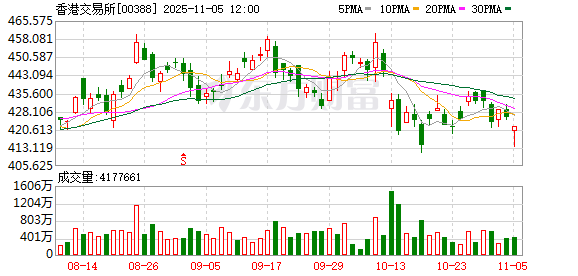
Core Viewpoint - Hong Kong Exchanges and Clearing Limited (HKEX) shows a stable technical trend with a slight pullback, indicating potential investment opportunities for conservative investors [1][3]. Technical Analysis - As of 10:17 AM, HKEX's stock price is at 442 HKD, down 0.58% [1]. - The Relative Strength Index (RSI) is at 55, indicating a healthy bullish zone [1]. - Moving averages (MA10 at 442.32 HKD, MA30 at 438.29 HKD, MA60 at 430.08 HKD) are in a bullish arrangement, providing strong support [1]. - Despite a "sell" signal from technical indicators, multiple oscillators show a neutral pattern, with MACD issuing a buy signal [1]. - Key support levels are identified at 435 HKD and 423 HKD, while resistance levels are at 457 HKD and a potential target of 466 HKD if broken [1]. Derivative Products Performance - On September 8, when HKEX's stock price rose by 1.93%, related derivative products performed well, with notable returns: 29% for the BNP Paribas call option (16781) and 26% for the UBS call option (16698) [3]. - HSBC's bull certificate (53124) and UBS's bull certificate (62570) achieved returns of 22% and 21%, respectively, demonstrating significant excess returns even in a moderate upward trend [3]. Investment Options - Investors are advised to focus on two quality call options: UBS call option (16698) with a strike price of 484.08 HKD offering 14x leverage and HSBC call option (17539) with the same strike price but 14.6x leverage, appealing to bullish investors [6]. - For bearish investors, UBS put option (18808) and Bank of China put option (18983) with a strike price of 368.48 HKD provide approximately 9x leverage, suitable for short positions [6]. Bull and Bear Certificates - Bull certificates from HSBC (65210) and UBS (55128) have a redemption price of 422 HKD, maintaining a safe distance from current prices, with actual leverage of 15.9x and 16.2x, respectively, making them attractive for low-cost leveraged investments [8]. - Bear certificates from UBS (60541) and Societe Generale (60816) have a redemption price of 470 HKD, offering leverage exceeding 16x, but investors are cautioned to manage positions carefully due to potential risks [8].
新交所集团CEO罗文才:国际投资者正以长远眼光看待中国资产
中国基金报· 2025-09-11 09:56
Core Viewpoint - The Singapore Exchange (SGX) aims to enhance the cross-border ETF connectivity with China, focusing on attracting Chinese companies with global strategies and promoting bilateral capital flow between the two markets [2][7]. Group 1: ETF Connectivity and Market Expansion - As of July 2025, the cross-border ETF connectivity mechanism has listed 10 cross-border ETF products with a total asset management scale exceeding 3 billion RMB [4][6]. - SGX plans to include more ETFs in the connectivity mechanism to broaden investment options and attract asset management companies from both China and Singapore [6]. - SGX and the Shanghai Stock Exchange are collaborating on developing indices related to core themes, industries, and large companies in Asia, aiming to convert these indices into ETF products [6]. Group 2: Support for Chinese Enterprises - SGX is committed to supporting Chinese companies in raising funds in international markets through secondary listings [7]. - The exchange welcomes Chinese enterprises seeking overseas expansion and financing opportunities, particularly targeting the growing middle-class consumers in Southeast Asia [11]. Group 3: International Investor Sentiment - International investors are increasingly viewing the Chinese market with a long-term perspective, driven by recent economic and capital market performance [8]. - There has been a notable increase in trading activity related to consumer sectors and REITs containing Chinese assets, with significant participation from institutional investors [9]. - The SGX has observed heightened interest from international investors in sectors such as industrial, consumer, and real estate recovery in China [9]. Group 4: Market Liquidity and Support Initiatives - The stock market transaction volume in Singapore has increased significantly, with a year-on-year growth of over 27% [12]. - The Monetary Authority of Singapore has launched various measures to improve market liquidity, including the EQDP plan aimed at enhancing the activity of small and mid-cap stocks [12]. - SGX has simplified the IPO application process, reducing the time from application to listing to approximately 6 to 8 weeks, providing greater certainty for applicants [12].
新交所集团CEO罗文才:国际投资者正以长远眼光看待中国资产
Zhong Guo Ji Jin Bao· 2025-09-11 09:23
Group 1 - The core viewpoint is that international investors are taking a long-term perspective on Chinese assets, with a focus on expanding the cross-border ETF connectivity between China and Singapore [1][3][4] - The Singapore Exchange (SGX) aims to attract Chinese companies with global strategies for secondary listings and to enhance capital flow related to Chinese concepts [1][3] - As of July 2025, the cross-border ETF mechanism has listed 10 products with a total asset management scale exceeding 30 billion RMB [2][4] Group 2 - SGX plans to include more ETFs in the connectivity mechanism to broaden investment options and attract asset management companies from both China and Singapore [2][3] - There is a focus on developing indices related to core themes and industries in Asia, with the goal of converting these indices into ETF products [2][3] - The SGX has observed a significant increase in trading activity related to Chinese assets, particularly in the consumer sector and REITs [4][5] Group 3 - The SGX has approximately 600 listed companies with a total market capitalization exceeding 600 billion USD, with about 20% of these companies coming from Greater China [3][4] - The STI index has a total return rate close to 18% in 2025, making it one of the best-performing indices in Southeast Asia [6] - The stock market trading volume has increased significantly, with a year-on-year growth of over 27% in the 2025 fiscal year [7]