
Transport

Search documents
Brookfield Infrastructure Partners(BIP) - 2025 Q2 - Earnings Call Transcript
2025-07-31 14:02
Financial Data and Key Metrics Changes - Brookfield Infrastructure Partners generated funds from operations (FFO) of $638 million or $0.81 per unit in Q2 2025, a 5% increase compared to the previous year, improving to a 9% increase when excluding foreign exchange effects [6] - The increase in FFO was primarily driven by strong organic growth and contributions from tuck-in acquisitions completed in the prior year [6] Business Line Data and Key Metrics Changes - Utilities segment generated FFO of $187 million, slightly ahead of the prior year, benefiting from inflation indexation and approximately $450 million of capital added to the rate base [7] - Transport segment's FFO was $304 million, slightly ahead of the prior year, supported by high asset utilization in global intermodal logistics and increased traffic levels on toll roads [8] - Midstream segment generated FFO of $157 million, representing a 10% increase over the same period last year, driven by strong organic growth [8] - Data segment's FFO was $113 million, a 45% increase compared to the prior year, driven by contributions from a tower portfolio acquisition in India and new capacity commissioning [9] Market Data and Key Metrics Changes - The Canadian energy sector is experiencing strong demand, with a significant increase in requested power demand from data centers in Alberta, rising from 200 megawatts to approximately 12 gigawatts [14] - Improved end market diversification with key Canadian infrastructure projects enhancing global market access, including LNG Canada ramping up production [15] Company Strategy and Development Direction - The company is focused on capital recycling and has secured $2.4 billion in sale proceeds to date, achieving an annual record for BIP [9] - Recent acquisitions include a leading fiber provider in the U.S. and a railcar leasing platform, with a total capital deployment of $1.3 billion [22][25] - The company aims to capture opportunities in the infrastructure super cycle driven by digitalization and AI [27] Management's Comments on Operating Environment and Future Outlook - Management expressed optimism about the current market conditions and the positive impact of AI infrastructure on business operations [32] - The Canadian midstream sector is expected to benefit from increased investor interest and organic growth opportunities [20] Other Important Information - The company has completed significant asset sales, including a 23% interest in an Australian export terminal and a partial sale of its UK Port operation, generating substantial proceeds [10][12] Q&A Session Summary Question: What prompted the acceleration in deal velocity? - Management noted that the increase in transaction activity is due to investors returning to the market, driven by strong capital markets and a positive outlook on operating conditions [32] Question: Are there opportunities to monetize partial stakes in Canadian midstream businesses? - Management indicated that while there are opportunities for partial sales, the focus remains on organic growth opportunities within the Canadian midstream sector [34][35] Question: What protections does Brookfield have in place for its investment in Intel's JV? - Management clarified that the arrangement with Intel is largely financial and contractual, minimizing commercial risks [41] Question: How should the potential impact of Class I railroad mergers be viewed? - Management highlighted that as the largest short line operator, they are well-positioned to maintain a competitive market and assist in the merger process [47] Question: Has the attractiveness of the U.S. as an investment geography expanded? - Management confirmed that the U.S. remains attractive due to the AI infrastructure boom, while also noting opportunities in other markets [52] Question: Are there plans to focus more on oil assets in midstream investments? - Management stated that while they continue to look at both gas and oil assets, most opportunities currently lie within existing portfolio expansions [71]

Brookfield Infrastructure Partners(BIP) - 2025 Q2 - Earnings Call Transcript
2025-07-31 14:00
Financial Data and Key Metrics Changes - Brookfield Infrastructure Partners generated funds from operations (FFO) of $638 million or $0.81 per unit in Q2 2025, representing a 5% increase year-over-year, which improves to a 9% increase when excluding foreign exchange effects [5] - The increase in FFO was primarily driven by strong organic growth and contributions from tuck-in acquisitions completed in the prior year [5] Business Line Data and Key Metrics Changes - Utilities segment generated FFO of $187 million, slightly ahead of the prior year, benefiting from inflation indexation and approximately $450 million of capital added to the rate base [6] - Transport segment's FFO was $304 million, slightly ahead of the prior year, supported by high asset utilization in global intermodal logistics and increased traffic levels on toll roads [6] - Midstream segment generated FFO of $157 million, a 10% increase year-over-year, driven by strong organic growth, particularly in Canadian diversified midstream operations [7] - Data segment's FFO was $113 million, a significant increase of 45% compared to the prior year, driven by acquisitions and new capacity commissioning [8] Market Data and Key Metrics Changes - The Canadian energy sector is experiencing strong demand, with a notable increase in power demand from data centers, particularly in Alberta, which has seen requests for approximately 12 gigawatts of power [14] - Improved end market diversification with key Canadian infrastructure projects enhancing global market access, including LNG Canada, which is set to ramp up production [15] - Canadian natural gas gathering and processing business has seen a 15% increase in utilization over the past two years [19] Company Strategy and Development Direction - The company is focused on capital recycling and has secured $2.4 billion in sale proceeds to date, achieving an annual record for BIP [8] - Recent investments include acquiring Hotwire, a leading provider of bulk fiber services, and a railcar leasing platform, indicating a strategy to expand in data transport and midstream segments [22][24] - The company aims to capture opportunities in the AI infrastructure boom, which is driving demand for power transmission and midstream investments [50] Management's Comments on Operating Environment and Future Outlook - Management expressed optimism about the current market conditions and the positive outlook for the Canadian midstream sector, driven by strong demand and investment interest [18] - The company anticipates strong EBITDA growth in its Canadian midstream platforms, with expected growth of CAD 650 million to 750 million between 2024 and 2027 [20] - Management noted that the U.S. remains an attractive investment geography, particularly due to the AI infrastructure boom [50] Other Important Information - The company has completed significant asset sales, including a 23% interest in an Australian export terminal and a 60% stake in a European data center portfolio, generating substantial proceeds [10][12] - The company is focused on integrating new acquisitions and initiating value creation activities post-acquisition [25] Q&A Session Summary Question: What has prompted the acceleration in deal velocity? - Management noted that increased market activity is due to investors returning to the market and strong capital availability, leading to more transactions [30] Question: Are there opportunities to monetize partial stakes in Canadian midstream businesses? - Management indicated that while there are opportunities for partial sales, the focus remains on organic growth opportunities in the midstream sector [32] Question: What protections does Brookfield have regarding the Intel JV? - Management clarified that the arrangement with Intel is largely financial and contractual, minimizing commercial risks [39] Question: How does the potential merger of Class I railroads impact Genesee and Wyoming? - Management highlighted that as the largest short line operator, they are well-positioned to maintain a pro-competitive market amidst potential mergers [44] Question: Has the attractiveness of the U.S. as an investment geography expanded? - Management confirmed that the U.S. remains attractive due to the AI infrastructure boom, with significant opportunities for capital deployment [50] Question: What is the outlook for midstream investments in oil versus gas? - Management stated that while they continue to explore both oil and gas opportunities, current focus is on investments within existing portfolio companies [69] Question: What is the approach to data center investments? - Management indicated a focus on both campus-style data centers and bespoke large-scale projects, depending on customer needs [70] Question: Is there interest in energy infrastructure companies with both traditional and renewable assets? - Management noted that such investments would depend on the specific situation, but collaboration across Brookfield's groups is common for sourcing and completing transactions [76]
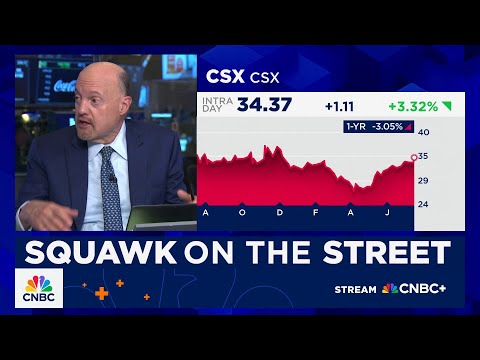
Cramer's Stop Trading: CSX
CNBC Television· 2025-07-17 14:23
Industry Outlook - The rail industry is performing well, with CSX having a strong quarter [1] - The capital equipment sector is expected to experience a boom due to legislation [3] - The transport sector is viewed positively [5] Company Performance - CSX's prospects are favorable, regardless of potential bids, due to improved conditions [2] - Norfolk Southern is favored due to a bullish outlook on industry and industrials [1] Investment Strategy - Recommends against selling rail or capital equipment companies [3] - The thesis of shorting transports based on limited cross-border trade is flawed due to underestimation of internal growth [4]


NTG Nordic Transport Group A/S - H1 2025 Conference Call
Globenewswire· 2025-07-14 06:00
Group 1 - NTG Nordic Transport Group A/S is set to release its H1 2025 interim results on August 11, 2025, in the evening [1] - A conference call will take place on August 12, 2025, at 10:00 am CET, where the Group CEO and CFO will present the financial report [1] - The presentation will be followed by a Q&A session for participants [1] Group 2 - Participants wishing to ask questions during the conference call must register through a provided link [2] - It is recommended for participants to dial in 10 minutes prior to the scheduled start time [2] - Contact information for Investor Relations is provided for further inquiries [2]

Brookfield Infrastructure to Host Second Quarter 2025 Results Conference Call
Globenewswire· 2025-06-30 11:00
Group 1 - Brookfield Infrastructure Partners will hold its second quarter 2025 conference call and webcast on July 31, 2025, at 9:00 a.m. (ET) [1] - Results will be released on the same day before 7:00 a.m. (ET) and will be available on the company's website [1] - Participants can join the conference call or webcast by pre-registering [1][4] Group 2 - Brookfield Infrastructure is a leading global infrastructure company that operates high-quality, long-life assets in various sectors including utilities, transport, midstream, and data across the Americas, Asia Pacific, and Europe [2] - The company focuses on assets with contracted and regulated revenues that generate predictable and stable cash flows [2] - Investors can access Brookfield Infrastructure's portfolio through Brookfield Infrastructure Partners L.P. or Brookfield Infrastructure Corporation [2] Group 3 - Brookfield Infrastructure is the flagship listed infrastructure company of Brookfield Asset Management, which manages over $1 trillion in assets [3]

汇丰:80 个数据点看世界,动力是否会暂时减弱?2025 年 5 月
汇丰· 2025-06-23 02:10
Investment Rating - The report maintains a "Buy" rating for Prysmian (PRY IM) with a target price of EUR74 and Emerson Electric (EMR US) with a target price of USD153, indicating positive investment opportunities in the capital goods sector [7][15][76][77]. Core Insights - The HSBC Global Composite Capex Lead Indicator declined to -30 in May 2025 from -7 in March 2025, reflecting a slowdown in global capital expenditure due to tariff volatility, although some sectors showed improvement [7][21]. - The FTSE World Industrials Index has shown resilience, increasing by 9% quarter-to-date despite geopolitical uncertainties and tariff-related challenges [7][14]. - The report highlights a potential for positive performance in the FTSE World Industrials over the next six months, supported by a reading of -30 in the lead indicator [7][21]. Summary by Sections Global Capex Outlook - The report forecasts global capex to reach approximately USD3.9 trillion in 2025, with sectors like Software, Airlines, and Computer Hardware expected to lead growth [23][24]. - The capital goods sector is experiencing varied performance across regions, with EMEA showing improvement while APAC and the Americas faced declines [7][31][35]. Regional Analysis - **Americas**: The capex lead indicator declined marginally to -36 in May 2025, with mixed performance across sectors; manufacturing improved while construction and utilities declined [31][32]. - **EMEA**: The capex lead indicator improved to -11 in May 2025, driven by early-cycle improvements in manufacturing and transport [33][34]. - **Asia Pacific**: The capex lead indicator fell to -40 in May 2025, primarily due to a significant decline in mainland China, although Japan showed some improvement [35][36]. Subsector Performance - **Manufacturing**: The lead indicator improved to +13 in May 2025, with positive trends in the Americas and EMEA, while mainland China declined [43][44]. - **Utilities**: The lead indicator rose significantly to +45 in May 2025, indicating strong growth in solar and gas generation investments [56][57]. - **Consumer**: The lead indicator improved slightly to -56 in May 2025, with low-level improvements in the Americas and EMEA, while Japan and mainland China saw declines [58][59]. Stock Recommendations - **Prysmian**: The company is well-positioned to benefit from US electrification trends and has a strong demand outlook in the T&D segment, justifying a Buy rating [68][69]. - **Emerson Electric**: The company is expected to benefit from a transformation towards automation and improved margins, leading to a Buy rating with a target price of USD153 [76][77].
Brookfield Infrastructure to Issue $250 Million of 30-Year Subordinated Notes
Globenewswire· 2025-05-13 22:22
Core Points - Brookfield Infrastructure Partners L.P. announced the issuance of $250 million in Fixed-to-Fixed Reset Rate Subordinated Notes due September 1, 2055, with an initial interest rate of 5.598% until September 1, 2030, and subsequent resets every five years [1][2] - The net proceeds from the offering will be used for general corporate purposes, including repayment of outstanding debt [1] - The Notes will be issued by Brookfield Infrastructure Finance ULC, a wholly-owned subsidiary, and are guaranteed on a subordinated basis by Brookfield Infrastructure and certain subsidiaries [2][3] Company Overview - Brookfield Infrastructure is a leading global infrastructure company that operates high-quality, long-life assets in utilities, transport, midstream, and data sectors across the Americas, Asia Pacific, and Europe [7] - The company focuses on assets with contracted and regulated revenues that generate predictable and stable cash flows [7] - Brookfield Infrastructure is the flagship listed infrastructure company of Brookfield Asset Management, which manages over $1 trillion in assets [8]

NTG Nordic Transport Group publishes interim report for Q1 2025
Globenewswire· 2025-05-12 15:34
Core Insights - NTG Nordic Transport Group has published its interim report for Q1 2025, indicating the company's financial performance during this period [1] - A conference call is scheduled for 13 May 2025 at 10:00 AM CEST to discuss the results, which will be available for live streaming on the company's website [1] Company Information - The interim report for Q1 2025 is attached to the announcement, providing detailed financial data and insights [2] - Contact information for investor relations is provided, including the head of investor relations, Sebastian Rosborg, along with his contact details [2]
2024年基础设施监测
Shi Jie Yin Hang· 2025-04-23 23:10
Investment Rating - The report indicates a positive investment outlook for infrastructure, particularly in developed markets, with a notable rebound in greenfield investments and a projected recovery in secondary market activities as interest rates decline [9][11][84]. Core Insights - Global private investment in infrastructure projects increased by 10 percent in 2023, primarily driven by developed markets, while low- and middle-income countries (LMICs) saw a slight decline [9][10]. - Infrastructure fundraising faced significant challenges in 2023, with total capital raised dropping to $94.9 billion, nearly half of 2022 levels, but is expected to stabilize in 2024 [18][84]. - Infrastructure debt remains attractive to investors due to its reliable cash flows and historically lower default rates compared to non-financial corporate debt, with a debt-to-equity ratio of 77 percent in 2023 [25][84]. - Renewable energy and transport sectors dominate infrastructure investment, accounting for two-thirds of total activity, with a significant surge in private investment in hydrogen projects [31][36]. - The report highlights a growing divergence in investment levels between high-income countries (HICs) and LMICs, with HICs experiencing a 15 percent increase in infrastructure investment in primary markets [45][46]. Summary by Sections Greenfield Investment - Greenfield investment in developed markets continues to rebound, while growth in emerging markets lags, with investment levels significantly higher than the five-year average [9][10]. Rising Interest Rates - Rising interest rates have tempered return expectations across most infrastructure fund types, leading to a significant decline in fundraising [17][18]. Infrastructure Resilience - Despite macroeconomic uncertainty, private infrastructure financing has maintained a stable debt-to-equity ratio, with infrastructure debt demonstrating lower default rates [25][84]. Policy and Incentives - Policy changes have influenced investor strategies, with renewable energy and transport consistently dominating investment, while digital infrastructure has gained importance [31][32]. Investment Gaps - There is a widening investment gap between HICs and LMICs, with LMICs representing less than 20 percent of overall volumes compared to 30 percent a decade ago [46][47]. Regulatory Frameworks - Strengthening regulatory frameworks is essential for attracting private capital in emerging markets, with improvements potentially increasing investment by approximately $500 million [54][58]. Development Institutions - Development institutions play a critical role in mobilizing private capital in LMICs, providing co-financing for 30 percent of total private investment [61][62]. Blended Finance - Blended finance and guarantees are effective tools for bridging investment gaps, with evidence showing that projects backed by guarantees have higher private commercial debt participation [65][67]. Local Currency Financing - Local currency financing for private investment in infrastructure projects in LMICs decreased to 37 percent in 2023, highlighting the need for stronger local markets [72][73]. Capital Markets - There is a growing shift towards leveraging domestic and international capital markets to mobilize long-term funding for infrastructure projects [78][79]. Conclusion - The report concludes that while private investment in infrastructure has faced volatility, it has shown resilience, particularly in the context of rising interest rates and macroeconomic uncertainty [83][84].