
在线零售

Search documents
印度大幅减税,莫迪:我们的敌人是……
Guo Ji Jin Rong Bao· 2025-09-22 07:33
Core Viewpoint - India has implemented a significant reform of the Goods and Services Tax (GST), simplifying the tax structure and expanding the tax-exempt range, aiming to boost domestic production and reduce reliance on foreign goods [1][2]. Tax Reform Details - The previous four-tier tax rate structure (5%, 12%, 18%, and 28%) has been simplified to two rates: 5% and 18% [2]. - The tax rate on daily necessities has been reduced from 18% to 5%, including items like toothpaste and shampoo [2]. - The tax rate on small cars, air conditioners, and televisions has been lowered from 28% to 18% [2]. - All goods and services tax on personal life and health insurance has been eliminated, and the GST compensation tax mechanism has been fully abolished [2]. Financial Impact - The Indian Finance Ministry estimates that this reform will lead to a combined revenue loss of approximately 480 billion rupees (about 39 billion yuan) for both central and state finances [3]. Political Context - The tax cuts are seen as a response to both internal and external pressures, particularly following the announcement of a 50% tariff on Indian goods by the U.S. [4]. - A report from Citibank suggests that this tariff could reduce India's GDP growth by 0.6 to 0.8 percentage points and has led to a withdrawal of $3 billion in foreign investment within a month [4]. - The reform is strategically aimed at the middle class, with an increase in the personal income tax exemption threshold to 1.2 million rupees, allowing 85% of taxpayers to avoid taxes [4]. Self-Reliance Emphasis - Prime Minister Modi emphasized the need for India to manufacture products domestically, stating that reliance on foreign goods undermines national dignity [5][6]. - He called for increased domestic production to ensure prosperity and stability, urging citizens to prioritize Indian-made products [5][6]. Economic Growth Outlook - The reform is expected to stimulate economic growth, which is currently insufficient to meet Modi's goal of transforming India into a developed nation by 2047 [7]. - The Indian economy is projected to grow at its slowest pace in five years for the fiscal year ending March 2026 [7].
美国8月零售销售环比增0.6%超预期 实际零售销售连续11个月增长
Hua Er Jie Jian Wen· 2025-09-16 13:56
Core Insights - US consumer spending showed unexpectedly strong momentum in August, with retail sales data increasing for the third consecutive month. Real retail sales adjusted for inflation grew by 2.1% year-over-year, marking the 11th consecutive month of positive growth [1][5]. Retail Sales Performance - August retail sales increased by 0.6% month-over-month, surpassing the expected 0.2% and the previous value of 0.5% [1]. - Retail sales excluding automobiles rose by 0.7%, exceeding the forecast of 0.4% and matching the prior month's growth [1]. - Retail sales excluding automobiles and gasoline also increased by 0.7%, again above the expected 0.4% [1]. Sector Contributions - The retail growth in August was broad-based, with 9 out of 13 major categories reporting increases. Online retailers, clothing stores, and sporting goods stores were the primary drivers, likely reflecting back-to-school shopping [3]. - The restaurant sector rebounded with a 0.7% increase after a decline in the previous month [3]. - Despite expectations that auto sales would drag down overall data, this category continued to grow, albeit at a slower pace [3]. Key Indicators - A critical indicator known as the "control group" sales rose by 0.7% in August, significantly above the estimated 0.4%. This metric excludes food services, auto dealers, building material stores, and gas stations, serving as a core reference for calculating GDP [7]. Economic Context - Consumer spending capacity appears supported by several factors, including wage growth that outpaces inflation for many workers. Additionally, rising stock markets have contributed to a wealth effect, particularly benefiting higher-income groups [8]. - This strong performance contrasts with market concerns about economic slowdown and may influence Federal Reserve decision-making regarding interest rates [8].

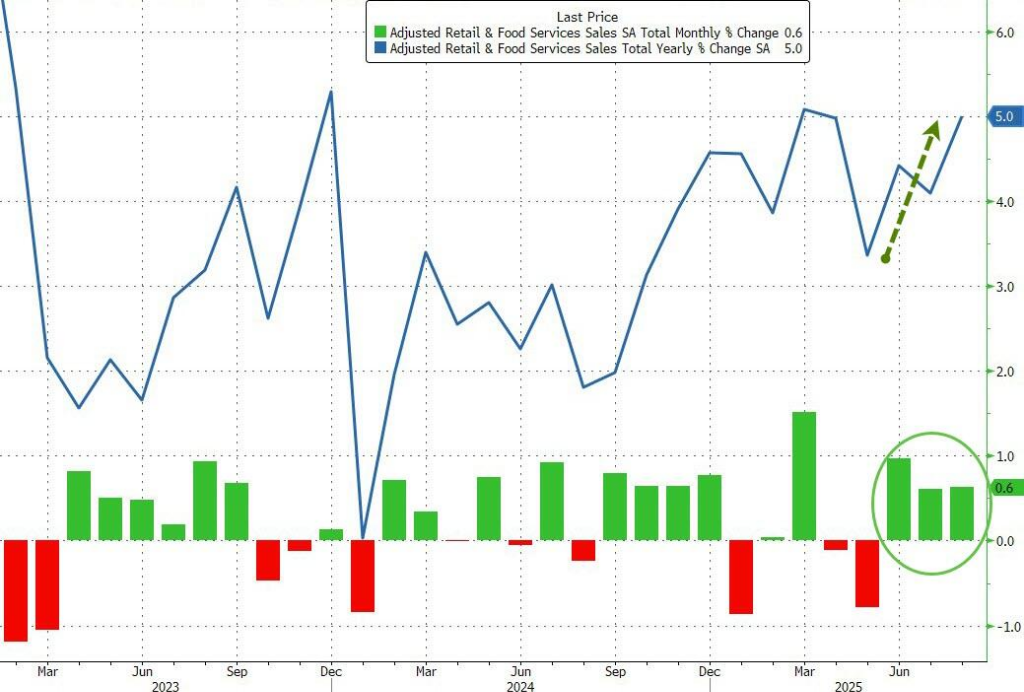
美国8月零售销售环比增0.6%超预期,实际零售销售连续11个月增长
Sou Hu Cai Jing· 2025-09-16 13:28
Core Insights - U.S. consumer spending showed unexpectedly strong momentum in August, with retail sales data increasing for the third consecutive month [1][2] - Real retail sales adjusted for inflation increased by 2.1% year-over-year, marking the 11th consecutive month of positive growth [1][4] Retail Sales Performance - Retail sales in August rose by 0.6% month-over-month, exceeding expectations of 0.2%, and the previous month's increase of 0.5% [3] - Retail sales excluding automobiles increased by 0.7%, surpassing the expected 0.4% [3] - Retail sales excluding both automobiles and gasoline also rose by 0.7%, against an expectation of 0.4% [3] Sector Contributions - The growth in August was broad-based, with 9 out of 13 major categories reporting increases [1] - Online retailers, clothing stores, and sporting goods stores led the growth, likely reflecting back-to-school shopping [1] - Restaurant spending rebounded by 0.7% after a decline in the previous month [1] Economic Implications - The strong retail performance contrasts with market concerns about an economic slowdown and may influence Federal Reserve decision-making [7] - The "control group" sales, which exclude food services, auto dealers, building materials, and gas stations, rose by 0.7%, serving as a key indicator for consumer demand [7]

美国IPO市场反弹,预计今年IPO数量达190家,融资额度破350亿美元
Sou Hu Cai Jing· 2025-09-01 09:14
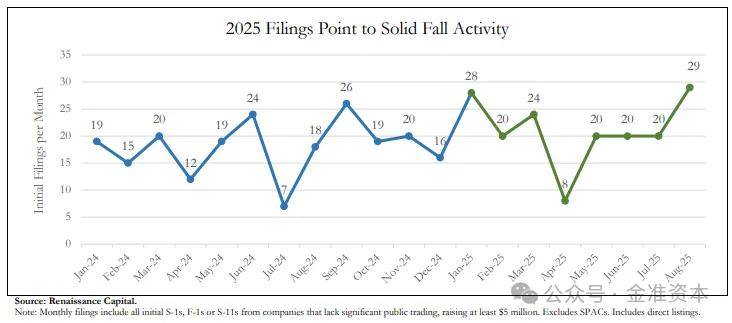
Group 1 - The US IPO market is expected to rebound in 2025, with 40-60 large IPOs anticipated, bringing the total to 190 and raising $35 billion [1] - Key sectors for potential IPOs include technology, fintech, and consumer goods, with Klarna and StubHub leading the way [1] - The list of companies to watch for potential IPOs in Q4 includes Avalara, Wealthfront, and Grayscale [1] - The momentum of the IPO rebound is expected to continue into 2026, with tech leaders like Databricks, Canva, and Proofpoint poised for recovery [1] Group 2 - As autumn approaches, trading activity is expected to reach its fastest pace since 2021, driven by a surge in IPO enthusiasm [2] - In August, 29 new IPO applications were submitted, with 10 seeking at least $50 million, double the number from the previous year [2] - A total of 113 US IPO companies submitted new or updated public applications in the past three months, with 15 seeking at least $50 million [2] - The thriving SPAC market is providing an alternative route for companies to go public [2] Group 3 - Technology IPOs are returning to the market at an encouraging pace, although overall activity remains below 2021 levels [4] - The pricing of tech IPOs this year has exceeded last year's levels, with many large transactions yielding substantial returns [4] - Retail investor enthusiasm for technology, fintech, cryptocurrency, and AI is driving this IPO rebound [4] Group 4 - Klarna, a leading IPO candidate, plans to raise $1 billion in its upcoming IPO, making it one of the largest IPOs of the year [5] - Other notable companies that submitted IPO applications in August include Netskope, Via Transportation, Figure, Pattern, and Gemini [5] Group 5 - Klarna offers "buy now, pay later" loans and has approximately 111 million active customers and 790,000 merchants across 26 countries as of June 2025 [7] - Klarna facilitated a total merchandise volume (GMV) of $112 billion in the 12 months ending June 30, 2025 [7]
新蛋上涨4.84%,报116.0美元/股,总市值23.66亿美元
Jin Rong Jie· 2025-08-21 20:09
Group 1 - Newegg's stock price increased by 4.84% to $116.0 per share, with a trading volume of $187 million and a total market capitalization of $2.366 billion as of August 22 [1] - For the fiscal year ending December 31, 2024, Newegg reported total revenue of $1.236 billion, a year-over-year decrease of 17.46% [1] - The company experienced a net loss attributable to shareholders of $43.328 million, which represents a year-over-year increase of 26.55% [1] Group 2 - Newegg Commerce, Inc. is a leading e-commerce company based in Industry, California, specializing in direct sales and online marketplace platforms for IT computer components, consumer electronics, entertainment, smart home, and gaming products [1]

兰亭集势上涨2.07%,报1.23美元/股,总市值2261.85万美元
Jin Rong Jie· 2025-08-21 13:40
Core Viewpoint - LITB (LanTing Jishi) has experienced a decline in total revenue while showing significant growth in net profit, indicating a potential shift in business strategy and operational efficiency [1][2]. Financial Performance - As of March 31, 2025, LITB reported total revenue of $47.018 million, a year-over-year decrease of 33.93% [1]. - The company achieved a net profit attributable to shareholders of $114,000, reflecting a year-over-year increase of 102.98% [1]. Upcoming Events - LITB is scheduled to disclose its fiscal year 2025 mid-term report on August 22, with the actual date subject to company announcement [2]. Business Strategy - LITB is shifting its focus towards clothing design in 2024, launching its proprietary brand Ador.com to cater to the growing demand for high-end fashion [2]. - Ador.com targets women aged 35-55, offering designer-quality clothing at competitive prices, with design studios and sample stores located in both the U.S. and China [2]. - The company also provides a comprehensive suite of services for e-commerce businesses, including advertising, supply chain management, payment processing, order fulfillment, and logistics solutions [2].

“天猫蓝星计划”第三季度政策解读,助力新商家提前抢双11先机
Zhong Guo Chan Ye Jing Ji Xin Xi Wang· 2025-08-21 11:19
Core Insights - The "Tmall Blue Star Program" has launched a new incentive policy to support high-quality new merchants, aiming to accelerate their growth in Q3 and build core competitiveness for Q4 [1] Group 1: Top New Merchant Plan - The "Top New Merchant Plan" targets three types of merchants: overseas well-known brands, domestic well-known brands, and leading e-commerce merchants [2] - Merchants can apply for "Top New Merchant" certification after joining, with a six-month assessment period, and can receive up to 2.5 million yuan in cash incentives based on sales performance [2] - Participation in this plan allows merchants to clarify their business goals and achieve a scientific growth rhythm, significantly reducing operational costs and promoting a positive growth cycle [2] Group 2: New Merchant Cold Start - The "Million New Merchant Ranking Competition" and various inclusive benefits are key tools for new stores to overcome the cold start phase [3] - New merchants participating for the first time in the competition receive a 1,000 yuan marketing management service incentive, which helps improve product conversion efficiency through intelligent traffic allocation [3] - After one month, top-performing new merchants can earn additional rewards, with the top 10 receiving 20,000 yuan and those ranked 11-100 receiving 10,000 yuan, valid for three months [3] - New merchants also receive a "Cold Start Gift Package" with over 20 entry rights, including exclusive growth services and basic traffic support, to help achieve sales over 200,000 yuan [3] Group 3: Advancement Breakthrough - After overcoming the cold start phase, new stores can focus on creating a "hot-selling product" to drive growth [4] - The program offers three traffic strategies: Taoke Speed Sales Treasure, New Enjoyment Cash, and Flash Sale Subsidy, catering to merchants with varying operational experience [4] - The Taoke Speed Sales Treasure provides a dedicated channel for new merchants to attract traffic through high commission rates, incentivizing affiliates to promote their products [4] - New Enjoyment Cash acts as a conversion accelerator by offering exclusive red envelopes to new customers, enhancing conversion rates for brands with some recognition [5][6] - The Flash Sale Subsidy provides price and promotional support for products in the flash sale channel, encouraging brands to boost sales quickly [6] Group 4: Q4 Performance Outlook - New merchants who have prepared comprehensively in terms of traffic, sales, and customer assets are more likely to excel in Q4 [7] - Despite facing competition from established merchants during the Double 11 shopping festival, the "Tmall Blue Star Program" is helping small and medium-sized businesses carve out a path for success [7] - Data indicates that in the 2024 Double 11 cycle, new merchants showed rapid performance growth, with five brands achieving over 100 million yuan in sales shortly after joining Tmall [7]

兰亭集势上涨5.16%,报1.22美元/股,总市值2243.10万美元
Jin Rong Jie· 2025-08-20 18:04
Group 1 - The stock price of LITB increased by 5.16% to $1.22 per share, with a total market capitalization of $22.43 million as of August 21 [1] - For the fiscal year ending March 31, 2025, LITB reported total revenue of $47.018 million, a year-over-year decrease of 33.93%, while net profit attributable to shareholders was $114,000, reflecting a year-over-year increase of 102.98% [1] Group 2 - LITB is set to disclose its fiscal year 2025 interim report on August 22, with the actual disclosure date subject to company announcement [2] - The company has shifted its focus to apparel design in 2024, launching its proprietary brand Ador.com, targeting the growing demand for high-end fashion at competitive prices for women aged 35-55 [2] - LITB operates design studios and sample shops in both the U.S. and China, including a boutique and design studio in Campbell, California [2] - Additionally, LITB provides a comprehensive suite of services for e-commerce companies, including advertising, supply chain management, payment processing, order fulfillment, and logistics solutions [2]
兰亭集势上涨4.92%,报1.28美元/股,总市值2353.80万美元
Jin Rong Jie· 2025-08-19 15:59
Core Insights - Lanting Jishi (LITB) experienced a stock price increase of 4.92%, reaching $1.28 per share with a total market capitalization of $23.538 million as of August 19 [1] - For the fiscal year ending March 31, 2025, Lanting Jishi reported total revenue of $47.018 million, a year-over-year decrease of 33.93%, while net profit attributable to shareholders was $114,000, reflecting a significant increase of 102.98% [1] Financial Performance - Total revenue for Lanting Jishi was $47.018 million, down 33.93% year-over-year [1] - Net profit attributable to shareholders was $114,000, up 102.98% year-over-year [1] Upcoming Events - Lanting Jishi is scheduled to release its fiscal year 2025 mid-term report on August 22, with the actual disclosure date subject to company announcement [2] Company Overview - Lanting Jishi is a global online retail company that has been providing affordable lifestyle products directly to consumers since 2007 [2] - In 2024, the company plans to shift its focus to clothing design and will launch its first proprietary brand, Ador.com, targeting the growing demand for high-end fashion [2] - Ador.com will offer designer-quality clothing at competitive prices specifically for women aged 35-55, with design studios and sample stores located in both the U.S. and China [2] - The company also provides a comprehensive suite of services for e-commerce businesses, including advertising, supply chain management, payment processing, order fulfillment, and shipping solutions [2]
兰亭集势上涨5.06%,报1.245美元/股,总市值2289.44万美元
Jin Rong Jie· 2025-08-18 14:00
Group 1 - The core viewpoint of the article highlights the financial performance and strategic direction of LITB, indicating a significant revenue decline but a notable increase in net profit [1][2][3] - As of March 31, 2025, LITB reported total revenue of $47.018 million, a year-over-year decrease of 33.93%, while the net profit attributable to the parent company was $114,000, reflecting a year-over-year increase of 102.98% [1] - LITB is transitioning its focus towards clothing design in 2024, launching its proprietary brand Ador.com, aimed at meeting the growing demand for high-end fashion at competitive prices for women aged 35-55 [2] Group 2 - LITB operates as a global online retail company, providing affordable lifestyle products directly to consumers since 2007 [2] - The company offers a comprehensive suite of services for e-commerce businesses, including advertising, supply chain management, payment processing, order fulfillment, and logistics solutions [2]