娱乐

Search documents
走进长春网红打卡地——红旗商圈
Xin Lang Cai Jing· 2026-02-18 23:25
Group 1 - The core idea of the article is the continuous development of Changchun's tourism industry, with the number of popular tourist spots increasing from 100 in 2023 to 150 by 2025, including an addition of 20 new spots in 2024 [1] - The initiative aims to convert online "traffic" into actual tourist "retention" and to establish a sustainable cultural tourism brand [1] - The company promotes an online tour model, highlighting a new tourist spot daily to enhance visitor engagement and experience in Changchun [1] Group 2 - The Hongqi Business District features various shopping centers such as Eurasia Shopping Mall, Wanda Plaza, and Zheyou Mountain, providing a one-stop shopping, entertainment, and cultural experience [3] - The district includes the Hongqi Street Changying Cultural and Art District, which is characterized by a strong cinematic atmosphere and serves as a must-visit location for experiencing the charm of the film city [3] - Key attractions in the area include the Changying Old Site Museum, Changying Cinema, and Changying Music Hall, which contribute to the cultural and entertainment offerings of the district [3][9][11][13][15]


受服务业成本走高影响 美国核心CPI环比增长0.3%
Xin Lang Cai Jing· 2026-02-13 14:18
Core Insights - The core Consumer Price Index (CPI) in the U.S. increased by 0.3% in January compared to December, marking the smallest year-over-year increase since 2021 [1] - The slight rise in inflation is attributed to price increases in airfare, personal care, entertainment, medical services, and communications [1] - Conversely, prices for used cars, trucks, household goods, and auto insurance experienced declines [1]
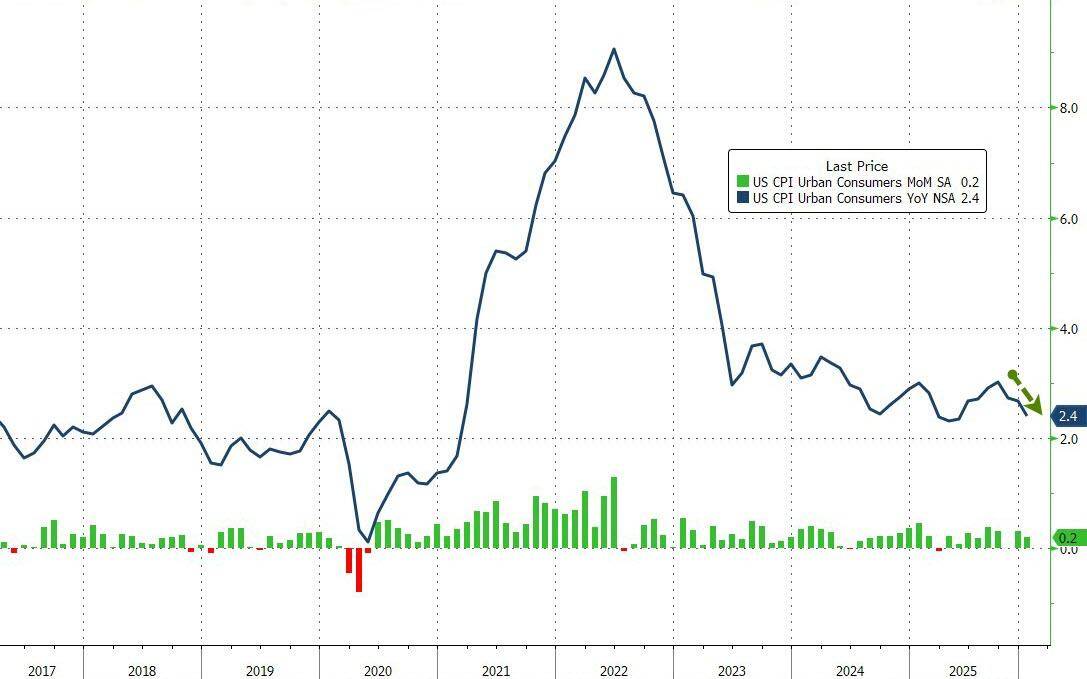
通胀“温和”放缓!美国1月CPI同比2.4%低于预期,核心CPI降至四年来最低水平,服务通胀坚挺
Sou Hu Cai Jing· 2026-02-13 14:10
Core Insights - The overall inflation data for January in the U.S. is described as "moderate," with the CPI year-on-year falling to 2.4%, below expectations, and the core CPI dropping to 2.5%, marking the lowest level since 2021 [1][2] - The monthly core inflation remains resilient, driven by rising service prices, despite some declines in certain goods and services [3][4] Inflation Data Summary - The January CPI increased by 0.2% month-on-month, lower than the expected 0.3%, and the year-on-year rate slowed from 2.7% in December to 2.4%, also below the anticipated 2.5% [1] - The core CPI, excluding food and energy, rose by 0.3% month-on-month, matching expectations and slightly higher than the previous value of 0.2%, with a year-on-year rate of 2.5%, down from 2.6% in December [2] Market Reactions - Following the data release, U.S. stock futures saw a short-term increase, with the Nasdaq futures up by 0.13%, S&P 500 futures up by 0.12%, and Dow futures up by 0.06%. The dollar index experienced a slight decline of 0.03% [3] - Traders are estimating a 50% probability for a third interest rate cut by the Federal Reserve this year [3] Service and Goods Price Dynamics - The rise in core inflation for January was primarily driven by service-related price increases, including airfares, personal care, entertainment, healthcare, and communication [3] - Conversely, prices for certain goods and services, such as used cars and trucks, household items, and auto insurance, decreased in January, offsetting some of the upward pressure from services [4] Federal Reserve Implications - The Federal Reserve's 2% inflation target is mainly based on the PCE price index, and both CPI and PCE remain above this target level. The labor market showed signs of stability, with January employment growth accelerating and the unemployment rate dropping from 4.4% in December to 4.3% [6] - Despite the lower-than-expected inflation readings, the resilience of core inflation and a stable labor market may lead the Federal Reserve to maintain interest rates for the time being, with the current benchmark overnight rate set between 3.50% and 3.75% [6] Seasonal Adjustments - It is noteworthy that core CPI often tends to "exceed expectations" in January, with many economists suggesting that seasonal adjustment factors may not fully capture the disturbances caused by one-time price increases at the beginning of the year [7]
从春节到全年 服务消费如何发力
Sou Hu Cai Jing· 2026-02-10 01:38
Core Viewpoint - The service consumption in China is expected to reach 46.1% of per capita consumption expenditure by 2025, indicating a significant shift towards service-oriented spending, particularly during the upcoming Spring Festival holiday [1]. Group 1: Changes in Supply Side - The demand for services is characterized by diversification, personalization, and quality, which drives continuous innovation in supply [1][2]. - New technologies and smart solutions are enhancing service offerings, particularly in areas like cruise economy, inbound tourism, and winter sports consumption, thereby improving consumer experience [1]. Group 2: Focus Areas of Service Consumption - Service consumption has shifted from being product-centric to a balanced focus on both goods and services, with strong demand in essential areas like elderly care, childcare, and domestic services [2]. - Potential growth areas include tourism, wellness, and entertainment, which are expected to see rapid development, especially during the nine-day Spring Festival holiday [2]. Group 3: Key Growth Areas - The nine key service sectors identified in the government's plan are crucial for the growth of service consumption and the overall service economy [3]. - Understanding service consumption is essential, as it fulfills both functional and emotional needs, enhancing consumer satisfaction through experiences like travel and leisure [3][4]. Group 4: Integration with Livelihood - Service sectors such as elderly care, childcare, and domestic services are closely linked to daily life and are foundational to service consumption [5]. - Policies aimed at supporting and regulating these sectors are necessary to expand supply while ensuring quality, which in turn can stimulate enterprise engagement and better meet consumer needs through data-driven insights [5].
外资机构密集调研A股公司
Xin Lang Cai Jing· 2026-02-09 23:02
Group 1 - Foreign institutions remain enthusiastic about A-shares, with 224 foreign institutions conducting 569 surveys of A-share listed companies as of February 9, 2026 [2][6] - Notable foreign institutions such as Morgan Stanley, BlackRock, Goldman Sachs, and Citigroup are involved in these surveys [2][6] - Goldman Sachs maintains a "overweight" rating on Chinese stocks, predicting a 20% increase in the China index and a 12% increase in the CSI 300 index [2][6] - UBS forecasts a significant rebound in the MSCI China index's earnings growth from 2.5% last year to 13.6% this year, primarily driven by technology stocks [2][6] - The top three companies attracting foreign interest are Huaming Equipment, Yingshi Innovation, and Huichuan Technology, with over 20 foreign institutions also researching companies like Aopt, Yihua, and Anji Technology [2][6] Group 2 - UBS Wealth Management's CIO office highlights the growth and profit potential of the Chinese market, driven by ongoing technological innovation and a favorable business environment [2][6] - The healthcare sector's international expansion, the rise of new consumption models, and the modernization of the power grid are expected to benefit industries such as healthcare, consumer goods, materials, and power equipment [2][6] Group 3 - In 2026, optimism for the Chinese stock market is maintained due to improving fundamentals and long-term growth drivers, which are expected to create a more sustainable structural growth cycle [3][7] - Key investment opportunities identified include industrial upgrades in electric vehicles, pharmaceuticals, and automation, with companies having strong R&D capabilities poised to meet market demands [3][7] - The trend of artificial intelligence is highlighted, with China emerging as a strong competitor in the global AI landscape, supported by a large internet user base, low energy costs, and abundant talent and data resources [3][7] - Changes in consumer preferences and demographic shifts are anticipated to lead to a significant transformation in the Chinese consumption market, with younger consumers increasingly spending on services and IP-related products [3][7]




美国12月核心消费者物价指数同比上涨2.6% 低于市场预期
Xin Lang Cai Jing· 2026-01-13 13:57
Core Insights - The December core Consumer Price Index (CPI) in the U.S. increased by 2.6% year-on-year, which is below market expectations, reinforcing the outlook for continued cooling of inflation [1][3] - The core CPI rose by 0.2% month-on-month, while the overall CPI increased by 0.3% month-on-month and 2.7% year-on-year, aligning with market expectations [1][3] Inflation Data - The U.S. Labor Department reported that housing costs were the largest contributor to the monthly inflation increase, rising by 0.4% month-on-month, with a year-on-year increase of 3.2% [4] - Food prices rose by 0.7% month-on-month in December, while entertainment, airfare, and healthcare prices also saw increases [5] - Entertainment prices surged by 1.2% month-on-month, marking the largest single-month increase since records began in 1993 [5]
新蛋上涨3.23%,报64.0美元/股,总市值13.42亿美元
Jin Rong Jie· 2025-12-15 15:15
Group 1 - The core viewpoint of the article highlights Newegg's stock performance and financial results, indicating a mixed outlook for the company [1] - On December 15, Newegg's stock opened at $64.00 per share, up 3.23%, with a total market capitalization of $1.342 billion [1] - Newegg's total revenue for the year ending December 31, 2024, is projected to be $1.236 billion, reflecting a year-over-year decrease of 17.46% [1] - The company reported a net loss attributable to shareholders of $43.328 million, which represents a year-over-year increase of 26.55% [1] Group 2 - Newegg Commerce, Inc., formerly known as Lianluo Smart Limited, is a leading e-commerce company based in Industry, California [1] - The company specializes in direct sales and online marketplace platforms for IT computer components, consumer electronics, entertainment, smart home, and gaming products [1] - Newegg also provides certain third-party logistics services globally [1]

华天酒店跌2.01%,成交额1913.01万元,主力资金净流出200.84万元
Xin Lang Cai Jing· 2025-11-20 02:34
Core Viewpoint - Huatian Hotel's stock price has experienced fluctuations, with a recent decline of 2.01% and a year-to-date increase of 6.56%, indicating volatility in investor sentiment and market performance [1][2]. Group 1: Stock Performance - As of November 20, Huatian Hotel's stock price was 3.41 CNY per share, with a market capitalization of 3.475 billion CNY [1]. - The stock has seen a 3.94% decline over the last five trading days and a 4.21% decline over the last 60 days [2]. - The stock has appeared on the "Dragon and Tiger List" three times this year, with the most recent appearance on September 23, where it recorded a net buy of 321,900 CNY [2]. Group 2: Financial Performance - For the period from January to September 2025, Huatian Hotel reported a revenue of 398 million CNY, a year-on-year decrease of 12.52%, and a net profit attributable to shareholders of -156 million CNY, down 39.99% year-on-year [2]. - The company's main revenue sources are from dining (34.69%), guest rooms (32.85%), and other services (30.87%) [2]. Group 3: Shareholder Information - As of September 30, 2025, the number of shareholders increased to 46,100, with an average of 22,114 circulating shares per person, a decrease of 1.91% from the previous period [2]. - The top circulating shareholder, the Fortune CSI Tourism Theme ETF, holds 10.44 million shares, an increase of 3.84 million shares compared to the previous period [3].

华天酒店跌2.27%,成交额1704.48万元,主力资金净流入55.09万元
Xin Lang Cai Jing· 2025-11-19 02:24
Core Viewpoint - Huatian Hotel's stock price has shown fluctuations, with a year-to-date increase of 7.81%, but a recent decline of 2.27% on November 19, reflecting ongoing market dynamics and investor sentiment [1]. Financial Performance - For the period from January to September 2025, Huatian Hotel reported a revenue of 398 million yuan, representing a year-on-year decrease of 12.52%. The net profit attributable to shareholders was -156 million yuan, a decline of 39.99% compared to the previous year [2]. - Cumulative cash dividends since the A-share listing amount to 328 million yuan, with no dividends distributed in the past three years [3]. Shareholder and Market Activity - As of September 30, 2025, the number of shareholders increased to 46,100, up by 1.95%, while the average circulating shares per person decreased by 1.91% to 22,114 shares [2]. - Huatian Hotel has appeared on the stock market's "龙虎榜" three times this year, with the most recent appearance on September 23, where net buying reached 321,900 yuan [1]. Ownership Structure - Among the top ten circulating shareholders, the "Fuguo Zhongzheng Tourism Theme ETF" holds 10.44 million shares, an increase of 3.84 million shares from the previous period. "Jinyuan Shun'an Yuanqi Flexible Allocation Mixed Fund" ranks fifth with 4.14 million shares, up by 636,300 shares [3]. Business Segmentation - Huatian Hotel's main business revenue breakdown includes: 34.69% from dining, 32.85% from guest rooms, 30.87% from other services, and 1.59% from entertainment [1].
青岛嘉年华海信广场VILLAGE跻身2025年度奥莱人气项目榜TOP30
Sou Hu Cai Jing· 2025-11-15 07:18
Core Insights - The 2025 China Outlets West Lake Forum highlighted the inclusion of Qingdao Carnival Hisense Plaza VILLAGE in the "Top 30 Popular Outlet Projects" due to its innovative "micro-vacation" business model and operational excellence [1][3] Industry Performance - Despite a slowing economy and more rational consumer behavior, the outlet industry continues to show strong growth, with an average daily foot traffic of 12,000 across over 280 outlet projects in China from January to September, marking a 13.3% year-on-year increase [3] - The Qingdao Carnival Hisense Plaza VILLAGE has achieved remarkable growth by focusing on family and young consumer demographics, creating a unique social and tourism destination [3][4] Business Model and Strategy - The project adopts a "beyond outlet" philosophy, integrating shopping, culture, entertainment, dining, and nightlife into a comprehensive consumption space, emphasizing "famous brands + discounts" [3][4] - By leveraging scenic coastal resources and enhancing the shopping experience, the project has established a differentiated competitive advantage in the competitive Tangdao Bay business district [3][4] Innovation and Events - The project has maintained strong appeal through continuous innovation, launching various activities such as the "Sea Flying Man" performance and a large-scale trendy play area, which generated significant ticket sales [4] - Major events like the "Year of Fish" shopping festival and the "Carnival Beer Season" have attracted large crowds, with single-day foot traffic exceeding 60,000 and sales surpassing 10 million [9][14] Collaborative Synergy - The overall synergy of the Qingdao Carnival coastal tourism and leisure district, which includes the exhibition center and hotel, enhances brand influence and customer attraction, establishing a new regional leisure consumption hub [5] Consumer Trends and Market Insights - The project effectively captures emerging consumer trends, particularly during major events, leading to significant increases in foot traffic and sales, with overall customer flow up by approximately 30% and sales up by 40% during specific events [13][14] - The outlet industry is undergoing a transformation, evolving from mere shopping venues to "content factories" and "social theaters," with a focus on creating engaging experiences [18][19] Future Outlook - The success of Qingdao Carnival Hisense Plaza VILLAGE exemplifies the outlet sector's potential for transformation and growth, with an average growth rate of 11.4% over the past three years, indicating resilience amid economic challenges [16][18]