
电子设备制造业

Search documents
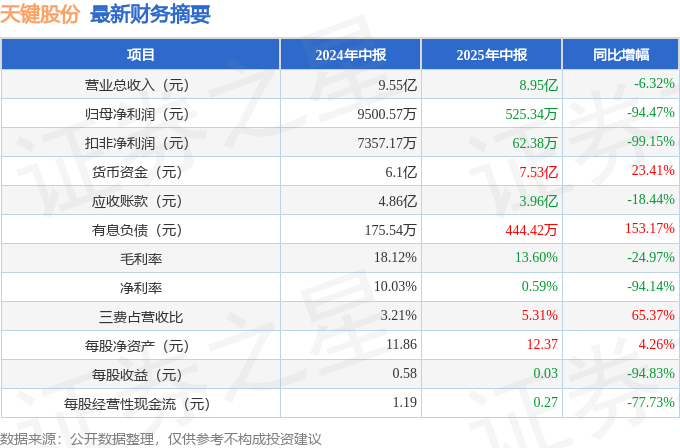
天键股份2025年中报简析:净利润同比下降94.47%,公司应收账款体量较大
Zheng Quan Zhi Xing· 2025-08-29 23:43
Core Viewpoint - Tianjian Co., Ltd. reported disappointing financial results for the first half of 2025, with significant declines in revenue and net profit compared to the previous year [1][4]. Financial Performance - The total revenue for the first half of 2025 was 895 million yuan, a decrease of 6.32% year-on-year [1]. - The net profit attributable to shareholders was 5.25 million yuan, down 94.47% year-on-year [1]. - In Q2 2025, total revenue was 459 million yuan, a decline of 15.15% year-on-year, with net profit of 1.77 million yuan, down 96.75% year-on-year [1]. Profitability Metrics - Gross margin was 13.6%, a decrease of 24.97% year-on-year [1]. - Net margin was 0.59%, down 94.14% year-on-year [1]. - Total selling, administrative, and financial expenses amounted to 47.53 million yuan, representing 5.31% of revenue, an increase of 65.37% year-on-year [1]. Balance Sheet Highlights - Cash and cash equivalents increased by 23.41% to 753 million yuan [1]. - Accounts receivable stood at 396 million yuan, down 18.44% year-on-year [1]. - Interest-bearing liabilities rose by 153.17% to 4.44 million yuan [1]. Shareholder Metrics - Earnings per share (EPS) dropped to 0.03 yuan, a decrease of 94.83% year-on-year [1]. - The net asset value per share increased by 4.26% to 12.37 yuan [1]. - Operating cash flow per share was 0.27 yuan, down 77.73% year-on-year [1]. Business Evaluation - The company's return on invested capital (ROIC) for the previous year was 10.29%, indicating average capital returns [3]. - Historical data shows a median ROIC of 12.17% since the company went public, with the worst year being 2019 at 5.98% [3]. Debt and Cash Flow Analysis - The company has a healthy cash position, but attention is needed on accounts receivable, which is 187.12% of net profit [4]. - Analysts expect the company's performance in 2025 to yield a net profit of approximately 82 million yuan, with an average EPS forecast of 0.5 yuan [4].

宝明科技2025年中报简析:亏损收窄,短期债务压力上升
Zheng Quan Zhi Xing· 2025-08-29 22:41
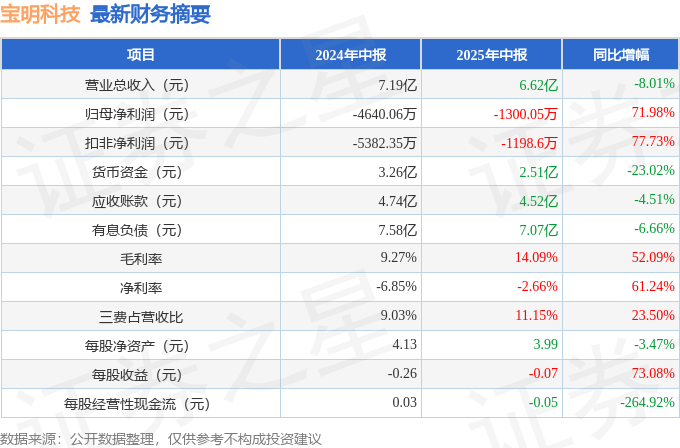
Core Viewpoint - Baoming Technology (002992) reported a decline in total revenue and a significant improvement in net profit for the first half of 2025, indicating mixed financial performance amid rising short-term debt pressure [1] Financial Performance Summary - Total revenue for the first half of 2025 was 662 million yuan, a decrease of 8.01% compared to 719 million yuan in the same period of 2024 [1] - The net profit attributable to shareholders was -13 million yuan, an increase of 71.98% from -46 million yuan in the previous year [1] - The gross profit margin improved to 14.09%, up 52.09% year-on-year, while the net profit margin was -2.66%, an increase of 61.24% [1] - Total expenses (selling, administrative, and financial) amounted to 73.78 million yuan, accounting for 11.15% of revenue, which is a 23.5% increase year-on-year [1] - Earnings per share improved to -0.07 yuan, a 73.08% increase from -0.26 yuan in the previous year [1] Cash Flow and Debt Analysis - The liquidity ratio reached 0.84, indicating increased short-term debt pressure [1] - Cash and cash equivalents decreased by 23.02% to 251 million yuan [1] - The company’s cash flow situation is concerning, with cash flow from operations per share at -0.05 yuan, a decline of 264.92% year-on-year [3] Investment Return Metrics - The historical median Return on Invested Capital (ROIC) since the company’s listing is 3.97%, with a notably poor ROIC of -19.24% in 2021 [3] - The company has reported losses in five out of its eight financial years since listing, indicating a generally poor investment return profile [3] Shareholder Activity - Several funds have recently adjusted their holdings in Baoming Technology, with notable reductions and new entries among top ten holdings [4]
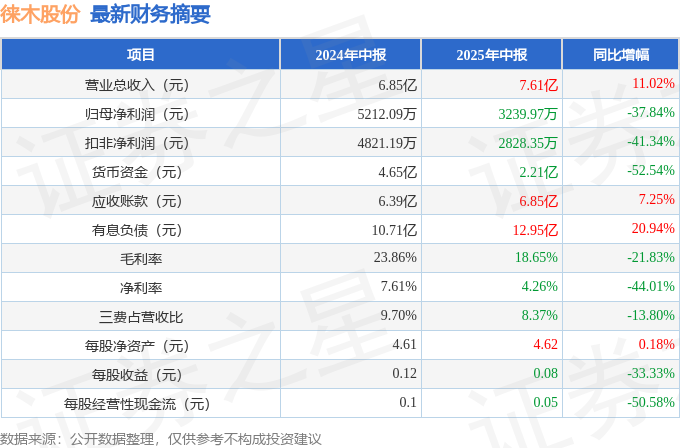
徕木股份2025年中报简析:增收不增利,公司应收账款体量较大
Zheng Quan Zhi Xing· 2025-08-29 22:41
Core Insights - The company reported a total revenue of 761 million yuan for the first half of 2025, representing an increase of 11.02% year-on-year, while the net profit attributable to shareholders decreased by 37.84% to 32.4 million yuan [1] - In Q2 2025, the total revenue was 411 million yuan, up 16.07% year-on-year, but the net profit attributable to shareholders fell by 49.61% to 13.6 million yuan [1] - The company's accounts receivable are significantly high, with accounts receivable amounting to 932.44% of the latest annual net profit [1] Financial Performance - The gross margin for the reporting period was 18.65%, down 21.83% year-on-year, and the net profit margin was 4.26%, down 44.01% year-on-year [1] - Total selling, administrative, and financial expenses amounted to 63.6 million yuan, accounting for 8.37% of revenue, which is a decrease of 13.8% year-on-year [1] - Earnings per share decreased by 33.33% to 0.08 yuan, while operating cash flow per share dropped by 50.58% to 0.05 yuan [1] Business Evaluation - The company's return on invested capital (ROIC) was 3.44% last year, indicating historically weak capital returns, with a median ROIC of 6.01% since its listing [2] - The net profit margin last year was 5.01%, suggesting that the added value of the company's products or services is average [2] - The company's performance heavily relies on R&D and capital expenditures, necessitating careful evaluation of the effectiveness of these investments [2] Cash Flow and Debt Analysis - The company's cash flow situation is concerning, with cash and cash equivalents to current liabilities at only 16.19%, and the average operating cash flow over the past three years to current liabilities at 6.91% [3] - The interest-bearing debt ratio has reached 32.59%, and the total interest-bearing debt to the average operating cash flow over the past three years is at 13.18% [3] - The accounts receivable to profit ratio is alarmingly high at 932.44% [3]

赛腾股份: 苏州赛腾精密电子股份有限公司董高持股变动管理制度(2025年8月)
Zheng Quan Zhi Xing· 2025-08-29 17:03
Core Viewpoint - The document outlines the management system for shareholding changes of directors and senior management at Suzhou Saiteng Precision Electronics Co., Ltd, emphasizing compliance with relevant laws and regulations regarding insider trading and share transfer restrictions [1][2][3]. Chapter Summaries Chapter 1: General Principles - The system is established to strengthen the management of shares held by directors and senior management, based on various laws and the company's articles of association [1]. - It applies to all shares held by directors and senior management, including those in margin trading accounts [1]. Chapter 2: Shareholding Change Rules and Information Disclosure - Directors and senior management must notify the board secretary in writing before trading shares, ensuring compliance with laws against insider trading [2]. - Additional restrictions may apply to share transfers due to company actions like public offerings or stock incentive plans [2][3]. - Directors and senior management must report their personal and family shareholding information to the stock exchange within specified timeframes [2]. - Share transfers are prohibited under certain conditions, such as within one year of the company's stock listing or within six months after leaving the company [3][4]. - A maximum of 25% of their total shares can be transferred annually during their tenure, with specific exceptions [5][6]. - Untransferred shares at the end of the year are counted towards the next year's transferable shares [6]. - The company must ensure accurate and timely reporting of share transactions to the stock exchange [3][7]. - Directors and senior management are restricted from trading shares during specific blackout periods, such as before financial report announcements [8]. Chapter 3: Supplementary Provisions - The board of directors is responsible for interpreting and revising the system, which takes effect immediately upon approval [10].

赛腾股份: 苏州赛腾精密电子股份有限公司独立董事专门会议工作细则(2025年8月)
Zheng Quan Zhi Xing· 2025-08-29 17:03
Core Viewpoint - The document outlines the working rules for the independent director special meetings of Suzhou Saiteng Precision Electronics Co., Ltd, aiming to enhance corporate governance and the role of independent directors in decision-making and protecting minority shareholders' rights [1][2]. Chapter 1: General Principles - The purpose of the rules is to improve corporate governance and the effectiveness of independent directors in the company [1]. - Independent directors are defined as those who do not hold other positions in the company and have no direct or indirect interests that could affect their independent judgment [1]. Chapter 2: Responsibilities and Authority - Certain matters must be discussed and approved by the independent director special meeting before being submitted to the board, including related party transactions and acquisition decisions [2]. - Independent directors have special powers that require prior approval from the special meeting, such as hiring external consultants and proposing temporary shareholder meetings [2]. Chapter 3: Meeting Rules - The company is required to hold regular or ad-hoc independent director special meetings, providing relevant materials at least three days in advance [3]. - Meetings can be held in person or via other means, ensuring all independent directors can communicate effectively [3]. - A majority of independent directors must be present for the meeting to proceed, and decisions require a majority vote [3][4]. Chapter 4: Meeting Records - Detailed records of the meetings must be kept, including attendance, voting results, and opinions expressed by independent directors [5]. - The company is responsible for covering costs associated with hiring professional institutions for independent directors [5]. Additional Provisions - The rules will take effect upon approval by the board and will be interpreted by the board [6].
赛腾股份: 苏州赛腾精密电子股份有限公司董事、高级管理人员离职管理制度(2025年8月)
Zheng Quan Zhi Xing· 2025-08-29 17:03
Core Viewpoint - The document outlines the management system for the resignation of directors and senior management at Suzhou Saiteng Precision Electronics Co., Ltd, emphasizing the need for compliance, transparency, and the protection of shareholder rights [1][2][3]. Chapter 1: General Principles - The system aims to ensure stability in corporate governance and protect the legal rights of the company and its shareholders [1]. - It applies to all directors and senior management personnel regarding their resignation or termination [1]. Chapter 2: Resignation Circumstances and Effectiveness - Resignation includes scenarios such as term expiration without reappointment, voluntary resignation, and dismissal [2]. - Directors must submit a written resignation report, effective upon receipt by the company [2]. - If a director's term expires without reappointment, they automatically resign upon the shareholders' meeting resolution [2]. Chapter 3: Responsibilities and Obligations upon Resignation - Resigning directors and senior management must complete handover procedures within five working days and report their resignation within two trading days [4][5]. - They are prohibited from using their former positions to interfere with the company's operations or harm shareholder interests [4]. - Confidentiality obligations regarding company secrets remain effective after resignation [5]. Chapter 4: Accountability Mechanism - Directors and senior management who leave before their term ends and cause losses to the company are liable for compensation [6]. - The company retains the right to pursue accountability for unfulfilled commitments or breaches of loyalty after resignation [6][7]. - Any disputes regarding accountability decisions can be reviewed by the audit committee within 15 days [7].
赛腾股份: 苏州赛腾精密电子股份有限公司投资者关系管理制度(2025年8月)
Zheng Quan Zhi Xing· 2025-08-29 17:03
Core Viewpoint - The document outlines the investor relations management system of Suzhou Saiteng Precision Electronics Co., Ltd, emphasizing the importance of effective communication with investors to enhance understanding and recognition of the company, thereby promoting a positive relationship and improving corporate governance and overall value [1][2]. Group 1: Objectives and Principles of Investor Relations Management - The objectives of investor relations management include fostering a positive relationship with investors, establishing a stable investor base, creating a culture of respect for investors, maximizing overall company interests, and increasing transparency in information disclosure [2][3]. - The basic principles of investor relations management are compliance, equality, proactivity, and honesty [2][3]. Group 2: Organization and Implementation - The board secretary is responsible for organizing and coordinating investor relations management, with the board secretary's office handling daily affairs [3][4]. - Other departments and subsidiaries are required to assist the board secretary's office in implementing investor relations management [4]. Group 3: Content and Methods of Investor Relations Management - Key content of investor relations management includes the company's development strategy, legal information disclosure, operational management information, environmental, social, and governance information, and handling investor requests [5][6]. - The company employs various communication methods with investors, including regular reports, shareholder meetings, company websites, and media interactions [8][9]. Group 4: Responsibilities and Training of Investor Relations Personnel - Investor relations personnel must possess good character, professional knowledge, communication skills, and a comprehensive understanding of the company and its industry [8][9]. - The company conducts regular training for board members and staff on investor relations management [11][12]. Group 5: Documentation and Compliance - The company maintains an investor relations management archive and database, documenting activities and communications in compliance with relevant regulations [12][12]. - The investor relations management system is subject to review and interpretation by the company's board of directors and becomes effective upon approval [12].
赛腾股份: 苏州赛腾精密电子股份有限公司董事会战略委员会工作细则(2025年8月)
Zheng Quan Zhi Xing· 2025-08-29 17:03
苏州赛腾精密电子股份有限公司 第一条 为适应苏州赛腾精密电子股份有限公司(以下简称"公司")战 略发展需要,增强公司核心竞争力,确定公司发展规划,健全投资决策程序, 加强决策民主性和科学性,提高重大投资决策的效益和决策的质量,完善公司 治理结构,根据《中华人民共和国公司法》《上市公司治理准则》《上市公司 独立董事管理办法》《上海证券交易所上市公司自律监管指引第 1 号——规范 运作》及《苏州赛腾精密电子股份有限公司章程》(以下简称"公司章程") 等有关规定,结合公司的实际情况,制定本细则。 第二条 董事会战略委员会是董事会下设的专门工作机构,主要负责对公 司长期发展战略和重大投资决策进行研究并提出建议,对董事会负责。 第二章 人员组成 第三条 战略委员会由三名董事组成,其中独立董事占半数以上。 第四条 战略委员会委员由董事长或者二分之一以上独立董事或者全体董 事的三分之一以上提名,并由董事会选举产生。 第五条 战略委员会设主任委员(召集人)一名,负责主持战略委员会工 作,由公司董事长担任。 第六条 战略委员会委员的任期与同届董事会成员的任期一致,委员任期 届满,连选可以连任。期间如有委员不再担任公司董事职务, ...
赛腾股份: 苏州赛腾精密电子股份有限公司董事会提名委员会工作细则(2025年8月)
Zheng Quan Zhi Xing· 2025-08-29 17:03
苏州赛腾精密电子股份有限公司 董事会提名委员会工作细则 第一章 总则 第一条 为规范公司领导人员的产生,优化董事会组成,完善公司治理结构, 根据《中华人民共和国公司法》(以下简称《公司法》)、《中华人民共和国证券 法》(以下简称《证券法》)、《苏州赛腾精密电子股份有限公司章程》(以下简称 《公司章程》)及其他有关法律、法规,参照《上市公司治理准则》,经公司股 东会的相关决议,公司特设立董事会提名委员会,并制定本细则。 第二条 董事会提名委员会是董事会按照股东会决议设立的专门工作机构, 主要负责对公司董事、高级管理人员的人选、选择标准和程序等事项进行选择 并提出建议。 本细则所称高级管理人员,是指《公司章程》规定的高级管理人员。 第二章 人员组成 第三条 提名委员会成员由三名董事组成,其中独立董事应当过半数并担任 召集人。 第四条 提名委员会委员由董事长、二分之一以上独立董事或全体董事三分 之一以上(包括三分之一)提名,并由董事会选举产生。 选举委员的提案获得通过后,新任委员在董事会会议结束后立即就任。 第五条 提名委员会设主任委员(召集人)一名,由独立董事委员担任,负 责主持委员会工作;主任委员在委员内选举, ...
赛腾股份: 苏州赛腾精密电子股份有限公司董事会审计委员会工作细则(2025年8月)
Zheng Quan Zhi Xing· 2025-08-29 17:03
Core Points - The article outlines the establishment and operational guidelines of the Audit Committee of Suzhou Saiteng Precision Electronics Co., Ltd, aimed at enhancing corporate governance and ensuring effective oversight of the management by the board of directors [2][3]. Group 1: General Provisions - The Audit Committee is established to strengthen the decision-making function of the board and ensure professional audits, thereby improving the company's governance structure [2]. - The committee is a specialized body set up by the board according to shareholder resolutions, responsible for communication, supervision, and verification of internal and external audits [2]. Group 2: Composition of the Committee - The Audit Committee consists of three directors, with a majority being independent directors, and at least one independent director must be a professional in accounting [3]. - The committee members are nominated by the chairman or a majority of independent directors and elected by the board [3]. Group 3: Responsibilities and Authority - The committee is responsible for reviewing financial information, supervising internal and external audits, and evaluating internal controls [5]. - Key responsibilities include approving financial reports, hiring or dismissing auditing firms, and overseeing changes in accounting policies or significant errors [5][6]. Group 4: Decision-Making Procedures - The internal audit department prepares necessary documentation for the committee's decisions, which include financial reports and other relevant materials [12]. - The committee meetings can be regular or temporary, with a minimum of two-thirds of members required for a quorum [10][11]. Group 5: Meeting Rules - The committee must hold at least one meeting per quarter, and decisions require a majority vote from the members present [10][19]. - Meeting records must be maintained for at least ten years, and confidentiality is required from all members regarding discussed matters [23][25].