
Semiconductor

Search documents
江波龙:搭载自研主控的UFS4.1产品在制程、读写速度及稳定性上优于市场可比产品
2 1 Shi Ji Jing Ji Bao Dao· 2026-02-10 10:57
Core Viewpoint - The company, along with a few others globally, possesses the capability to develop UFS4.1 products at the chip level, indicating a competitive edge in the market [1] Group 1: Product Development and Capabilities - The UFS4.1 products developed by the company, featuring its self-developed main control, outperform comparable market products in terms of process, read/write speed, and stability [1] - UFS4.1 is positioned as a high-end consumer storage product and is the preferred storage configuration for flagship smart terminal models from Tier 1 major clients [1] Group 2: Partnerships and Market Position - The company has established deep cooperative relationships with multiple wafer foundries and leading smart terminal device manufacturers [1] - Flagship storage products represented by UFS4.1 are on the verge of mass shipment, indicating strong market demand and readiness for deployment [1]
芯联集成(688469):车载&AI等持续驱动 盈利拐点临近
Xin Lang Cai Jing· 2026-02-10 08:30
Core Viewpoint - The company forecasts a revenue of approximately 8.19 billion yuan for 2025, representing a year-on-year growth of about 25.83%, with a projected net profit of approximately -577 million yuan, indicating a reduction in losses by about 385 million yuan [1][2]. Group 1: Revenue and Profit Forecast - The company expects to achieve a revenue of approximately 8.19 billion yuan in 2025, which is a year-on-year increase of about 25.83% [1][2]. - The projected net profit for 2025 is approximately -577 million yuan, reflecting a reduction in losses by about 385 million yuan compared to the previous year [2]. Group 2: Product Lines and Market Position - The company is leveraging four major product lines to create a diversified growth pattern, benefiting from market demand upgrades, accelerated domestic substitution, and supportive policies [2]. - Continuous innovation and expansion of customer relationships have enhanced the company's market competitiveness, leading to rapid revenue growth in four core application areas [2]. Group 3: Financial Metrics and Efficiency - The company anticipates a gross margin of 5.92% in 2025, which is an increase of approximately 4.89 percentage points year-on-year, driven by scale effects and operational efficiencies [2]. - Improvements in management efficiency and cost control have led to a gradual reduction in expense ratios [2]. Group 4: Investment Recommendations - Revenue projections for 2025, 2026, and 2027 are estimated at 8.19 billion yuan, 10.25 billion yuan, and 12.83 billion yuan respectively, with net profits expected to be -580 million yuan, 60 million yuan, and 630 million yuan [3]. - The investment rating is maintained at "Buy" [3].

公司问答丨云天励飞:公司向客户的家庭主机产品提供DeepEdge 10 Max芯片
Ge Long Hui A P P· 2026-02-10 08:28
Group 1 - The company has responded to an investor inquiry regarding the progress of its collaboration with top domestic and international hardware manufacturers for a home AI host, indicating that the product has not yet been launched [1] - The company provides the DeepEdge 10 Max chip for its home host products aimed at customers [1]

芯联集成:车载、AI等持续驱动,盈利拐点临近-20260210
China Post Securities· 2026-02-10 05:45
Investment Rating - The investment rating for the company is "Buy" and is maintained [2][7] Core Insights - The company is expected to achieve a revenue of approximately 81.90 billion yuan in 2025, representing a year-on-year growth of about 25.83%. The net profit attributable to the parent company is projected to be around -5.77 billion yuan, indicating a reduction in losses by approximately 3.85 billion yuan [5][6] - The company has established a diversified growth pattern with four major product lines, driven by market demand upgrades, accelerated domestic substitution, and policy benefits. The utilization rate of production capacity remains high, and the company is enhancing its market competitiveness through continuous technological innovation and deepening customer relationships [6] - The gross profit margin is expected to reach 5.92% in 2025, an increase of approximately 4.89 percentage points year-on-year, supported by scale effects and operational efficiency improvements [6] Financial Projections - Revenue projections for 2025, 2026, and 2027 are 81.90 billion yuan, 102.50 billion yuan, and 128.30 billion yuan, respectively. The net profit attributable to the parent company is expected to be -5.8 billion yuan, 0.6 billion yuan, and 6.3 billion yuan for the same years [7][9] - The company is expected to show significant improvement in profitability, with a projected net profit margin turning positive by 2026 [9][12] Relative Valuation - The company operates in the semiconductor industry, focusing on MEMS, IGBT, MOSFET, and other integrated circuits, providing one-stop chip system foundry solutions for various sectors including automotive and industrial control. It is recognized as a leading domestic foundry for automotive-grade IGBT/SiC chips and modules [10][11] - The average price-to-book (P/B) ratio for comparable companies is 4.83x, while the company's projected P/B ratio for 2026 is 3.51x, indicating potential undervaluation [11]
内存市场已步入超级牛市!科创芯片设计ETF天弘(589070)标的指数盘中涨超2.5%
Mei Ri Jing Ji Xin Wen· 2026-02-10 04:44
Group 1 - The market is experiencing narrow fluctuations, with the chip design concept showing an increase. The Tianhong ETF (589070) tracking the chip design index rose by 2.52%, with a trading volume of 29.86 million yuan. Key stocks such as Chip Origin, Shengke Communication-U, Haiguang Information, and Canxin shares increased by over 5% [1] - The Tianhong ETF (589070) has seen a net inflow of 43.84 million yuan over the past five days, reaching a new high of 654 million yuan as of February 9, 2026 [1] - The Tianhong ETF (589070) focuses on companies listed in the chip design sector on the Sci-Tech Innovation Board, with over 95% of its index weight concentrated in digital and analog chip design industries, highlighting its focus on the core design segment of the semiconductor supply chain [1] Group 2 - According to a recent report by Counterpoint Research, the memory market has entered a "super bull market," with prices expected to achieve a record increase of 80%-90% quarter-on-quarter by the first quarter of 2026, driven mainly by general server DRAM [2] - The Semiconductor Industry Association projects a 25.6% year-on-year growth in global semiconductor sales by 2025, indicating that the industry is entering a high prosperity cycle [2] - Several semiconductor companies, including Infineon, have announced price increases for their products, leading to a price surge in various types of chips, including power semiconductors [2] - Guangfa Securities highlights that the Sci-Tech chip sector is one of the current strong trends with favorable odds, exhibiting moderate volatility and good investment value and trend sustainability within the industry [2]
华为超节点赶超英伟达:驾驭“光”很关键
Guan Cha Zhe Wang· 2026-02-10 03:20
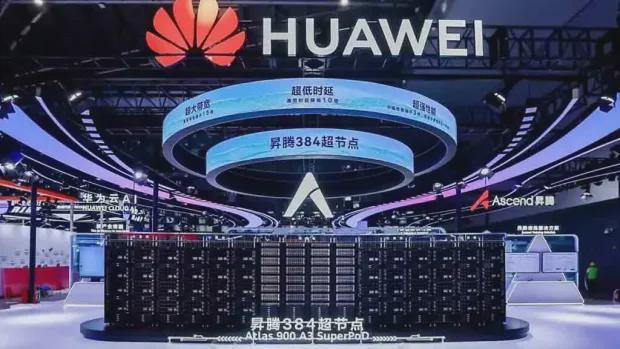
Core Insights - The emergence of SuperPods as a new AI computing infrastructure has become a focal point in the industry since 2025, with Huawei's Ascend 384 SuperPod leading the way in performance metrics compared to foreign competitors [1][3] - The demand for computing power is far from being met, with token consumption expected to exceed trillions daily in China, highlighting the inadequacy of simply stacking servers to address the computing gap [3][4] Group 1: SuperPod Characteristics - SuperPods are not merely about stacking chips; they represent a fundamental restructuring of traditional computing architectures, enabling equal interconnectivity among CPUs, NPUs, and memory units [4][6] - Key features of a true SuperPod include high bandwidth to eliminate communication delays, low latency, and the ability to form a logically unified system through unified memory addressing [6][7] Group 2: Efficiency and Performance - SuperPods can significantly enhance computing efficiency, with potential model utilization rates increasing from 30% to 45%, effectively a 50% improvement, which can help mitigate the limitations of chip manufacturing processes [7][8] - The architecture of SuperPods differs from traditional systems, as Huawei employs optical communication technology, allowing for greater scalability and interconnectivity compared to NVIDIA's copper-based systems [8][9] Group 3: Innovation and Ecosystem - Huawei's systematic innovation in chip design, optical components, and foundational protocols has positioned it uniquely in the market, leveraging over 20 years of experience in optical technology [9][12] - The company is also developing general computing SuperPods, with the TaiShan 950 SuperPod set to launch in Q1 2026, aimed at replacing various server applications [11][12] Group 4: Software and Community Engagement - The success of SuperPods relies not only on hardware but also on a robust software ecosystem, including open-source initiatives like CANN and openEuler, which are crucial for fostering industry collaboration [14] - Huawei has engaged a large developer community, with 3.8 million registered developers for Kunpeng and nearly 4 million for Ascend, emphasizing the importance of open-source collaboration in the AI era [14]


华为打造“最强超节点”,这项全球领先技术很关键
Guan Cha Zhe Wang· 2026-02-10 03:10
Core Viewpoint - The emergence of SuperPod as a new AI computing infrastructure has become a focal point in the industry since 2025, with Huawei's Ascend 384 SuperPod leading the way in performance metrics compared to foreign competitors [1][3]. Group 1: SuperPod Concept and Advantages - SuperPod is not merely about stacking chips; it represents a fundamental restructuring of traditional computing architecture, enhancing communication efficiency among CPU, NPU, and memory units [4][6]. - The key advantages of SuperPod over traditional clusters include significantly improved computational efficiency, with potential model computing utilization rates increasing from 30% to 45%, equating to a 50% performance boost [7][8]. Group 2: Technical Challenges and Innovations - Building a true SuperPod is complex; Huawei's Ascend 384 SuperPod consists of 12 computing cabinets and 4 bus cabinets, while NVIDIA's NVL72 system is confined to a single cabinet due to architectural differences [8]. - Huawei employs optical communication technology for interconnection, allowing for greater scalability beyond single cabinet limitations, while traditional systems face constraints with electrical signal transmission [8][9]. Group 3: Systematic Innovation and Ecosystem Development - Huawei's systematic innovation includes proprietary chip development, optical device capabilities, and foundational protocols, enabling the creation of SuperPods that leverage full optical interconnectivity [9][12]. - The company is also developing general computing SuperPods, such as the TaiShan 950, which aims to replace various server applications by 2026 [9][11]. - A robust software ecosystem, including open-source initiatives like CANN and openEuler, is essential for the operation of SuperPods, with a focus on collaborative development within the industry [14].

未知机构:中泰电子长电科技高景气AI先进封装重视封测龙头价值重估-20260210
未知机构· 2026-02-10 02:10
Summary of Conference Call Notes Company and Industry Involved - The notes focus on **Zhongtai Electronics** and **Changdian Technology**, which are key players in the semiconductor packaging and testing industry, particularly in the context of AI advancements and market recovery in the semiconductor sector [1][2]. Core Points and Arguments - **High Capacity Utilization**: The company has maintained high capacity utilization rates in Q1, indicating strong demand despite seasonal trends. This is attributed to the global AI boom and the ongoing recovery in the semiconductor market [1]. - **Price Increases**: Major global competitor, ASE Technology, has initiated price increases ranging from 5% to 20%. Zhongtai Electronics is expected to follow suit, which could lead to profit margins exceeding those seen in 2021 during the current cycle [1]. - **Revenue Projections**: According to Wind consensus estimates, the company's revenue is projected to reach **40.4 billion yuan** by 2025, representing a **30% increase** compared to 2021. Significant growth is anticipated in 2026, which will enhance profit elasticity [1]. - **Demand for Advanced Packaging**: The demand for advanced packaging solutions, essential for AI chips, is expected to surge. As manufacturing capacity ramps up in 2026, the testing and packaging segment is likely to experience a demand explosion [1]. - **High Revenue Potential from Advanced Packaging**: The unit price for 2.5D/3D packaging is projected to reach **$10,000 per piece**. Assuming a production of **10,000 pieces per month**, this could generate an annual revenue of **$1.2 billion**, highlighting the high profit margins and potential for significant revenue growth [1]. Other Important but Possibly Overlooked Content - **Long-term Industry Positioning**: The company has been strategically positioning itself in the advanced packaging sector for several years, which places it in a favorable position to benefit from the anticipated industry growth [1]. - **Market Dynamics**: The semiconductor testing and packaging industry is experiencing a revaluation of assets due to the high capital intensity of various segments, as indicated by the "smile curve" analysis [2].

US Stocks Today | Wall Street advances as tech bounces further off of recent losses
The Economic Times· 2026-02-10 01:43
Market Overview - The Dow Jones Industrial Average closed at 50,135.87, marking a small gain of 20.20 points or 0.04%, achieving its second consecutive closing record [7] - The S&P 500 gained 32.52 points or 0.47% to close at 6,964.82, but fell short of its previous closing record [7] - The Nasdaq Composite rose by 207.46 points or 0.90%, but remained 3% below its latest record closing high [7] Technology Sector Performance - The S&P 500 technology sector increased by 1.6%, continuing gains from the previous Friday after a significant selloff [1] - The S&P 500 Software Services index rose by 2.9%, recovering some losses after a seven-day decline driven by AI competition fears [1] - Oracle's stock surged by 9.6% following an upgrade to a "buy" recommendation from D.A. Davidson [2] AI and Market Sentiment - Sam Altman, CEO of OpenAI, indicated that the ChatGPT AI chatbot is exceeding 10% monthly growth, which positively influenced technology stocks [4][5] - Keith Lerner from Truist Advisory Services noted that the market was sharply oversold, suggesting that positive news could significantly impact stock prices [6] Sector Performance - The materials index rose by 1.4%, benefiting from a rally in gold and silver prices [8] - The consumer staples and healthcare sectors experienced declines of 0.86%, with Waters' shares dropping by 13.9% due to lower profit forecasts [8] - The Philadelphia SE Semiconductor index gained 1.4%, with Nvidia shares contributing a 2.5% increase [9] Individual Stock Movements - Hims & Hers Health shares fell by 16% for the seventh consecutive day due to a patent infringement lawsuit from Novo Nordisk [11] - Workday's shares decreased by 5% after announcing the return of co-founder Aneel Bhusri as CEO [11] - Kyndryl's shares plummeted by 54.9% after delaying its quarterly filing and reporting material weaknesses in financial reporting [12] - Kroger's shares increased by 3.9% following the appointment of former Walmart executive Greg Foran as CEO [12] Market Statistics - Advancing issues outnumbered decliners by a ratio of 2.13-to-1 on the NYSE, with 789 new highs and 99 new lows [12] - The S&P 500 recorded 63 new 52-week highs and 20 new lows, while the Nasdaq Composite had 165 new highs and 127 new lows [13] - Trading volume was about 17.78 billion shares, lower than the 20.66 billion moving average over the last 20 sessions [14]


Monday's Final Takeaways: META Legal Test & MU Weakness
Youtube· 2026-02-09 22:45
Legal Challenges for Meta - Meta is facing a significant legal trial in New Mexico, where state prosecutors allege that the company failed to protect children from sexual exploitation and harmful content on its platforms, including Facebook, Instagram, and WhatsApp. The prosecutors claim that Meta's algorithms prioritized engagement over safety, creating a "breeding ground for predators" targeting minors [2][3] - Concurrently, a related trial in Los Angeles accuses Meta and YouTube of designing addictive platforms that harm young users' mental health, which could reshape liability protections for tech companies [3][4] Apploven's Stock Performance - Apploven's stock surged approximately 13% after a major short seller retracted allegations that the company was involved in laundering illicit funds from Southeast Asia, which had previously caused investor concern [5][6] - Despite the stock's recovery, analysts caution that scrutiny regarding Apploven's financials and data security remains, as the company prepares for its earnings release [6] Memory Chip Market Dynamics - Micron's stock fell amid competition in the memory chip market, particularly as Samsung is set to begin mass production of HBM 4 chips, which are expected to be used in Nvidia's GPUs. This development raises concerns for Micron and its domestic rival SK Hynix [8][9] - HBM3 chips currently dominate the market, but HBM4 is anticipated to become a key technology, indicating a shift in market dynamics and potential higher margins for companies involved [9] Upcoming Earnings Reports - Coca-Cola is expected to report earnings of approximately $0.57 per share on revenues of $12.05 billion, reflecting a nearly 5% year-over-year increase. Investors are particularly focused on organic growth, margin trends, and pricing power guidance [14] - Spotify is projected to report earnings of about $3.30 per share on revenues of $5.37 billion, representing a year-over-year growth of around 28%. Key metrics for Spotify include subscriber growth, revenue trends, and profitability measures [15]


