Steel

Search documents
GRUPO SIMEC ANNOUNCES RESULTS OF OPERATIONS FOR THE FIRST NINE MONTHS OF 2025
Prnewswire· 2025-10-27 23:59
Core Insights - Grupo Simec reported a significant decline in net income, down 91% from Ps. 8,587 million in the first nine months of 2024 to Ps. 763 million in the same period of 2025, primarily due to a shift from net exchange income to net exchange loss [13][36]. Financial Performance Overview - **Net Sales**: Net sales decreased by 10% to Ps. 22,320 million in the first nine months of 2025 from Ps. 24,828 million in the same period of 2024, driven by a 9% reduction in shipments of finished steel products and a 1% decline in average sales price [2][36]. - **Cost of Sales**: Cost of sales fell by 9% to Ps. 16,893 million in the first nine months of 2025, representing 76% of net sales compared to 75% in 2024 [3][36]. - **Gross Profit**: Gross profit decreased by 13% to Ps. 5,427 million, with gross profit as a percentage of net sales dropping from 25% in 2024 to 24% in 2025 [4][36]. - **Operating Profit**: Operating profit declined by 15% to Ps. 3,784 million, with operating income as a percentage of net sales at 17% in 2025 compared to 18% in 2024 [7][36]. - **EBITDA**: EBITDA decreased by 11% to Ps. 4,594 million in the first nine months of 2025 [8][36]. - **Selling, General and Administrative Expenses**: These expenses increased by 11% to Ps. 2,036 million, representing 9% of net sales in 2025 compared to 7% in 2024 [5][36]. Quarterly Performance Analysis - **Third Quarter Net Sales**: Net sales increased by 6% from Ps. 7,052 million in the second quarter of 2025 to Ps. 7,485 million in the third quarter, but decreased by 12% compared to Ps. 8,549 million in the third quarter of 2024 [15][26]. - **Cost of Sales**: Cost of sales rose to Ps. 5,726 million in the third quarter of 2025 from Ps. 5,381 million in the second quarter, representing 77% of net sales [16][37]. - **Gross Profit**: Gross profit increased by 5% to Ps. 1,759 million in the third quarter of 2025, but decreased by 18% compared to Ps. 2,156 million in the third quarter of 2024 [17][28]. - **Operating Profit**: Operating profit decreased to Ps. 1,159 million in the third quarter of 2025 from Ps. 1,198 million in the second quarter, and down from Ps. 1,524 million in the third quarter of 2024 [20][31]. - **Net Income**: The company recorded a net income of Ps. 459 million in the third quarter of 2025, a recovery from a net loss of Ps. 1,000 million in the second quarter, but a significant drop from Ps. 3,152 million in the third quarter of 2024 [25][35]. Comprehensive Financial Costs - **Comprehensive Financial Cost**: The company faced a net loss of Ps. 2,229 million in the first nine months of 2025, a stark contrast to a net income of Ps. 4,907 million in the same period of 2024, primarily due to a net exchange loss of Ps. 3,050 million [11][36].

Big Day For Nucor After Q3 Earnings
247Wallst· 2025-10-27 22:17
Core Insights - Nucor reported Q3 earnings that significantly exceeded expectations, with adjusted EPS of $2.63 compared to the consensus estimate of $2.16, marking a 21.8% beat [3][4][13] - Revenue reached $8.52 billion, surpassing the expected $8.15 billion, resulting in a $370 million beat on the top line [4][13] - The company experienced a remarkable 143% year-over-year growth in net income, totaling $607 million [5][11][13] Financial Performance - Adjusted EPS: $2.63, up 21.8% from expectations [4][13] - Revenue: $8.52 billion, reflecting a 4.5% increase year-over-year from $7.44 billion in Q3 2024 [4][13] - Net Income: $607 million, a 143% increase year-over-year [5][13] - Cash and Investments: $2.75 billion, down 35% year-over-year from $4.26 billion [9][13] - Total Assets: $34.78 billion; Shareholders' Equity: $20.97 billion [8][13] Strategic Positioning - Nucor's strong balance sheet supports ongoing dividends and share buybacks, having returned nearly $1 billion to shareholders year-to-date [7] - The company declared its 210th consecutive quarterly dividend of $0.55 per share, payable on November 10 [7] - Management is focusing on expanding core steelmaking capabilities while venturing into downstream, steel-adjacent businesses [8][14] Industry Context - The steel mills segment faced challenges with declining earnings due to lower volumes and margin compression, reflecting broader industry dynamics [8][12] - Management anticipates Q4 earnings to be lower than Q3 due to expected decreases in volumes and selling prices in the steel mills segment [12][15] - The commentary indicates a stabilization in the industry, but not an immediate acceleration in demand [14]

ArcelorMittal announces the publication of its third quarter 2025 sell-side analyst consensus figures
Globenewswire· 2025-10-27 21:15
Core Viewpoint - ArcelorMittal has released its third quarter 2025 sell-side analyst consensus figures, which reflect the aggregated expectations of approximately 15 brokers covering the company [1][2]. Financial Estimates - The consensus estimates for Q3 2025 are as follows: - EBITDA is projected at $1,464 million - Net income is expected to be $404 million - Earnings per share are estimated at $0.53 [3]. Analyst Participation - A total of 12 brokers contributed to the consensus estimates, indicating active participation from sell-side analysts [4][6]. Company Overview - ArcelorMittal is a leading integrated steel and mining company with operations in 60 countries and primary steelmaking in 15 countries. It is the largest steel producer in Europe and has significant operations in the Americas and Asia [8]. - In 2024, ArcelorMittal generated revenues of $62.4 billion, produced 57.9 million metric tonnes of crude steel, and 42.4 million tonnes of iron ore [8].



Nucor Third-Quarter Profit Climbs on Higher Revenue
WSJ· 2025-10-27 21:12
Core Insights - Nucor reported increased revenue and profits in the third quarter, indicating strong performance in its operations [1] - The company cautioned that earnings are expected to decline in the current quarter due to a decrease in volumes within its steel mills business [1] Financial Performance - Nucor achieved higher revenue and profits in the third quarter compared to previous periods [1] - The increase in financial performance suggests robust demand and operational efficiency during the reported quarter [1] Future Outlook - The company anticipates a sequential decline in earnings for the current quarter [1] - This forecast is attributed to a drop in production volumes in the steel mills segment, which may impact overall profitability [1]
Nucor Reports Better-Than-Expected Q3 Earnings: Details
Benzinga· 2025-10-27 20:43
Nucor Corp. (NYSE:NUE) released its third-quarter earnings report after Monday's closing bell. Here's a look at the key figures from the quarter. NUE stock is moving. See the real-time price action here.The Details: Nucor reported quarterly earnings of $2.63 per share which beat the analyst estimate of $2.25 by 16.63%. Quarterly revenue came in at $8.52 billion which beat the consensus estimate of $8.15 billion. Read Next: Trump’s White House Ballroom Donors Include Google, Micron, Palantir and More“We cont ...
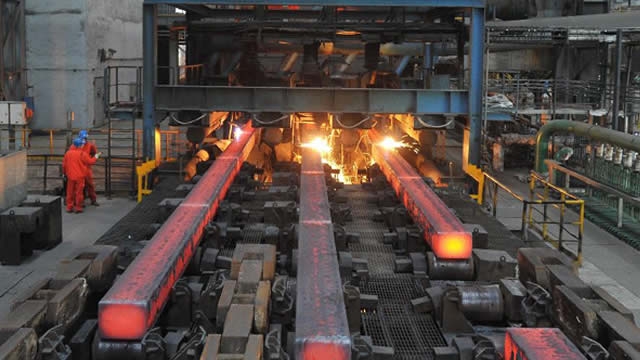
Nucor Reports Results for the Third Quarter of 2025
Prnewswire· 2025-10-27 20:30
Core Insights - Nucor Corporation reported consolidated net earnings of $607 million, or $2.63 per diluted share, for Q3 2025, showing a slight increase from $603 million, or $2.60 per diluted share, in Q2 2025, and a significant rise from $250 million, or $1.05 per diluted share, in Q3 2024 [1][6][17] Financial Performance - Net sales for Q3 2025 reached $8.52 billion, compared to $8.46 billion in Q2 2025 and $7.44 billion in Q3 2024, indicating a 1% increase from the previous quarter and a 14% increase year-over-year [6][19] - Earnings before income taxes and noncontrolling interests for Q3 2025 were $683 million, with EBITDA reported at $1.27 billion [6][19] - The steel mills segment saw a decrease in earnings due to lower volumes and margin compression, while the steel products segment's earnings declined due to higher average costs per ton despite stable pricing [3][9] Strategic Developments - Nucor is focusing on expanding its core steelmaking capabilities and entering downstream, steel-adjacent businesses, including ramping up production at new bar mill projects and advancing sheet steel production [2][9] - The company has returned nearly $1 billion to shareholders year-to-date, representing over 70% of net earnings through Q3 2025 [2][7] Financial Strength - As of the end of Q3 2025, Nucor held $2.75 billion in cash and cash equivalents, with an undrawn $2.25 billion revolving credit facility [5][19] - Nucor maintains strong credit ratings in the North American steel sector, with recent upgrades from Moody's to A3 [5][19] Shareholder Returns - During Q3 2025, Nucor repurchased approximately 0.7 million shares at an average price of $140.46 per share, with a total of about 4.8 million shares repurchased in the first nine months of 2025 [7][19] - A cash dividend of $0.55 per share was declared, marking Nucor's 210th consecutive quarterly cash dividend [8][19] Future Outlook - Nucor anticipates lower earnings in Q4 2025 compared to Q3 2025, primarily due to expected decreases in volumes and average selling prices across its segments [9][19]
What Lumber And Steel Futures Are Telling Flatbedders As We Wrap Up 2025
Yahoo Finance· 2025-10-27 19:33
Core Insights - The housing market is experiencing a slowdown, leading to builders cutting prices and offering incentives to sell finished homes, which in turn affects the demand for construction materials like lumber [1][3][19] - Lumber futures have decreased significantly from their August peak of around $695 per thousand board feet to the $590–$610 range, indicating a shift in market dynamics where supply exceeds demand [3][4][17] - Steel demand is also weak, with global prices under pressure due to insufficient consumption across various sectors, although certain regions still show strong demand for steel related to infrastructure and industrial projects [12][16][20] Lumber Market Analysis - Builders overestimated the demand for new homes, leading to excess inventory and a subsequent decline in lumber prices as housing starts and permits dropped [2][3][4] - The lumber market is signaling that housing is not absorbing materials quickly enough, which is a precursor to a slowdown in flatbed freight related to residential construction [8][19] - The expectation is that flatbed carriers heavily reliant on residential construction will face increased competition and need to diversify their service offerings to maintain profitability [10][18] Steel Market Analysis - Global steel demand has been weak throughout 2025, with prices affected by oversupply and insufficient end-use demand, particularly in Asia [12][13] - U.S. steel mills are benefiting from tariffs that limit imported steel, allowing them to maintain production levels despite weak global demand [14][16] - Certain sectors, such as energy and infrastructure, continue to drive demand for steel, indicating that while the overall market is soft, opportunities still exist in specific regions and industries [15][20] Future Outlook - The overall sentiment for flatbed freight heading into 2026 is one of caution, with expectations of a slow recovery in both lumber and steel markets [17][20] - The best opportunities for flatbed carriers will likely shift away from residential construction towards non-residential projects that are less sensitive to interest rates, such as utility infrastructure and industrial builds [18][20] - Carriers are advised to adapt to the changing landscape by broadening their service areas and focusing on sectors that continue to show demand despite the cooling housing market [10][18]
X @Bloomberg
Bloomberg· 2025-10-27 19:10
A group of lenders to Swedish steel start-up Stegra tapped Houlihan Lokey to advise it as the company faces a funding gap, sources say https://t.co/XjC08l1PI7 ...
Jim Cramer Says “Nucor’s the Best Steel Maker in the World”
Yahoo Finance· 2025-10-27 16:03
Group 1 - Nucor Corporation is highlighted as a key stock in Jim Cramer's game plan, with expectations for positive earnings due to President Trump's tariffs protecting the U.S. steel industry [1] - The company is recognized as the largest steel producer in the U.S. and is noted for its resilience against foreign competition, particularly from China [1] - Despite being a leading steel manufacturer, Nucor is facing challenges in a sluggish economic environment, particularly outside of the data center sector, which may limit earnings potential [1] Group 2 - Nucor manufactures and sells a variety of steel products, including sheet, plate, bar, and structural steel, as well as raw materials like direct reduced iron and scrap metal [2]
Business Brief: The crisis behind the budget
The Globe And Mail· 2025-10-27 10:19
Trade Relations - The relationship between the U.S. and Canada is strained, with President Trump stating he will not meet Prime Minister Carney for an extended period due to a disagreement over a Canadian government ad criticizing U.S. tariffs [2] - Prime Minister Carney is promoting Canada as a reliable trading partner, emphasizing its resources like natural gas and critical minerals, especially in light of Trump's announcement of a 10% increase in tariffs on Canadian imports [3] Economic Context - Both the U.S. Federal Reserve and the Bank of Canada are anticipated to cut interest rates, with investors looking for guidance on future monetary policy amid a government shutdown limiting data availability [4] - Canada's labor productivity has been declining, with GDP per capita reverting to 2019 levels, raising concerns about wage growth and living standards [6][7] Investment Challenges - A significant factor contributing to Canada's low productivity is insufficient business investment, which hampers workers' efficiency due to a lack of necessary tools and technology [8] - A report from Toronto Dominion Bank emphasizes the need for urgent action to address the decline in business investment, suggesting a broadening of the tax base while lowering statutory rates [9][10] Fiscal Policy Recommendations - The Bank of Nova Scotia advocates for clear macroeconomic goals alongside fiscal accountability to enhance productivity and living standards [10] - The Prime Minister has indicated forthcoming changes to the corporate tax system, aiming to ensure competitive tax rates to stimulate investment [12] Trade Diversification Efforts - There is a push for Canada to diversify its trade relationships, particularly with countries like China and India, despite public sentiment favoring trade with the EU over these nations [15]