
Textiles

Search documents
X @The Wall Street Journal
The Wall Street Journal· 2025-09-21 19:39
The latest thing in fashion might be reducing waste through better recycling of textiles https://t.co/GGt45TgWFR ...
Bitter Pills | Summers on the Fed, Funding Fallout, Milei's Tough Policies, UK's Growth Gamble
Youtube· 2025-09-19 22:59
Group 1: U.S. University Research Funding - The Trump administration has halted significant funding for university research, impacting higher education and startup culture [24][25] - U.S. government funding for university research has grown from $253 million in 1953 to approximately $60 billion in 2023, highlighting its importance for innovation [29] - The partnership between the government and universities has been crucial for scientific advancements and economic growth over the past 80 years [28][30] Group 2: Economic Impact of Funding Cuts - Cuts to federal funding for scientific research could lead to a loss of innovation and competitiveness, particularly against countries like China [50][54] - The disruption in funding has already resulted in halted research activities and job losses in academic labs [39][42] - Alternative funding sources, such as venture capital and private sector investments, are emerging but may not fully replace the $60 billion previously provided by the government [47][48] Group 3: Argentina's Economic Reforms - President Javier Milei's austerity measures have reduced inflation from nearly 300% to just over 30%, but have also led to significant job losses and public discontent [61][62] - The Argentine economy has a long history of fiscal deficits, with government spending consistently exceeding tax revenues [66] - The success of Milei's reforms hinges on public support and the ability to maintain fiscal discipline across future administrations [67][72] Group 4: UK Economic Landscape - The UK economy is characterized by regional inequality, with London historically dominating economic activity [105][106] - Recent investments in cities like Birmingham indicate a shift towards diversifying economic growth beyond London [90][100] - The devolution of decision-making to local authorities is seen as a potential driver for improved economic performance in regions outside London [108][112]
Artistic Milliners Acquires Cone Denim
Yahoo Finance· 2025-09-18 13:31
Core Insights - Artistic Milliners, a Pakistan-based denim manufacturer, has acquired a majority stake in Cone Denim, a U.S.-based denim mill, from Elevate Textiles, creating a multinational company under the Cone Denim name [1][2] - The acquisition is expected to close in the first quarter of 2026, with Cone Denim continuing to operate its existing facilities in Mexico and China independently [1][4] Group 1 - The new organization will leverage the combined infrastructure and expertise of both companies to enhance customer service and supply chain flexibility [2][7] - Cone Denim will provide fully vertical, end-to-end solutions, from premium denim fabric to finished garments, operating a global platform [3][5] - The leadership of Cone Denim will remain intact, with Steve Maggard continuing as president and reporting to a new Board of Directors [6] Group 2 - The collaboration aims to enhance Cone Denim's competitive strengths while preserving its unique identity and legacy of over 130 years [5][7] - Both companies share a commitment to innovation, traceability, and sustainability, positioning them as responsible and ethical manufacturers in the global market [7]
India's Gokaldas eyes EU growth, Africa expansion to counter Trump's tariffs
Reuters· 2025-09-18 07:30
Core Viewpoint - Indian textile manufacturer Gokaldas Exports is planning to increase shipments to the European Union and the United Kingdom while expanding production in Africa due to the impact of punitive U.S. tariffs on profits [1] Group 1: Company Strategy - Gokaldas Exports aims to boost shipments to the European Union and the United Kingdom as a strategic response to U.S. tariffs [1] - The company is also looking to expand its production capabilities in Africa to mitigate the risks posed by U.S. tariffs [1] Group 2: Market Context - The decision to shift focus towards the European market and Africa is driven by the need to protect profit margins affected by U.S. tariffs [1]


UniFirst Corporation Plans to Announce Fourth Quarter Results on October 22, 2025
Globenewswire· 2025-09-17 19:28
Core Viewpoint - UniFirst Corporation is set to report its Fiscal 2025 fourth quarter results on October 22, 2025, and will hold a conference call to discuss financial results and outlook [1]. Group 1: Financial Reporting - The company will announce its fourth quarter results before the market opens on October 22, 2025 [1]. - A conference call is scheduled for 9:00 a.m. Eastern Time on the same day to discuss quarterly financial results and business highlights [1]. Group 2: Company Overview - UniFirst Corporation is a North American leader in uniform and workwear supply, facility service products, and safety supplies [3]. - The company operates five ISO-9001-certified manufacturing facilities and manages specialized garment programs for cleanroom and nuclear industries [3]. - With over 270 service locations and more than 300,000 customer locations, UniFirst outfits over 2 million workers daily [3].


US manufacturing output unexpectedly rises on rebound in motor vehicle production
Yahoo Finance· 2025-09-16 14:04
Core Insights - U.S. factory production unexpectedly increased by 0.2% in August, rebounding from a downwardly revised 0.1% decline in July, contrary to economists' expectations of a 0.2% decrease [2][3] - The manufacturing sector, which constitutes 10.2% of the economy, saw a year-over-year production increase of 0.9% in August [2] Manufacturing Sector Performance - Motor vehicle and parts production rose by 2.6% in August after a 0.7% decline in July, while production of fabricated metal products and machinery decreased [4] - Durable manufacturing production increased by 0.2% in August, following a 0.3% gain in July [4] - Nondurable manufacturing output rebounded by 0.3% after a 0.5% decline in the previous month, with increases in textiles, petroleum, and coal products, although plastics and rubber products saw a decline [5] Mining and Utilities - Mining output increased by 0.9% in August after a 1.5% decrease in July, while utilities production dropped by 2.0% following a 0.7% decline in the prior month [6] Industrial Production Overview - Overall industrial production edged up by 0.1% in August after a 0.4% decline in July, with a year-over-year increase of 0.9% [6] Capacity Utilization - Capacity utilization in the industrial sector remained unchanged at 77.4% in August, which is 2.2 percentage points below the 1972–2024 average, while the manufacturing sector's operating rate increased slightly to 76.8%, 1.4 percentage points below its long-run average [7]
Reinventing the Forgotten Language of Textiles | Gaurang Shah | TEDxThe Gaudium School
TEDx Talks· 2025-09-15 16:07
[Music] Namaste and a very beautiful good morning. First time a talk in the school for me. Indian textiles, handcraft, hand loom.one of the second most employment giving after agriculture and over that in Indian textiles it's the saris my first love it's more than just a garment it's a living canvas a canvas which is 7 m long a dream come true for any artist and for me any kind of weave any kind of design any account of my story, thought process I can put on the seven mters of canvas and there are if you go ...

GST reforms set to reignite consumption growth, spur corporate profitability
The Economic Times· 2025-09-15 01:00
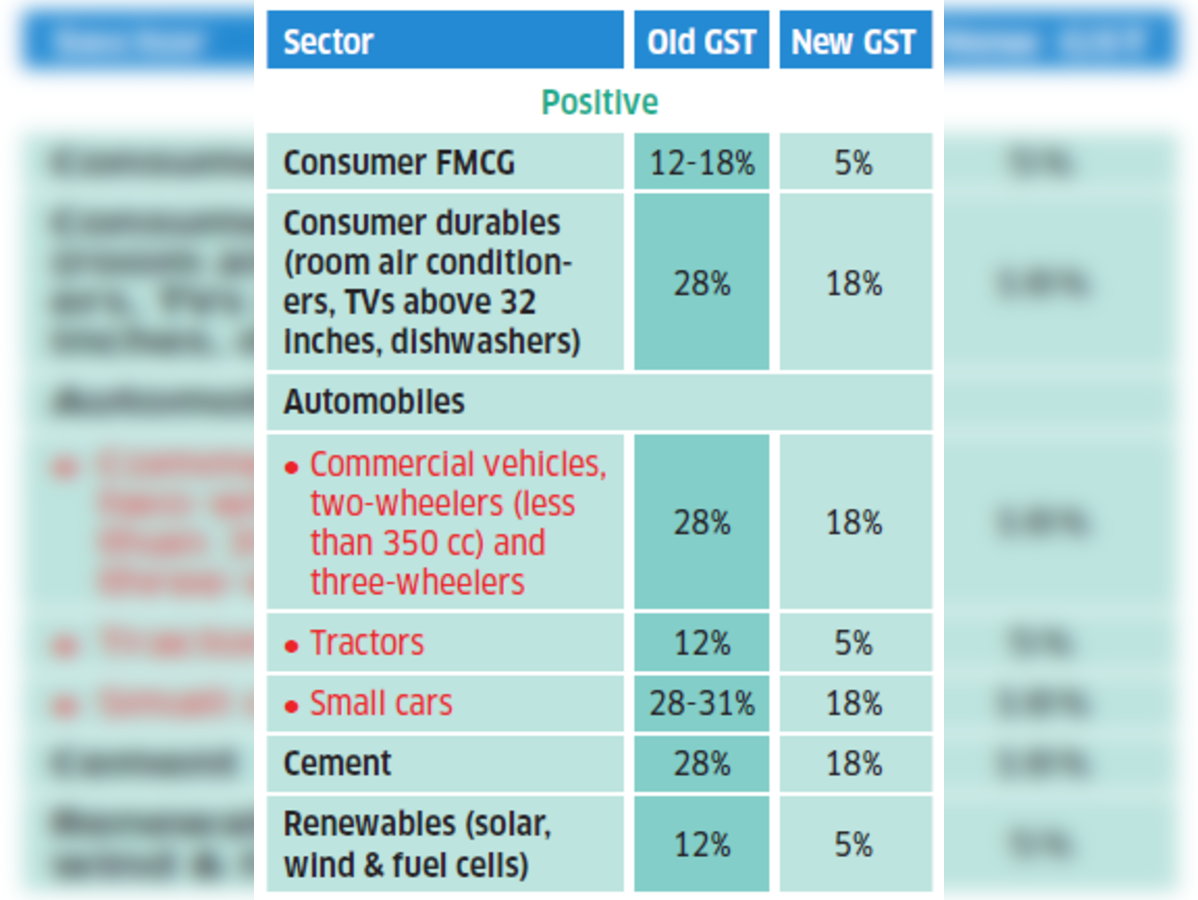
Consumption Sector - The recent GST reforms are expected to boost affordability and consumption across rural and urban markets, with around 90% of items moved from higher to lower tax slabs [1][38] - Experts anticipate a premiumisation effect among low- and middle-income households, as savings on essential goods will redirect purchasing power towards high-value consumption [2][38] - The consumption sector is projected to recover over the next 12-15 months, with private consumption growth expected to rise by 40-50 basis points in the second half of the current financial year [4][41] Corporate Profitability - Lower prices from GST reforms will create volume acceleration for producers, supporting profit margins and leading to an anticipated overall profitability increase of 1-1.5% relative to 2024-25 earnings [5][41] - The reforms are expected to stimulate demand for first-time buyers and replacement purchases, particularly during the festive season, with an industry expectation of a 10-15% improvement in demand for room air conditioners [22][41] Sector-Specific Impacts - Key beneficiaries in the consumer FMCG sector include Britannia Industries, Colgate Palmolive (India), Nestle India, and Emami due to reduced GST on essentials from 12-18% to 5% [11][15][41] - In the consumer durables sector, companies like LG, Daikin, Blue Star, and Dixon Technologies will benefit from reduced GST on room air conditioners and dishwashers from 28% to 18% [18][41] - The automobile sector, including Maruti Suzuki, TVS Motor, Hero MotoCorp, and Bajaj Auto, will see positive impacts from reduced GST rates on commercial vehicles and small cars [23][41] Infrastructure and Housing - The cement industry is expected to benefit from a reduction in GST from 28% to 9%, potentially lowering cement prices by Rs.25-30 per bag, which will support infrastructure and housing sectors [24][41] - Cost-efficient firms like Prism Johnson and Heidelberg Cement are positioned to enhance net realizations and margins over the medium to long term due to these reforms [25][41] Renewable Energy - The renewable energy sector will benefit from a reduction in GST on equipment from 12% to 5%, with key beneficiaries including Tata Power, JSW Energy, and Vikram Solar [26][41] - This reduction is expected to lower capital costs for solar and wind power projects, improving the internal rate of return and supporting government initiatives around renewable energy transition [31][41] Banking and Financial Services - Banks such as HDFC Bank, ICICI Bank, and IDFC First Bank are expected to benefit from increased demand for credit due to a pick-up in consumption and economic activities [32][41] - Non-Banking Financial Companies (NBFCs) focused on retail loans will also benefit from rising demand for consumer durables and vehicles [32][41] Insurance and Textiles - The insurance sector will face mixed impacts, with a reduction in GST on life and health insurance to nil, improving affordability but potentially diluting margins due to loss of input tax credit [33][41] - The textile industry will see a reduction in GST on fabrics and home textiles from 12% to 5%, benefiting companies like Sanathan Textiles and Grasim Industries [30][36][41] Oil and Gas - The oil exploration sector will be adversely impacted by an increase in GST from 12% to 18%, affecting companies like ONGC and Oil India [37][41] - The increase in costs for exploration and production is expected to dent cash flows significantly, with estimates of Rs.2,500-3,000 crore in losses for ONGC [40][41]

Loop Industries and Hyosung TNC Launch Strategic Alliance to Support Shift by Global Brands to Circular Polyester
Accessnewswire· 2025-09-11 22:00
Core Insights - The article highlights the collaboration between Loop and Hyosung TNC to support Loop's Infinite Loop™ India project, which aims to expand the customer base for sustainable textile solutions [1] Group 1: Company Initiatives - Loop is transforming textile waste into high-purity Twist™ polyester, which is a key component in sustainable textile production [1] - Hyosung TNC will utilize Loop's Twist™ polyester to produce high-performance yarns under its Regen™ portfolio, which is recognized by leading apparel and textile brands [1]

Material World: AMSilk Secures Over $60M to Scale, Sealwool’s Biomimetic Twist
Yahoo Finance· 2025-09-11 18:30
AMSilk Overview - AMSilk has transitioned to full-scale production, indicating strong commercial validation and readiness to meet market demand for biofabricated materials [1] - The company has installed dedicated production facilities at key industrial partners to manufacture its proprietary silk-based protein materials [1] Funding and Growth - AMSilk secured €52 million (approximately $61.1 million) in funding, which will be used to scale up production and establish a new industry for high-performance biotech materials [5] - The funding round was led by Athos, with participation from MIG Capital and Novo Holdings, combining $35.25 million in equity and $22.85 million in convertible bonds, reflecting strong investor confidence [4] Production Agreements and Strategy - AMSilk has entered into multi-year production agreements to establish a long-term basis for industrial output and supply reliability [2] - The company is focused on creating robust processes and resilient supply chains to deliver on its industrial commitments and scale its biomaterials for global markets [3]