
仪器仪表

Search documents
汇中股份股价下跌3.10% 股东户数连续4期下降
Jin Rong Jie· 2025-08-21 20:27
Group 1 - The stock price of Huizhong Co., Ltd. is reported at 14.08 yuan, down 0.45 yuan from the previous trading day, with a decline of 3.10% [1] - The opening price was 14.30 yuan, reaching a high of 14.35 yuan and a low of 13.92 yuan, with a trading volume of 93,706 hands and a transaction amount of 1.32 billion yuan [1] - Huizhong Co., Ltd. operates in the instrumentation industry, focusing on the research, production, and sales of smart water meters and heat meters, widely used in urban water supply and heating sectors [1] Group 2 - The number of shareholders of Huizhong Co., Ltd. has decreased for four consecutive periods, with the latest number at 12,236, a reduction of 712 shareholders, representing a decline of 5.50% [1] - In the first quarter, the company achieved operating revenue of 73.6493 million yuan, a year-on-year increase of 47.52%, and a net profit of 6.9693 million yuan, up 71.77% year-on-year [1] - The company expects a net profit for the first half of the year to be between 39.9762 million yuan and 42.0262 million yuan, indicating a year-on-year growth of 95% to 105% [1] Group 3 - On August 21, the net outflow of main funds was 9.3061 million yuan, accounting for 0.49% of the circulating market value [1] - Over the past five days, the net outflow of main funds totaled 6.6808 million yuan, representing 0.35% of the circulating market value [1]

汉威科技股价下跌2.90% 人形机器人新品发布引关注
Jin Rong Jie· 2025-08-21 19:35
Group 1 - The stock price of Hanwei Technology on August 21 was 46.61 yuan, down by 1.39 yuan, a decrease of 2.90% from the previous trading day [1] - The trading volume on that day was 229,769 hands, with a transaction amount of 1.094 billion yuan, and a turnover rate of 8.12% [1] - Hanwei Technology specializes in sensor research and manufacturing, with products widely used in industrial safety and environmental monitoring [1] Group 2 - Hanwei Technology is a significant player in the instrumentation industry, involved in various fields including the Internet of Things and energy conservation [1] - The market is paying attention to Hanwei Technology due to the announcement of the first partner conference by Zhiyuan Robotics on August 21 in Shanghai, where hundreds of robots will be showcased [1] - Recent policy measures from Guangdong Province aim to promote high-quality development in commercial aerospace, supporting companies in investing in satellite constellations [1] Group 3 - On August 21, the net outflow of main funds for Hanwei Technology was 126.3738 million yuan, accounting for 0.96% of the circulating market value [1] - Over the past five days, the cumulative net outflow of main funds reached 352.8863 million yuan, representing 2.68% of the circulating market value [1]

蓝盾光电股价下跌1.58% 公司探索AI在环境监测领域应用
Jin Rong Jie· 2025-08-21 17:20
Group 1 - The stock price of Landun Optoelectronics closed at 26.83 yuan on August 21, down 1.58% from the previous trading day [1] - The trading volume on that day was 62,147 hands, with a transaction amount of 168 million yuan [1] - The company specializes in the research, production, and sales of instruments and equipment for environmental monitoring and meteorological observation, with applications in environmental protection, meteorology, and transportation [1] Group 2 - On August 21, the company stated on its interactive platform that it is actively exploring the application of artificial intelligence in the field of environmental monitoring [1] - The company aims to develop smarter solutions through the integration of artificial intelligence [1]

优利德: 薪酬与考核委员会关于公司2024年限制性股票激励计划相关事项的核查意见
Zheng Quan Zhi Xing· 2025-08-21 16:46
优利德科技(中国)股份有限公司 董事会薪酬与考核委员会关于公司2024年限制性股 票激励计划相关事项的核查意见 (2)最近 12 个月内被中国证监会及其派出机构认定为不适当人选; (3)最近 12 个月内因重大违法违规行为被中国证监会及其派出机构行政处 罚或者采取市场禁入措施; (4)具有《公司法》规定的不得担任公司董事、高级管理人员情形的; (5)法律法规规定不得参与上市公司股权激励的; (6)中国证监会认定的其他情形。 优利德科技(中国)股份有限公司(以下简称"公司")董事会薪酬与考核 委员会根据《中华人民共和国公司法》(以下简称"《公司法》")、《中华 人民共和国证券法》《上市公司股权激励管理办法》(以下简称"《管理办 法》")、《上海证券交易所科创板股票上市规则》(以下简称"《上市规 则》")等相关法律、法规及规范性文件和《优利德科技(中国)股份有限公 司章程》(以下简称"《公司章程》")的有关规定,对公司《2024 年限制性 股票激励计划(草案)》(以下简称"本次激励计划"、"《激励计划(草 案)》")预留授予激励对象名单(截至授予日)及首次授予部分限制性股票 第一个归属期的归属名单进行了核查,并发 ...

Why Is Badger Meter (BMI) Down 2.3% Since Last Earnings Report?
ZACKS· 2025-08-21 16:31
Core Viewpoint - Badger Meter's recent earnings report showed a mixed performance, with earnings per share missing estimates but net sales increasing year over year, indicating potential growth despite challenges in the market [2][10]. Financial Performance - Badger Meter reported Q2 2025 earnings per share (EPS) of $1.17, missing the Zacks Consensus Estimate by 3.3%, but up from $1.12 in the same quarter last year [2]. - Quarterly net sales reached $238.1 million, a 10% increase from $216.7 million in the prior year, driven by higher utility water sales and contributions from the SmartCover acquisition [2]. - Gross profit was $97.8 million, up from $85.4 million year over year, with a gross margin of 41.1%, reflecting a 170 basis point improvement [6]. - Operating earnings increased by 8% year over year to $44.9 million, while operating margin slightly declined to 18.8% from 19.2% [7]. Segmental Performance - Utility water sales rose 11% year over year, supported by the adoption of digital smart water technologies, with organic utility water sales up 6% excluding SmartCover [4]. - Flow instrumentation sales remained flat year over year, as growth in water-related markets was offset by reduced demand in non-water-related applications [5]. Cost and Expenses - Selling, general and administrative (SGA) expenses increased by 20.7% year over year to $52.9 million, primarily due to the SmartCover acquisition [8]. - Without the SmartCover impact, SGA expenses rose by 8%, driven by higher personnel costs and deferred compensation expenses [8]. Cash Flow and Liquidity - In Q2 2025, Badger Meter generated $44.6 million in net cash from operating activities, compared to $36.4 million a year ago [9]. - As of June 30, 2025, the company had $165.2 million in cash and cash equivalents, with total current liabilities of $138.7 million [9]. Outlook - The company is optimistic about achieving high single-digit revenue growth in the long term, supported by strong industry fundamentals and sustained customer demand [10]. - However, estimates have been trending downward, with a consensus estimate shift of -8.68%, leading to a Zacks Rank of 5 (Strong Sell) [11][13].


雪迪龙股价上涨4.24% 公司召开董事会审议临时股东会议案
Jin Rong Jie· 2025-08-21 16:19
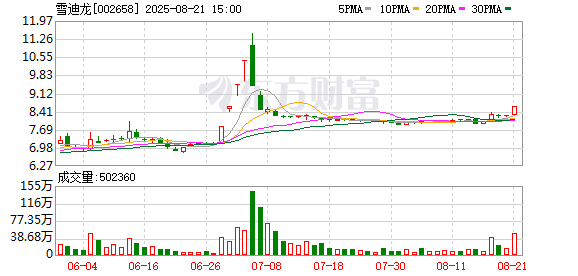
Group 1 - The latest stock price of Xuedilong is 8.60 yuan, an increase of 0.35 yuan from the previous trading day, with a highest intraday price of 8.62 yuan and a lowest of 8.23 yuan, and a trading volume of 502,360 hands, amounting to 426 million yuan [1] - Xuedilong operates in the instrumentation industry, focusing on the research, production, and sales of environmental monitoring equipment, with 92.99% of the company's revenue from instrumentation in the first half of 2025 [1] - On August 21, the company held its 21st meeting of the fifth board of directors, approving the proposal to convene the first extraordinary shareholders' meeting of 2025, and the supervisory board also approved several proposals including the half-year report for 2025 [1] Group 2 - On the same day, the net inflow of main funds was 54.30 million yuan, with a cumulative net inflow of 38.02 million yuan over the past five trading days [2]

雪迪龙:8月21日召开董事会会议
Mei Ri Jing Ji Xin Wen· 2025-08-21 15:46
2025年1至6月份,雪迪龙的营业收入构成为:仪器仪表占比92.99%,其他占比7.01%。 (文章来源:每日经济新闻) 雪迪龙(SZ 002658,收盘价:8.6元)8月21日晚间发布公告称,公司第五届第二十一次董事会会议于 2025年8月21日在公司会议室,以远程视频与现场会议结合的方式召开。会议审议了《关于召开公司 2025年第一次临时股东会的议案》等文件。 ...
持续拓展新市场新领域 川仪股份上半年实现净利3.25亿元
Zheng Quan Shi Bao Wang· 2025-08-21 11:27
Core Insights - The company reported a revenue of 3.281 billion and a net profit of 325 million for the first half of 2025, with a basic earnings per share of 0.63 [1] - The company faced challenges such as insufficient domestic demand and intensified market competition but focused on core business, technological innovation, and market expansion [1] - The company achieved a significant increase in new orders in various sectors, with growth rates ranging from 38% to 64% [1] Financial Performance - The company achieved an operating income of 3.281 billion and a net profit attributable to shareholders of 325 million in the first half of 2025 [1] - The non-recurring net profit was reported at 268 million, indicating a solid financial performance despite external challenges [1] Market Strategy - The company focused on large clients and projects, actively exploring new markets and fields, particularly in nuclear power, fine chemicals, non-ferrous metals, and water resources [1] - The company emphasized the "Belt and Road" initiative, enhancing cooperation with overseas agents in regions such as the Middle East, Central Asia, and Southeast Asia [1] Technological Advancements - The company has made significant strides in domestic technology replacement, successfully applying the H400 control valve in the metallurgical industry and delivering the first domestically produced "Hualong One" turbine bypass valve [2] - The company has developed high-end applications and new fields, achieving breakthroughs in various technologies, including multi-turn DC electric actuators and high-temperature ultrasonic flow meters [2] Research and Development - The company invested 230 million in R&D, accounting for over 7% of its operating income, and is currently involved in 20 national and provincial projects [3] - The company has obtained 74 new patents, including 16 invention patents, and has a total of 1,158 effective patents, demonstrating a strong commitment to innovation [3]

川仪股份: 川仪股份2025年半年度报告摘要
Zheng Quan Zhi Xing· 2025-08-21 09:08
Core Points - The report summarizes the financial performance and operational status of Chongqing Chuan Yi Automation Co., Ltd. for the first half of 2025, highlighting significant changes in revenue and profit metrics [1][5]. Company Overview - Chongqing Chuan Yi Automation Co., Ltd. is listed on the Shanghai Stock Exchange under the stock code 603100, with the stock name "Chuan Yi Shares" [2]. - The company has a total of 20,238 shareholders as of the report date [4]. Financial Data - Total assets at the end of the reporting period amounted to 808,139.78 million RMB, a decrease of 3.90% compared to the previous year [2]. - The net assets attributable to shareholders of the listed company were 451,546.74 million RMB, reflecting an increase of 4.70% year-on-year [2]. - Operating revenue for the reporting period was 328,112.75 million RMB, down 12.37% from the previous year [2]. - Total profit for the period was 36,562.70 million RMB, a decline of 8.78% compared to the previous year [2]. - The net profit attributable to shareholders was 32,455.78 million RMB, representing a decrease of 10.46% year-on-year [2]. - The net profit after deducting non-recurring gains and losses was 26,826.20 million RMB, down 14.66% from the previous year [2]. - The net cash flow from operating activities was reported as -32,749.35 million RMB, with no applicable comparison [2]. - The weighted average return on net assets was 7.23%, a decrease of 1.62 percentage points from the previous year [2]. - Basic and diluted earnings per share were both 0.63 RMB, down 11.27% from the previous year [2]. Shareholder Information - The top three shareholders include China Four Union Instrument Group Co., Ltd. (30.09% ownership), Chongqing Yufu Holdings Group Co., Ltd. (10.65% ownership), and Chongqing Water Environment Holdings Group Co., Ltd. (7.88% ownership) [4]. - The report indicates that the aforementioned shareholders are considered concerted actors under the regulations of listed companies [4]. Control Change - The report mentions an ongoing change in control, where Guojiji Instrument (Chongqing) Co., Ltd. is set to acquire a 19.26% stake from the current controlling shareholder, Four Union Group, and will gain voting rights through a delegation agreement [4].
川仪股份(603100.SH):上半年净利润3.25亿元,同比下降10.46%
Ge Long Hui A P P· 2025-08-21 08:46
格隆汇8月21日丨川仪股份(603100.SH)公布2025年半年度报告,上半年实现营业收入32.81亿元,同比下 降12.37%;归属于上市公司股东的净利润3.25亿元,同比下降10.46%;归属于上市公司股东的扣除非经 常性损益的净利润2.68亿元,同比下降14.66%;基本每股收益0.63元。 ...