公积金

Search documents
打通“住房与养老”,公积金改革可否借鉴新加坡经验|新京报专栏
Xin Jing Bao· 2026-01-08 12:25
Core Viewpoint - The recent discussions on the reform of the housing provident fund system in China have gained significant attention, particularly with the upcoming Central Economic Work Conference in 2025 emphasizing the need for deepening reforms [2][7]. Group 1: Current Challenges - The existing housing provident fund system faces challenges such as insufficient coverage and low utilization efficiency, primarily benefiting large enterprises and government institutions while excluding small businesses and flexible employment workers [7]. - There is a significant regional disparity in the contribution and usage of the provident fund, leading to an imbalance in the system [7]. - The current system is criticized for its rigidity, with many restrictions on withdrawals that do not meet diverse needs [7]. Group 2: Reform Directions - The reform should expand the provident fund's role from a single housing guarantee function to a comprehensive livelihood account, incorporating pension and medical care [7][11]. - A potential pathway includes establishing a conversion mechanism between the provident fund and enterprise annuities, optimizing fund utilization and investment returns [7]. - Short-term reforms could focus on increasing coverage and flexibility, allowing for withdrawals for housing, education, and other essential expenditures [8]. Group 3: International Experiences - The Singapore Central Provident Fund (CPF) serves as a model, featuring a three-in-one account system that integrates housing, retirement, and healthcare, allowing for flexible fund allocation [3][4]. - Other countries, such as the UK and Canada, provide insights into integrating reverse mortgages and personalized loan plans, which could inform China's reform efforts [5][6]. - The successful implementation of reforms in other nations highlights the importance of adapting mechanisms to local conditions while ensuring a balance between fund flow, functional integration, and risk control [6]. Group 4: Long-term Vision - A long-term goal could be the establishment of a "comprehensive livelihood account" that integrates housing, pension, and medical accounts, providing lifelong security [8][11]. - Introducing market-oriented investment mechanisms would allow members to allocate assets based on their risk preferences, supported by tax incentives to encourage long-term contributions [8]. - The reform should focus on a holistic approach that prioritizes the full lifecycle needs of individuals, moving beyond mere adjustments to a complete restructuring of the system [11].

明年1月起,部分公积金贷款可降月供
Xin Lang Cai Jing· 2025-12-27 11:16
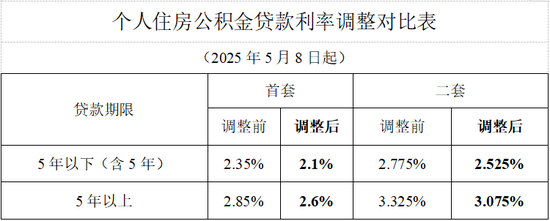
Core Viewpoint - The People's Bank of China announced a reduction in personal housing provident fund loan interest rates, effective from May 8, 2025, with a decrease of 0.25 percentage points for both first and second home loans [1][7]. Group 1: Interest Rate Adjustments - The new interest rates for first home loans will be 2.1% for loans of 5 years or less and 2.6% for loans over 5 years, while second home loans will be 2.525% and 3.075% respectively [1][2]. - For loans issued before May 8, 2025, the adjusted rates will take effect from January 1, 2026 [2][8]. - Examples show that a typical family borrowing 1.2 million yuan over 30 years will save approximately 57,100.85 yuan in interest for a first home and 59,070.01 yuan for a second home after the rate adjustment [2][8]. Group 2: Policy Enhancements for Housing Support - Various regions are increasing support for housing loans, with Tianjin proposing to raise the maximum loan limits for first and second homes from 1 million yuan and 500,000 yuan to 1.2 million yuan and 1 million yuan respectively [3][10]. - Policies are becoming more refined, such as Yunnan increasing loan limits for families with multiple children by 20% to 30% for first and second homes [3][10]. - Other cities like Shanghai are also raising loan limits for qualifying new green buildings by 15% [3][10]. Group 3: Rental Support Initiatives - Cities are enhancing support for rental housing, with Shijiazhuang increasing the annual rental withdrawal limit from 15,000 yuan to 18,000 yuan per person, and further to 21,000 yuan for those meeting certain criteria [4][11]. - Some regions are optimizing the methods for withdrawing funds for rent, such as allowing monthly direct payments for rent in Chengdu [4][11]. Group 4: Expansion of Fund Usage - There is a trend towards expanding the use of housing provident funds beyond just housing, with cities like Shijiazhuang and Xuzhou allowing withdrawals for property management fees and heating costs [5][11]. - The range of eligible conditions for fund withdrawals is also being broadened, with cities like Weifang allowing family members to withdraw funds for home purchases [5][12]. Group 5: Support for Flexible Employment - Several provinces are encouraging participation in the provident fund system among flexible employment workers, with policies allowing them to withdraw funds for home purchases without restrictions based on residency or work location [12]. - Benefits for flexible employment workers include low-interest loans and tax reductions [12]. Group 6: Intercity Recognition of Funds - There is ongoing progress in the intercity recognition of housing provident funds, with cities like Shenzhen expanding withdrawal ranges nationwide and Kunming removing restrictions on intercity withdrawals [6][12].