
农用化学品

Search documents
利民股份:关于签订重大合同的公告
Zheng Quan Ri Bao Zhi Sheng· 2026-02-27 11:09
Group 1 - The core point of the article is that Limin Co., Ltd. has signed a long-term supply contract for agricultural chemicals with BAYERS.A., which is set to last for three years with an option for automatic renewal for another three years if neither party objects [1] - The estimated contract value for the first three years is 800 million yuan, with a total estimated value of 1.6 billion yuan over six years, subject to actual order amounts [1] - Either party can notify the other in writing at least 180 days before the current contract period ends if they do not wish to renew, without incurring any penalties or liabilities [1]

002734,午后涨停!午间公告,签订大单
Xin Lang Cai Jing· 2026-02-27 06:41
Core Viewpoint - Limin Co., Ltd. (002734) has signed a long-term supply contract for agricultural chemicals with BAYER S.A. for a duration of three years, with potential automatic renewal for another three years if neither party objects [1][2][4]. Group 1: Contract Details - The contract's subject is agricultural chemicals, with an estimated total amount of 800 million yuan for the first three years and approximately 1.6 billion yuan over six years [4]. - Either party can notify the other in writing at least 180 days before the contract's expiration if they do not wish to renew, without incurring penalties or liabilities [2][3]. Group 2: Financial Impact - The execution of this contract is expected to have a positive impact on the company's financial status and operating results for the fiscal year 2026 and subsequent accounting periods [4]. - Following the announcement, Limin Co., Ltd. experienced a rapid increase in stock price, reaching a peak increase of over 9%, with the stock price reported at 22.38 yuan per share and a total market capitalization exceeding 10.6 billion yuan [4].

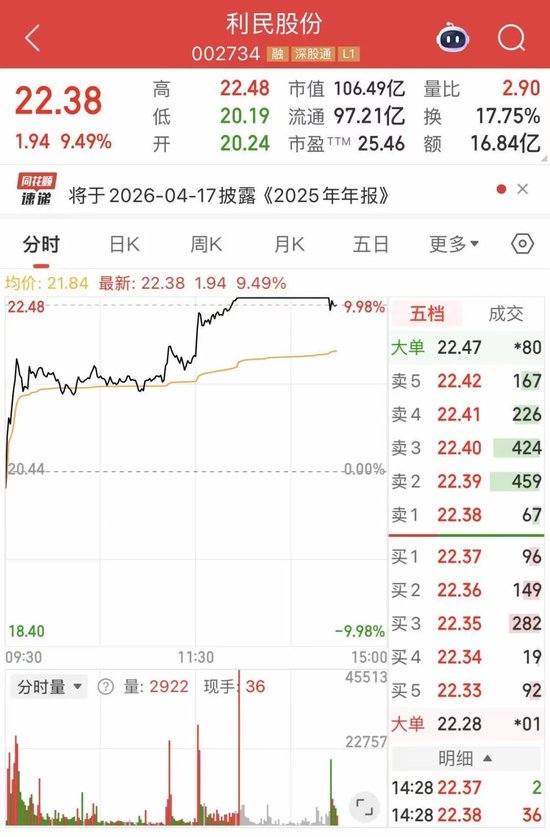
利民股份(002734.SZ)与拜耳签订农用化学品长期供货合同 前3年合同金额8亿元
Ge Long Hui A P P· 2026-02-27 04:05
Group 1 - The core point of the article is that Limin Co., Ltd. has signed a long-term supply contract for agricultural chemicals with Bayer S.A. for a duration of three years, with an option for automatic renewal for another three years if neither party objects [1] - The estimated contract value for the first three years is 800 million RMB, with a total estimated value of 1.6 billion RMB over the six-year period, subject to actual order amounts [1] - Either party can notify the other in writing at least 180 days before the current contract expires if they do not wish to renew, without incurring any penalties or liabilities [1]
利民股份:与拜耳签订最长6年期农用化学品长期供货合同 总金额约16亿元
Mei Ri Jing Ji Xin Wen· 2026-02-27 04:02
Core Viewpoint - Limin Co., Ltd. has signed a long-term supply contract for agricultural chemicals with Bayer S.A., which is expected to generate significant revenue over the next several years [1] Group 1: Contract Details - The contract duration is set for 3 years, with an automatic renewal for another 3 years unless either party provides written notice at least 180 days prior to the expiration [1] - The estimated contract value for the first 3 years is 800 million RMB, with a total estimated value of approximately 1.6 billion RMB over 6 years, subject to actual order amounts [1]
利民股份与拜耳签订16亿元长期供货合同
Zhi Tong Cai Jing· 2026-02-27 03:57
Core Viewpoint - The company signed a long-term supply contract with Bayer S.A. for agricultural chemicals, which is expected to positively impact its financial performance in the coming years [1] Group 1: Contract Details - The contract duration is set for three years, with an automatic renewal for another three years unless either party provides a written notice at least 180 days prior to expiration [1] - The estimated contract value for the first three years is 800 million RMB, with a total estimated value of 1.6 billion RMB over six years, subject to actual order amounts [1] Group 2: Financial Impact - The contract value for the first three years represents approximately 18.83% of the company's audited revenue for the year 2024 [1] - The execution of this contract is expected to have a positive impact on the company's financial condition and operating results for the fiscal year 2026 and beyond [1]
利民股份(002734.SZ)与拜耳签订16亿元长期供货合同
智通财经网· 2026-02-27 03:52
Core Viewpoint - The company, Limin Co., Ltd. (002734.SZ), has signed a long-term supply contract for agricultural chemicals with Bayer S.A., which is expected to positively impact its financial performance in the coming years [1] Group 1: Contract Details - The contract is for a duration of three years, with an option for automatic renewal for another three years unless either party provides written notice at least 180 days before the expiration [1] - The estimated contract value for the first three years is 800 million RMB, with a total estimated value of 1.6 billion RMB over six years, subject to actual order amounts [1] Group 2: Financial Impact - The estimated contract value for the first three years represents approximately 18.83% of the company's audited revenue for its main business in 2024 [1] - The execution of this contract is expected to have a positive impact on the company's financial condition and operating results for the fiscal year 2026 and subsequent accounting periods [1]
利民股份:公司与拜耳签订16亿元长期供货合同
Xin Lang Cai Jing· 2026-02-27 03:46
Group 1 - The company has signed a long-term supply contract for agricultural chemicals with BAYER S.A. (Bayer) [1] - The contract duration is set for 3 years, with an automatic renewal for another 3 years if both parties agree [1] - The estimated contract value for the first 3 years is 800 million RMB, with a total estimated value of approximately 1.6 billion RMB over 6 years [1]
Why FMC Corporation Plunged Today
Yahoo Finance· 2026-02-05 19:09
Core Viewpoint - FMC Corporation's shares experienced a significant decline of 20.7% following disappointing fourth-quarter earnings and the announcement of exploring strategic options, including a potential sale of the company [1][2]. Financial Performance - In the fourth quarter, FMC reported revenue of $1.08 billion, which is a 12% decrease and below market expectations. Adjusted earnings per share were $1.20, down 33% from the previous year, meeting expectations [3]. - The company's preliminary outlook for 2026 anticipates a further 5% decline in revenue to $3.7 billion, a 17% decline in adjusted EBITDA to $700 million, and a 41% decline in adjusted EPS to $1.76 [5]. Strategic Challenges - FMC is currently facing a difficult agricultural downcycle characterized by overcapacity in agricultural chemicals and low margins for growers. The company's chemical portfolio has largely gone off-patent, necessitating price reductions, which negatively impacts profitability [4]. - FMC's debt stands at $4.07 billion, which is 5.8 times the company's EBITDA guidance for 2026, indicating a high debt-to-profits ratio [4]. Future Outlook - Management projects that its current on-patent chemicals could generate sales of $300 million to $400 million in 2026, representing about 10% of total revenue. These sales are expected to grow to $800 million by 2028, $1 billion by 2030, and $2 billion by 2035 [6].

阿根廷大幅放松农用化学品管制
Shang Wu Bu Wang Zhan· 2026-01-21 15:42
Core Viewpoint - The new regulations issued by the National Agricultural Food Hygiene and Quality Service will simplify the registration, import, and sales processes for agricultural chemicals, effective January 5, 2026 [1] Group 1: Regulatory Changes - The new regulations amend and clarify the previous Resolution No. 458, focusing on easing entry requirements for production companies and shortening product approval times [1] - Production companies will only need to submit a sworn declaration to initiate production activities, eliminating the need for prior authorization and a technical manager [1] - The scope of recognition for research and trial reports conducted abroad will be expanded, facilitating international collaboration [1] Group 2: Import Process Simplification - International trial reports that comply with Good Laboratory Practice (GLP) will be recognized, streamlining the import process for pesticide products approved in high-regulation countries such as the EU, USA, Canada, Switzerland, and Norway [1] - The import process will be simplified to a sworn declaration and a temporary registration system for these products [1] Group 3: Genetically Modified Organisms (GMOs) - For genetically modified products, prior approval from the National Agricultural Biotechnology Advisory Committee (Conabia) will suffice, eliminating the need for new assessments [1] Group 4: Transparency and Guidance - The National Agricultural Food Hygiene and Quality Service will publish a "Pesticide Product Management Operation Guide" to enhance process transparency and assist companies in understanding the relevant procedures [1]
农用化学品市场喜忧参半
Zhong Guo Hua Gong Bao· 2026-01-20 02:56
Core Viewpoint - The global agricultural chemicals market is expected to face mixed prospects in 2026 due to resilient recovery and policy uncertainties, with cautious optimism from pesticide and fertilizer companies despite challenges [1] Market Overview - The global agricultural chemicals market is projected to reach $77.7 billion in 2026, a 2.7% increase from $75.7 billion in 2025, marking a significant recovery from the 0.3% growth rate of 2024-2025 [2] - The global seed market is also expected to grow by 2.3% during the same period, providing a boost to agricultural companies that have faced prolonged downturns [2] Industry Challenges - U.S. agricultural profits are expected to decline, with net income projected to drop from $177 billion in 2025 to $148 billion in 2026, influenced by falling crop prices and rising core costs such as fertilizers and labor [1] - Policy risks, particularly related to tariff uncertainties from the Trump administration, continue to create volatility for farmers and suppliers, expected to persist into 2026 [2] Positive Factors - Demand for grains, oilseeds, meat, and biofuels is anticipated to remain historically high, supporting stable demand from farmers who will prioritize high-tech products to maximize yields [3] - The fertilizer market shows a positive outlook, with the removal of import tariffs providing some relief, although supply shortages are expected to keep prices elevated [3] Overall Outlook - Despite facing policy uncertainties and high costs, industry leaders maintain a cautiously optimistic view for the agricultural chemicals market in 2026, driven by stable agricultural demand and a gradual recovery in input markets [4]