创意行业

Search documents
分析了1.8亿个岗位后,我发现应届生们好像被AI堵在了门外。
数字生命卡兹克· 2025-11-11 01:21
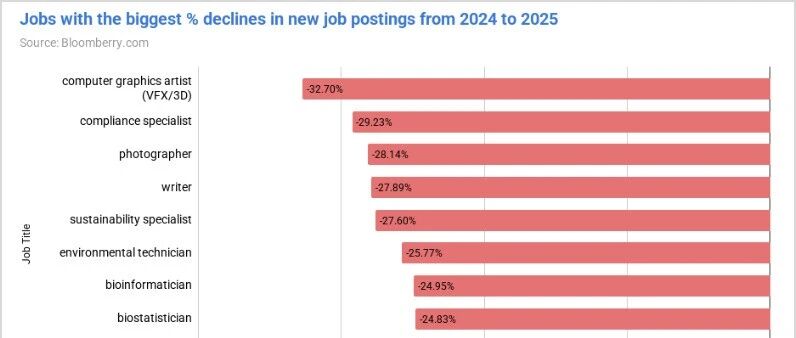
Core Insights - The article analyzes the impact of artificial intelligence (AI) on job markets by examining 180 million job postings from 2023 to 2025, revealing significant trends in job displacement and creation [1][3]. Group 1: Job Market Trends - The overall job postings are projected to decrease by 8% in 2025 compared to 2024, indicating a contraction in the employment market [3]. - Specific job roles have seen declines exceeding this average, suggesting deeper issues potentially linked to AI [4]. Group 2: Job Displacement - The top ten job roles with the largest declines include CG artists, compliance officers, photographers, writers, and sustainability experts, with creative roles particularly affected [5][7]. - Creative management positions, such as creative directors and managers, have shown resilience and even growth, contrasting with execution-level roles [8][12]. Group 3: Job Creation - The ten job roles with the highest growth include software engineering directors, legal directors, real estate directors, and data engineering directors, with machine learning engineers seeing a notable increase of 39.62% [11]. - Senior leadership roles have experienced minimal decline, only dropping by 1.7%, while management roles decreased by 5.7%, indicating a preference for experienced professionals over entry-level positions [14]. Group 4: Impact on New Graduates - New graduates, particularly in entry-level positions, are facing significant challenges, with many roles disappearing from the market [20][22]. - The article highlights a sentiment among young job seekers that the job market has become increasingly difficult, with many feeling disillusioned despite low overall unemployment rates [24][26]. Group 5: The Future of Work - The article discusses the potential loss of apprenticeship models due to AI's efficiency, which may eliminate the need for training and mentorship of new employees [30][32]. - The narrative emphasizes a shift where experienced professionals may prefer to utilize AI for tasks, leading to a lack of opportunities for newcomers to gain essential skills [54][63].