学徒制

Search documents
英国政府承诺新增5万个学徒制岗位
Shang Wu Bu Wang Zhan· 2025-12-15 09:56
Group 1 - The UK government is significantly expanding its apprenticeship program, aiming to provide 50,000 apprenticeship positions to address rising youth unemployment [1] - The number of young people starting apprenticeship training has decreased by nearly 40% over the past decade, prompting government action [1] - The government will eliminate the 5% levy for apprentices under 25 and introduce new apprenticeship opportunities in sectors such as artificial intelligence, hospitality, engineering, and defense [1] Group 2 - An additional £820 million will be invested to assist young people on Universal Credit in finding employment [2] - From April 2026, 55,000 fully subsidized internship positions will be launched in six areas with the highest youth unemployment rates, targeting young people who have been on benefits for 18 months or more [2] - The overall goal of the government is to create 350,000 training and work experience opportunities [2]
分析了1.8亿个岗位后,我发现应届生们好像被AI堵在了门外
虎嗅APP· 2025-11-14 14:21
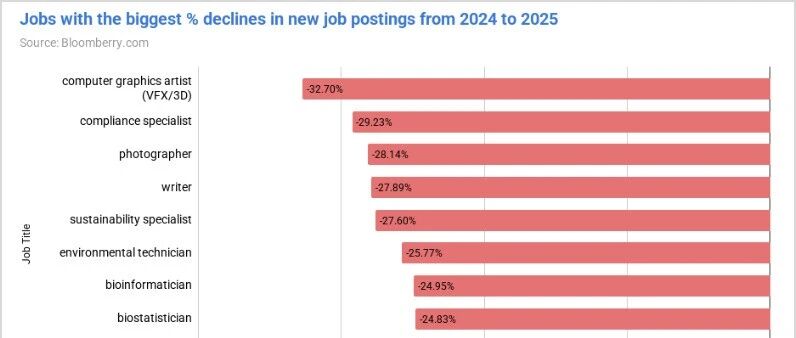
Core Insights - The article discusses the impact of AI on job markets, particularly focusing on the decline of entry-level positions and the rise of management roles, indicating a shift in employment dynamics due to AI advancements [5][10][11]. Employment Trends - A baseline is established showing that global job postings are expected to decrease by 8% from 2024 to 2025, indicating a contraction in the job market [11][12]. - The top ten job roles experiencing the largest declines include CG artists, compliance officers, photographers, and writers, with creative positions being particularly affected [14][16]. - Conversely, roles such as software engineering directors and machine learning engineers are seeing significant growth, with machine learning engineers increasing by 39.62% [24][25]. Management vs. Entry-Level Positions - Senior leadership roles have only decreased by 1.7%, while management positions have dropped by 5.7%, indicating that higher-level roles are more resilient to market changes [30][31]. - Entry-level positions have seen a decline of 9%, which is below the overall market contraction, highlighting a troubling trend for new graduates [32][35]. Implications for New Graduates - The article highlights the struggles of recent graduates in securing entry-level jobs, with many positions disappearing and the job market becoming increasingly competitive [43][44]. - The narrative of a recent computer science graduate illustrates the disconnect between qualifications and job availability, emphasizing the challenges faced by young professionals [40][41]. Cultural and Educational Impact - The traditional apprenticeship model, which has been crucial for skill development, is being undermined by AI's efficiency, leading to a potential loss of mentorship and experiential learning opportunities [56][60]. - The story of a carpenter's apprentice serves as a metaphor for the loss of hands-on experience and the nuanced understanding that comes from years of practice, which AI cannot replicate [64][68]. Future Outlook - The article warns that as AI continues to replace entry-level roles, the pathway for young professionals to ascend to management positions may become increasingly obstructed, leading to a homogenized workforce lacking diversity in experience and innovation [92][93]. - The potential for a future where experienced professionals find themselves without successors is highlighted, raising concerns about the sustainability of knowledge transfer and innovation in the industry [94][96].


分析了1.8亿个岗位后,我发现应届生们好像被AI堵在了门外。
数字生命卡兹克· 2025-11-11 01:21
Core Insights - The article analyzes the impact of artificial intelligence (AI) on job markets by examining 180 million job postings from 2023 to 2025, revealing significant trends in job displacement and creation [1][3]. Group 1: Job Market Trends - The overall job postings are projected to decrease by 8% in 2025 compared to 2024, indicating a contraction in the employment market [3]. - Specific job roles have seen declines exceeding this average, suggesting deeper issues potentially linked to AI [4]. Group 2: Job Displacement - The top ten job roles with the largest declines include CG artists, compliance officers, photographers, writers, and sustainability experts, with creative roles particularly affected [5][7]. - Creative management positions, such as creative directors and managers, have shown resilience and even growth, contrasting with execution-level roles [8][12]. Group 3: Job Creation - The ten job roles with the highest growth include software engineering directors, legal directors, real estate directors, and data engineering directors, with machine learning engineers seeing a notable increase of 39.62% [11]. - Senior leadership roles have experienced minimal decline, only dropping by 1.7%, while management roles decreased by 5.7%, indicating a preference for experienced professionals over entry-level positions [14]. Group 4: Impact on New Graduates - New graduates, particularly in entry-level positions, are facing significant challenges, with many roles disappearing from the market [20][22]. - The article highlights a sentiment among young job seekers that the job market has become increasingly difficult, with many feeling disillusioned despite low overall unemployment rates [24][26]. Group 5: The Future of Work - The article discusses the potential loss of apprenticeship models due to AI's efficiency, which may eliminate the need for training and mentorship of new employees [30][32]. - The narrative emphasizes a shift where experienced professionals may prefer to utilize AI for tasks, leading to a lack of opportunities for newcomers to gain essential skills [54][63].