商旅

Search documents
中国AI旅游应用分化加剧:谁在领跑?谁陷停滞?
Sou Hu Cai Jing· 2025-10-06 02:30
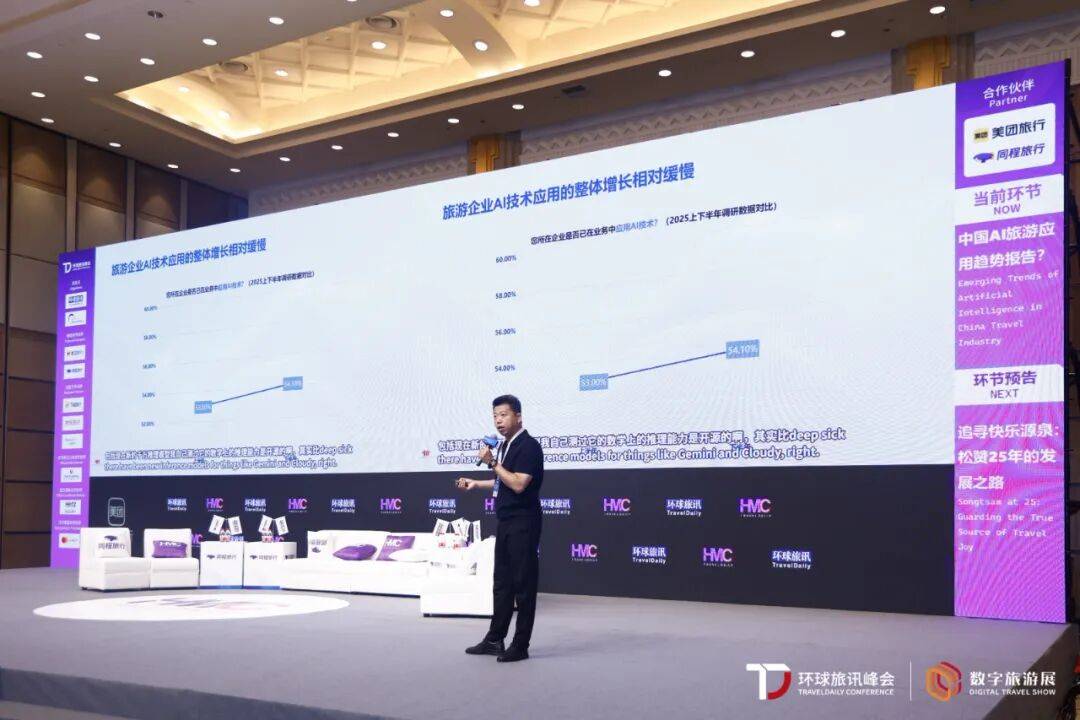
Core Insights - The application of AI in China's tourism industry is evolving from conceptual discussions to practical implementations, significantly transforming operational methods for both travelers and tourism companies [2][3] - A report presented at the 2025 Global Travel Summit highlights the challenges and trends of AI adoption within tourism enterprises, emphasizing the role of grassroots employees over CEOs in driving AI integration [4][5] AI Adoption Trends - In the first half of 2024, 53% of surveyed companies reported using AI, with a slight increase to 54.1% in the second half, indicating a slow adoption rate in B2B contexts despite frequent media coverage of new models [5][6] - Large enterprises (1,000+ employees) saw a decline in AI usage from 80.6% to 74.4%, while medium-sized enterprises (200-500 employees) increased their usage from 38.5% to 53.3% [6][7] Sectoral Disparities - The AI application rates among tourism companies show a clear three-tier differentiation: - The first tier includes technology-intensive sectors like airlines, which have a high AI penetration rate - The second tier consists of business travel companies and travel tech firms, known for their quick adoption of new technologies - The third tier includes OTAs, tourism boards, and scenic spots, which are lagging behind [7][8][9] Organizational Challenges - Despite individual employees using AI, many companies have not established end-to-end AI workflows, indicating a gap in organizational integration [11] - Over 50% of companies believe that external policies and market conditions significantly impact AI technology applications, highlighting the uncertainty in the current environment [12] Application Focus - 76.3% of companies are prioritizing AI for internal operational efficiency, although some application rates, such as store management and personalized recommendations, have decreased due to perceived cost-benefit issues [12][13][14] - A significant portion of companies (46.8%) believes AI will mature within one to two years, reflecting an overly optimistic outlook on AI capabilities [16][18] Key Recommendations for AI Integration - Companies need to redefine their understanding of generative AI, moving beyond viewing it as a mere IT project aimed at replacing human roles [19] - Successful AI implementation requires overcoming three capability bridges: organizational questioning ability, data leadership, and human-machine collaboration [19][20] - Establishing dedicated AI project management offices and cultural performance metrics can facilitate better integration of AI into business processes [20][23]

积极推进多项业务 陆家嘴上半年营收增长34%
Shang Hai Zheng Quan Bao· 2025-07-30 08:41
Core Viewpoint - The company reported a mixed financial performance for the first half of 2025, with significant revenue growth but a decline in net profit, indicating challenges in profitability despite strong operational cash flow [1][2]. Financial Performance - The company's operating revenue for the first half of 2025 was 6.6 billion yuan, an increase of 33.91% year-on-year [1]. - The net profit attributable to shareholders was 815 million yuan, a decrease of 7.87% year-on-year [1]. - The net profit excluding non-recurring items was 828 million yuan, down 6.67% year-on-year [1]. - The net operating cash flow was 4.735 billion yuan, showing a significant increase of 96.98% year-on-year [1]. - Earnings per share (fully diluted) stood at 0.1619 yuan [1]. Quarterly Performance - In the second quarter, the company achieved an operating revenue of 2.38 billion yuan, a year-on-year increase of 31.7% [1]. - The net profit attributable to shareholders for the second quarter was 185 million yuan, up 30.0% year-on-year [1]. - The net profit excluding non-recurring items for the second quarter was 208 million yuan, reflecting a year-on-year increase of 42.6% [1]. - Earnings per share for the second quarter were 0.0367 yuan [1]. Asset and Equity Growth - As of the end of the second quarter, the company's total assets reached 167.667 billion yuan, a growth of 4.4% compared to the end of the previous year [1]. - The net assets attributable to shareholders were 24.915 billion yuan, an increase of 1.2% from the end of the previous year [1]. Business Strategy - The company is actively promoting multiple business initiatives, particularly in regional development operations and financial services [1]. - The company adheres to a "steady progress" work guideline, focusing on resource allocation and capability enhancement in the Pudong area [1]. - In the financial services sector, the company is implementing a strategy of "stable operations, promoting transformation, and controlling risks" to ensure high-quality development [2]. - The business travel sector aims to enhance market influence and operational performance through brand building and commercial integration [2].

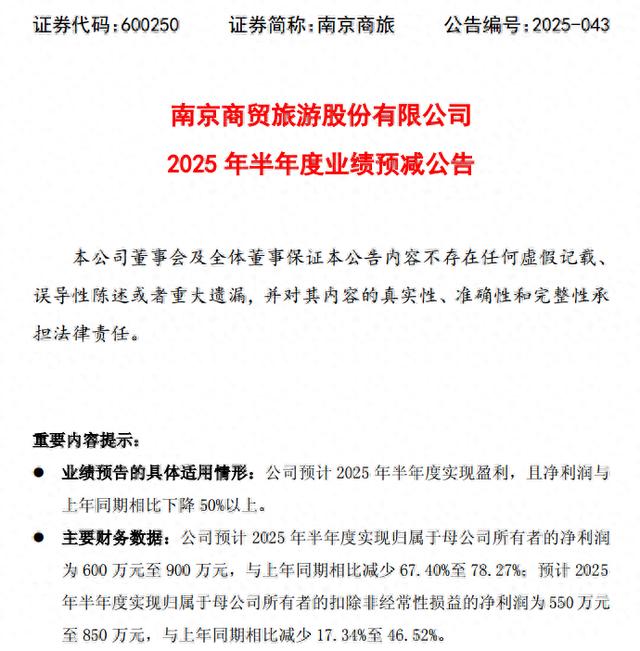
南京商旅亏近八成
Huan Qiu Wang· 2025-07-03 07:01
Core Viewpoint - Nanjing Commercial Tourism Co., Ltd. (referred to as "Nanjing Tourism") expects a significant decline in net profit for the first half of 2025, projecting a profit of only 6 million to 9 million yuan, representing a year-on-year decrease of 67.40% to 78.27% [1][4] Group 1: Financial Performance - The company attributes the profit reduction to two main factors: the decline of non-operating income and pressure on core business operations [4] - Last year's net profit for the same period was 27.607 million yuan, with a total profit of 69.096 million yuan, indicating a stark contrast to the current year's projections [4] - The year-on-year decline in net profit excluding non-recurring items is estimated to be between 17.34% and 46.52%, indicating weakened profitability in core business segments [4] Group 2: Market Reaction - Despite the poor earnings forecast, Nanjing Tourism's stock price surged, hitting the daily limit up on July 2, closing at 12.85 yuan per share, with a total market capitalization of 3.991 billion yuan [4][5] - The market's positive response may be linked to the ongoing asset restructuring, where the company plans to acquire 100% equity of Nanjing Huangpu Grand Hotel from its controlling shareholder, Nanjing Tourism Group [5] Group 3: Strategic Outlook - The restructuring aims to extend the cultural tourism industry chain and enhance market competitiveness, with the controlling shareholder showing support by entrusting management of several businesses to the listed company [5] - Although the restructuring process faced delays due to expired evaluation materials, the company has received a notice to resume the review process as of June 28 [5] - The company is at a crossroads, facing significant challenges in its core business while also having potential transformation opportunities through asset restructuring [5]