
政府监管

Search documents
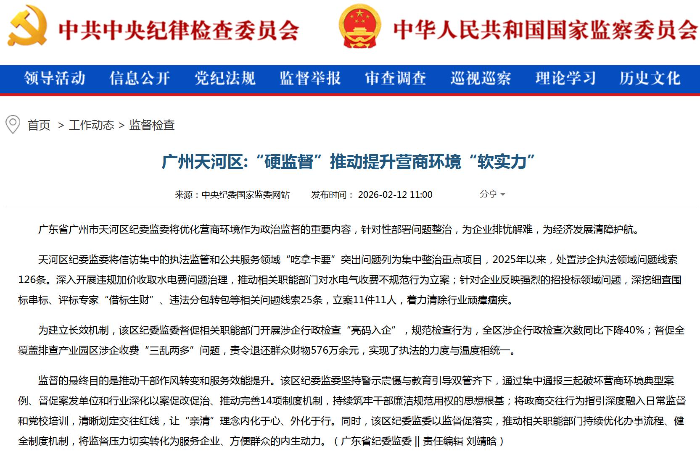
中央纪委国家监委网站:广州天河区“硬监督”推动提升营商环境“软实力”
Zhong Yang Ji Wei Guo Jia Jian Wei Wang Zhan· 2026-02-12 07:53
Group 1 - The Tianhe District Commission for Discipline Inspection and Supervision in Guangzhou, Guangdong Province, is prioritizing the optimization of the business environment as a key aspect of political supervision, focusing on problem rectification to alleviate issues for enterprises and support economic development [1] - Since 2025, the district has addressed 126 problem clues related to law enforcement in the business sector, with a focus on issues such as illegal price hikes in utility fees and irregularities in bidding processes, leading to the establishment of 11 cases involving 11 individuals [1] - The district is implementing a long-term mechanism by promoting standardized administrative inspections in enterprises, resulting in a 40% year-on-year decrease in the number of inspections, and has mandated the return of over 5.76 million yuan to the public [1] Group 2 - The ultimate goal of supervision is to promote a transformation in the work style of officials and enhance service efficiency, with the district emphasizing both deterrence and educational guidance [2] - The district has reported three typical cases of damaging the business environment and is urging relevant units to deepen reforms and improve 14 institutional mechanisms to strengthen the integrity of officials [2] - The district is integrating guidelines for government-business interactions into daily supervision and training, clearly defining boundaries to internalize the "Qin Qing" concept in practice [2]

实践故事 | 推动惠民惠农补贴精准发放
Zhong Yang Ji Wei Guo Jia Jian Wei Wang Zhan· 2025-10-28 00:37
Core Insights - The article discusses the implementation of a big data supervision model by the Jiangyang District Commission for Discipline Inspection and Supervision in Luzhou, Sichuan Province, to identify irregularities in agricultural insurance fund distribution [1][2] - The use of big data has enabled quicker identification of issues, such as the case of a village official misappropriating agricultural insurance subsidies [1] - The initiative aims to ensure that agricultural subsidies reach the intended beneficiaries, thereby enhancing the effectiveness of policies aimed at improving people's livelihoods [1] Group 1 - The Jiangyang District's Commission has developed a big data supervision platform to analyze agricultural insurance fund distribution, leading to the identification of anomalies [1] - A specific case was highlighted where a village official was found to have misappropriated funds, resulting in disciplinary action and full recovery of the misused funds [1] - The platform employs 16 data supervision models focusing on various subsidy types, allowing for efficient detection of potential issues through data analysis and alerts [1] Group 2 - The Commission emphasizes the importance of data integration for effective supervision, following principles of integrated management and secure data sharing [2] - Custom supervision models are created based on specific needs, enabling real-time tracking and analysis of subsidy distribution, including identifying cases of fraud or unclaimed benefits [2] - The approach includes forming investigation teams to verify strong leads and systematically analyzing related information to prevent future risks in subsidy management [2]
南京高淳区:精准监督守好国资“家底”
Zhong Yang Ji Wei Guo Jia Jian Wei Wang Zhan· 2025-10-10 06:44
Core Insights - The article highlights the successful revitalization of a previously idle land parcel in Yangjiang Town, Nanjing, through effective supervision and management of state-owned assets, leading to both economic development and asset optimization [1][2] Group 1: Asset Management and Utilization - The Nanjing High-tech District's Discipline Inspection and Supervision Commission initiated a comprehensive review of state-owned assets, focusing on real estate and land to identify management issues and enhance asset utilization [1] - The commission employed a "four-dimensional work method" involving data analysis, document review, field verification, and interviews to clarify the status of state-owned assets and address management challenges [1] Group 2: Problem Identification and Resolution - The commission identified discrepancies in asset management, such as missing rental contracts and inconsistencies in reported asset sizes, by comparing various data sources including management ledgers and financial records [1] - Over 2,400 assets were inspected, and more than 1,100 individuals were interviewed to uncover issues like unreported assets, idle properties, unpaid rents, and management deficiencies, leading to the referral of over 30 problem cases [1] Group 3: Collaborative Governance - In response to the identified issues, the commission is promoting a "big supervision" framework that encourages collaboration among various departments, including finance and state-owned assets, to enhance governance and oversight [2] - Measures such as improving management systems, facilitating the reissuance of property certificates, and developing an online supervision system are being implemented to create a closed-loop supervision mechanism [2]
泰州海陵:专项监督保障营商环境优化提升
Xin Hua Ri Bao· 2025-08-13 22:59
Group 1 - The core viewpoint emphasizes the importance of a good business environment as a catalyst for high-quality development, with the Haoling District's disciplinary inspection and supervision committee actively optimizing the business environment through various measures [1][2]. - The "Qingfeng Warm Enterprise" special supervision initiative has been implemented, focusing on seven key issues including policy implementation, service approval, and judicial fairness [1][2]. - The committee has identified 46 issues through self-inspection and has established monitoring points for 20 representative enterprises, collecting feedback on eight obstructive issues affecting the business environment [2]. Group 2 - The Haoling District's disciplinary committee has conducted a special inspection over ten working days, visiting 154 enterprises and 12 departments, resulting in a report that outlines 23 issues across five areas, which have been assigned to 31 departments for resolution [2]. - The committee has established a mechanism for tracing unresolved issues and has reviewed over 1,300 complaints from the public, addressing 144 pain points in government services [2][3]. - Continuous efforts are being made to enhance the business environment by focusing on the conduct of officials, addressing issues such as corruption and inefficiency, and ensuring that problems are genuinely resolved [3].
宿迁实现涉企检查“一网统管”
Xin Hua Ri Bao· 2025-07-27 23:48
Group 1 - The core viewpoint is that Suqian City has implemented a digital regulatory system called "Su Yi Cha" to enhance the business environment and streamline enterprise inspections [1][2] - The "Su Yi Cha" system integrates resources from 352 administrative agencies and includes 571 inspection items covering 54,604 enterprises, aiming to standardize administrative checks [2] - The system has led to a 42% year-on-year decrease in repeated inspections, with a total of 3,601 joint inspections conducted so far this year [1][2] Group 2 - Suqian City has designated this year as the "Year of Business Environment Improvement" and has introduced several measures to support this initiative [2] - The system promotes a "quiet period" for enterprises and employs a "credit + risk" regulatory model, ensuring minimal disruption for businesses with a high credit rating [2] - From January to May, the number of administrative penalty cases related to enterprises was 1,260, a decrease of 2.06%, while the total fines amounted to 4.056 million yuan, down 23.25% [2]