无障碍产业

Search documents
【前瞻分析】2025年中国无障碍行业产品市场规模及无障碍服务分析
Sou Hu Cai Jing· 2026-01-29 10:06
Core Insights - The accessibility industry focuses on providing services for the elderly and disabled, aiming to eliminate barriers to their daily lives and enhance their quality of life [1][3] - The industry includes a variety of products and services, such as mobility aids, communication devices, and smart technology, catering to different needs and scenarios [1][3] Industry Overview - The accessibility industry is characterized by its social care attributes, demand-driven features, and integration of resources across multiple fields [1] - Key products include rehabilitation aids like prosthetics and wheelchairs, communication tools like Braille software, and smart devices for navigation and monitoring [1] Market Trends - The electric wheelchair market is projected to grow from approximately 49.4 billion yuan in 2020 to about 70.5 billion yuan by 2024, with a compound annual growth rate (CAGR) of 7% [6][7] - The rehabilitation robot market is expected to expand significantly, from 3.7 billion yuan in 2019 to 15.29 billion yuan by 2024, reflecting a CAGR of over 30% [8] Policy Development - The legal framework for the accessibility industry began to take shape in 2023, with the implementation of the "Barrier-Free Environment Construction Law" marking a shift towards a regulated industry [12] - Prior to 2023, policies focused on basic support for disabled individuals and the elderly, with initiatives aimed at promoting rehabilitation and accessibility services [12]

2026年中国无障碍产业政策、产业链、市场规模、竞争企业及发展趋势研判:随着老龄化加速和残障群体需求升级,无障碍产业迎来前所未有的发展机遇[图]
Chan Ye Xin Xi Wang· 2026-01-26 01:40
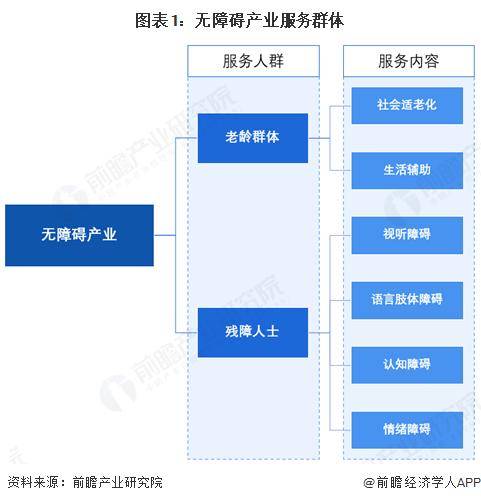
Core Viewpoint - The accessibility industry is emerging as a significant economic growth point in China, transitioning from a welfare-focused sector to a market-driven one, driven by the aging population and the increasing needs of disabled groups [1][2]. Group 1: Industry Definition and Service Objects - The accessibility industry aims to improve, compensate, or replace human functions for groups such as the disabled, elderly, patients, and pregnant women, enhancing their quality of life and promoting social inclusion [1][2]. Group 2: Current Development Status - The market size of China's accessibility industry is projected to grow from 78 billion yuan in 2020 to 140 billion yuan by 2025, with an expected increase to 163 billion yuan by 2026 [2]. Group 3: Industry Chain - The upstream of the accessibility industry includes raw materials like metals, plastics, and electronic components, while the midstream consists of software systems and hardware products, and the downstream applications are found in homes, public buildings, and rehabilitation institutions [3]. Group 4: Development History - The accessibility industry in China has undergone four stages: the embryonic stage (2001-2007), the regulatory stage (2008-2014), the smart transformation stage (2015-2023), and the service ecosystem stage (2024-present) [3]. Group 5: Policy Environment - Recent national policies, such as the "Barrier-Free Environment Construction Law," have established a legal framework for the development of the accessibility industry, enhancing the construction of urban accessibility facilities [4]. Group 6: Competitive Landscape - Major companies in the accessibility software sector include iFlytek, SenseTime, and Tencent, while hardware companies include Yuyue Medical, Kefu Medical, and Shanghai Construction Group, among others [5][6]. - Kefu Medical reported a revenue of 1.496 billion yuan in the first half of 2025, with rehabilitation aids contributing 563 million yuan, accounting for 37.63% of total revenue [7][8]. - Yuyue Medical is a leading supplier of medical consumables, with a focus on rehabilitation care products, generating 234 million yuan in revenue from these products in the first half of 2025 [6]. Group 7: Future Development Trends - The accessibility industry is expected to expand significantly due to the aging population, with a shift from physical accessibility standards to digital, cultural, and social service areas, indicating a trend towards high-value software services and integrated solutions [9][10].