假肢

Search documents
AWE 2026 探展回顾:30人大佬团,0距离对话明星企业CXO
雷峰网· 2026-03-20 11:11
Group 1 - The article discusses the exploration of AI hardware opportunities and trends through a visit to AWE 2026, involving 30 industry leaders and 20 core companies [2][3] - The exploration team included professionals from various sectors such as technology finance, industrial decision-making, and research, highlighting the diverse backgrounds of participants [2] - Key companies visited during the exploration included Qingxin Yichuang, Aoshark Intelligent, Qiangnao Technology, and others, showcasing innovations in AI hardware [4] Group 2 - Qingxin Yichuang introduced a small home robot named Amoo, which focuses on emotional value output and is expected to reduce its price from 20,000-50,000 yuan to around 10,000 yuan after mass production [6] - Aoshark Intelligent showcased its consumer and industrial exoskeleton products, priced at 6,000-7,000 yuan, designed for outdoor sports and featuring AI-driven algorithms [7] - Qiangnao Technology presented a prosthetic limb utilizing brain-machine interface technology, allowing users to perform activities like playing the piano, and a sleep device that significantly reduces sleep onset time [9] Group 3 - Yingling displayed the world's first panoramic drone, Antigravity A1, which features 360-degree viewing capabilities and supports 8K material export [13] - SenseTime introduced its multimodal large model applications in both home and commercial scenarios, including an intelligent robot guide for exhibitions [13][14] - Xiaopeng Huitian presented a "land aircraft" with a price under 2 million yuan, designed for personal use and featuring advanced driving capabilities [16] Group 4 - The exploration highlighted the popularity of embodied intelligent robots, with companies like Zhiyuan Robotics and Jingshi Technology showcasing their innovative robotic designs and functionalities [18] - iRobot presented its development history and new products, including the AI-enhanced cleaning robot capable of identifying various stubborn stains [20] - The exploration also included discussions on the technological advancements in real-time interaction and high-precision sensors for cleaning robots by companies like Agora and Lingtu [21] Group 5 - Post-exploration feedback indicated that participants found the experience valuable, with insights into industry trends and product innovations shared during closed-door dinners [23] - Suggestions for improvement included expanding the exploration scope and enhancing audio clarity during presentations [25] - The exploration team plans to continue engaging in future events, such as the Beijing Auto Show and CES, to further explore new opportunities in the hardware sector [25]


康复辅具行业可持续发展白皮书
荣续智库· 2026-03-02 09:20
Investment Rating - The report does not explicitly provide an investment rating for the rehabilitation assistive devices industry. Core Insights - The rehabilitation assistive devices industry is increasingly important due to the accelerating global aging population, which highlights the need for improved quality of life for the elderly and disabled [3][4]. - The industry is supported by strong government policies and is experiencing significant growth in China, with the market expected to reach 70 billion yuan by 2025 [16][19]. - Sustainable development is a key focus, with the report discussing various dimensions such as accessibility, green materials, circular economy, and technological innovation [3][4]. Summary by Sections Chapter 1: Introduction to Rehabilitation Assistive Devices - Rehabilitation assistive devices are defined as products that improve, compensate, or replace human functions, widely used by individuals with disabilities, the elderly, and patients [12][16]. - The market for rehabilitation assistive devices is growing, with a significant demand from various groups, including the elderly and chronic disease patients [16][18]. Chapter 2: Development of the International Elderly Care Industry - Countries like Japan and Germany have established comprehensive elderly care systems, integrating community services and professional care [27][31]. - Japan's rental model for rehabilitation assistive devices is highlighted as a successful example, with a structured insurance system supporting accessibility [30][31]. Chapter 3: Development of China's Elderly Care Industry - China's elderly care industry is evolving through various stages, with significant growth in the number of elderly individuals and the demand for services [35][43]. - The report outlines the development of a three-tier rehabilitation system to enhance service delivery and accessibility [51][52]. Chapter 4: Sustainable Development Directions for the Rehabilitation Assistive Devices Industry - The report emphasizes the importance of sustainability in the industry, focusing on green materials, circular economy practices, and technological advancements [3][4]. - It discusses the need for a skilled workforce to support these sustainable initiatives [3]. Chapter 5: Case Studies of Rehabilitation Assistive Device Companies - The report includes successful case studies from companies like Matsunaga, providing insights into innovative practices and business models in the industry [3].
【前瞻分析】2025年中国无障碍行业产品市场规模及无障碍服务分析
Sou Hu Cai Jing· 2026-01-29 10:06
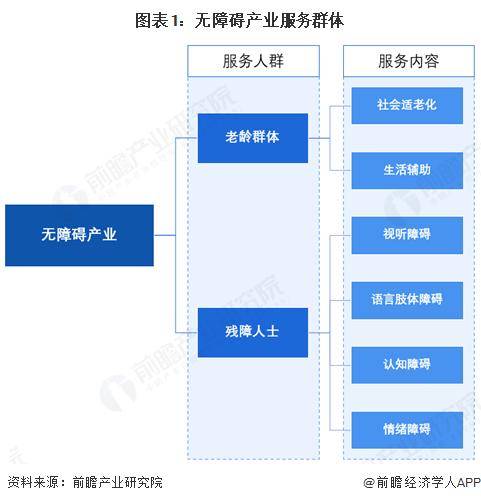
Core Insights - The accessibility industry focuses on providing services for the elderly and disabled, aiming to eliminate barriers to their daily lives and enhance their quality of life [1][3] - The industry includes a variety of products and services, such as mobility aids, communication devices, and smart technology, catering to different needs and scenarios [1][3] Industry Overview - The accessibility industry is characterized by its social care attributes, demand-driven features, and integration of resources across multiple fields [1] - Key products include rehabilitation aids like prosthetics and wheelchairs, communication tools like Braille software, and smart devices for navigation and monitoring [1] Market Trends - The electric wheelchair market is projected to grow from approximately 49.4 billion yuan in 2020 to about 70.5 billion yuan by 2024, with a compound annual growth rate (CAGR) of 7% [6][7] - The rehabilitation robot market is expected to expand significantly, from 3.7 billion yuan in 2019 to 15.29 billion yuan by 2024, reflecting a CAGR of over 30% [8] Policy Development - The legal framework for the accessibility industry began to take shape in 2023, with the implementation of the "Barrier-Free Environment Construction Law" marking a shift towards a regulated industry [12] - Prior to 2023, policies focused on basic support for disabled individuals and the elderly, with initiatives aimed at promoting rehabilitation and accessibility services [12]
2026年残疾儿童康复救助开始报名
Zheng Zhou Ri Bao· 2026-01-23 00:43
Group 1 - The core point of the article is the launch of the rehabilitation assistance program for disabled children in Zhengzhou City, which will start accepting applications in 2026 [1] Group 2 - The assistance targets children aged 0-14 years with various disabilities, including visual, auditory, speech, physical, intellectual disabilities, and autism, who meet specific criteria [2] - Applicants must have a permanent residence or residence permit in Zhengzhou and hold a disability certificate or a diagnosis from a secondary hospital indicating the need for rehabilitation [2] Group 3 - The assistance covers three main categories: surgeries, adaptive equipment, and rehabilitation training [3] - For surgeries, the one-time subsidy is 12,000 yuan for basic cochlear implant surgery and 17,200 yuan for corrective surgery for physically disabled children, with subsidies provided after multiple insurance reimbursements [3] - Average subsidies for adaptive equipment include 4,800 yuan per person for hearing aids, 5,000 yuan for prosthetics and orthotics, and 1,500 yuan for wheelchairs and other aids [3] - Rehabilitation training subsidies are set at 1,800 yuan per person per year for visually impaired children and 19,000 yuan for other disabilities, with a higher standard of 20,000 yuan for children from low-income families or orphanages [3] Group 4 - Applications can be submitted through both online and offline channels, with the local disability association responsible for review and public announcement [4] - Costs for surgeries and rehabilitation services will first be covered by various insurance schemes, with remaining costs subsidized according to set standards [4] - A list of contact numbers for various districts in Zhengzhou is provided for inquiries regarding the application process [4]
强脑科技比马斯克脑机先盈利 揭秘最神秘杭州“六小龙”
Xin Lang Cai Jing· 2026-01-19 13:16
Core Insights - Strong Brain Technology has achieved its first annual profit in 2025, marking a significant milestone in the brain-computer interface industry [1][2] - The company has capitalized on favorable market conditions, including the positive perception of the "Hangzhou Six Dragons," global interest sparked by Elon Musk, and supportive domestic policies [1] - Unlike invasive competitors like Neuralink, which took eight years to generate revenue and is not expected to commercialize until 2030, Strong Brain Technology has found success through consumer-oriented products [1] Group 1 - Strong Brain Technology's profitability is attributed to its consumer market products, particularly those related to meditation and sleep, which have become important revenue sources [2] - The company has effectively leveraged the current market environment to enhance its visibility and growth potential [1] - The challenges faced by invasive brain-computer interface technologies highlight the innovative approach taken by Strong Brain Technology in achieving early profitability [1]
2008年已经远去 廖智没有忘记那片废墟|我们的四分之一世纪
经济观察报· 2025-12-25 08:30
Core Viewpoint - The article narrates the inspiring journey of Liao Zhi, a survivor of the Wenchuan earthquake, who transformed her trauma into a mission of helping others, particularly children with disabilities, while also embracing her own identity and freedom despite her physical challenges [3][10][21]. Group 1: Personal Journey and Resilience - Liao Zhi lost her daughter and both legs in the 2008 earthquake, marking a turning point in her life where she had to rebuild herself and her purpose [3][10]. - After her rescue, Liao Zhi focused on self-recovery, engaging with fellow patients and spreading positivity, which she described as a form of self-help [12][13]. - She made a pivotal decision to return to the stage despite her injuries, viewing it as a way to reclaim her life and express her resilience [15][16]. Group 2: Advocacy and Community Support - Liao Zhi founded "Morning Star Home" with her husband Charles, providing prosthetic fittings and psychological support for amputee children, aiming to eliminate societal biases against disabilities [22][24]. - The initiative has already assisted nearly forty disabled children, emphasizing the importance of self-acceptance and confidence in their identities [28]. - Liao Zhi's mission extends to sharing her knowledge and experiences with amputee mothers, aiming to improve the quality of life for disabled individuals through advanced prosthetic technology [30][33].

2008年已经远去 廖智没有忘记那片废墟|我们的四分之一世纪
Jing Ji Guan Cha Wang· 2025-12-24 09:04
Core Insights - The article highlights the journey of Liao Zhi, a survivor of the 2008 Wenchuan earthquake, who transformed her trauma into a mission of empowerment and advocacy for the disabled community [5][10][20]. Group 1: Personal Journey and Resilience - Liao Zhi lost her daughter and both legs in the earthquake, but she redefined her identity as a survivor and embraced life with gratitude [5][10]. - After her rescue, she focused on recovery and actively engaged with other patients, using humor and camaraderie to uplift spirits [11][12]. - Liao Zhi's determination led her to perform on stage again, symbolizing her defiance against her past and her commitment to living fully [13][14]. Group 2: Advocacy and Community Support - Liao Zhi founded "Morning Star Home" with her husband Charles, providing prosthetic support and emotional care for amputee children [20][21]. - The initiative aims to empower children to embrace their identities and combat societal prejudices against disabilities [22][23]. - Liao Zhi's personal experiences drive her mission to help others, emphasizing that her journey of giving back is also a form of healing for herself [24][26]. Group 3: Future Aspirations and Innovations - Liao Zhi and Charles are working on advanced prosthetic technologies, including 3D printing and AI, to improve comfort and accessibility for amputees [26]. - Their goal is to bring these innovations back to China, enhancing the quality of life for disabled individuals [26].
医疗辅助技术(AT)行业“十五五”市场战略研究及投资建议可行性评估预测报告(2025版)
Sou Hu Cai Jing· 2025-09-29 02:16
Core Insights - The medical assistive technology (AT) market is projected to reach a size of $37.94 billion by 2029, with a compound annual growth rate (CAGR) of 6.6% in the coming years [3][5]. Group 1: Industry Overview - Medical assistive technology refers to products and services designed to maintain or improve functionality and promote well-being, particularly for individuals with disabilities, the elderly, and those with non-communicable diseases [2][5]. - The market is driven by technological advancements and an increasing focus on improving the quality of life for individuals with disabilities [5][6]. Group 2: Market Dynamics - Innovations such as smart sensors, wearable devices, and connectivity solutions enhance user independence and participation [5]. - The aging population and rising disability rates create a strong demand for solutions that promote autonomy and well-being [5][6]. Group 3: Challenges - High research and manufacturing costs pose significant challenges, particularly for innovative technologies [5][6]. - Compliance with stringent regulations and varying requirements across different countries complicates market entry and increases resource demands [5][6]. - Slow adoption rates by healthcare institutions and insurance reimbursement processes hinder widespread use of assistive technologies [6]. Group 4: Future Outlook - The integration of supportive policies and initiatives by governments and healthcare systems is expected to further drive market growth [5]. - The combination of technological advancements and social awareness highlights the dynamic potential of the medical assistive technology market [5].