港航业

Search documents
支持全球海洋中心城市建设,深圳发布16条港航新举措
2 1 Shi Ji Jing Ji Bao Dao· 2025-12-10 13:52
Core Viewpoint - Shenzhen is accelerating the implementation of the marine power strategy, focusing on building a modern marine industry system with Shenzhen characteristics and advantages, supported by the newly released "Several Measures for High-Quality Development of Maritime Services and Port Navigation" [1] Group 1: Key Measures - The "Several Measures" includes 16 specific innovative initiatives aimed at addressing critical issues hindering the high-quality development of Shenzhen's maritime industry [1] - One of the key innovations is the implementation of "non-stop operation certification" for ship registration transfers, which aims to streamline the process and reduce the operational downtime for ships during the transfer period [2][3] - The initiative to establish a "dual license" management model for Hong Kong and Macau yachts is designed to enhance the convenience of yacht travel within the Guangdong-Hong Kong-Macau Greater Bay Area [4] Group 2: Economic Impact - The new ship registration transfer policy is expected to save approximately 20 days of operational downtime for a typical Panamax bulk carrier, potentially generating over one million yuan in additional economic benefits for companies during the transfer period [3] - The total container throughput of Shenzhen Port reached 32.41 million TEUs from January to November, reflecting a year-on-year increase of 6.57%, with a water-to-water transshipment ratio of 33.0% [5] - The exploration of a direct river-sea model aims to facilitate direct shipping to the Yantian Port area, which is currently limited by its lack of coverage in the inland river shipping area, thereby optimizing logistics costs and promoting green development [5]
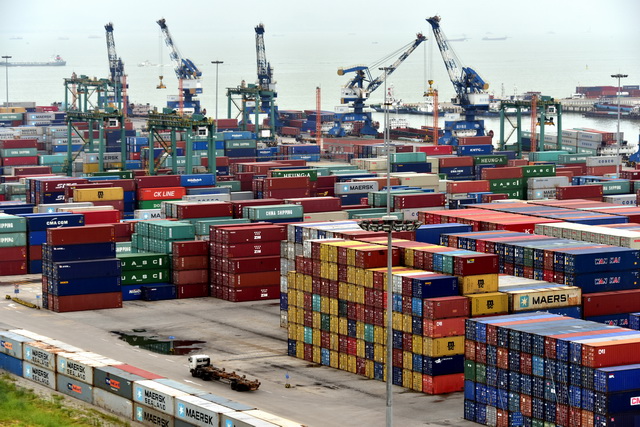
从规模增长向质量跃升转型,我国港航业瞄准智能航运
Di Yi Cai Jing· 2025-11-28 02:33
Core Viewpoint - The development of new productivity in China's port and shipping industry has laid a solid foundation for high-quality water transport development, transitioning from scale growth to quality improvement, with a focus on technological innovation and green, low-carbon initiatives [1][2]. Group 1: Industry Transformation - China's port and shipping industry is undergoing a transformation from "scale growth" to "quality improvement," emphasizing technological leadership and focusing on smart shipping and green low-carbon initiatives [1]. - The industry aims to achieve a systematic transformation by upgrading all elements including "ship, port, cargo, and people," and moving from factor-driven to innovation-driven growth [1][5]. Group 2: Infrastructure and Capacity - During the 14th Five-Year Plan period, China added 379 berths of 10,000 tons or more, bringing the total to 2,971, with over 70% of important coastal port areas having rail access [2]. - In 2024, China's port cargo throughput is projected to reach 17.6 billion tons, a year-on-year increase of 3.7%, while container throughput is expected to reach 33 million TEUs, up 7% [2]. Group 3: Automation and Efficiency - Major domestic ports have achieved automation in key operational processes such as loading and unloading, with examples like the Yangshan Phase IV automated terminal demonstrating a 50% increase in efficiency through innovative technologies [3]. - The introduction of automated systems, such as dual-container automated cranes, has significantly improved operational efficiency in container handling [3]. Group 4: Technological Innovation - The industry is increasingly focusing on independent innovation, achieving breakthroughs in key technologies, such as the development of proprietary terminal operation systems by ports like Shanghai and Shandong [5]. - The Shanghai Port's automated terminal utilizes a fully domestically developed intelligent operation control system, showcasing advancements in self-sufficiency in technology [5]. Group 5: Future Directions - The industry is encouraged to strengthen technological innovation, overcome key technological bottlenecks, and enhance green and low-carbon transformation to improve overall efficiency across the supply chain [5]. - The China Maritime Association aims to continue fostering technological leadership and collaboration in smart shipping and green initiatives, promoting the transition of innovative results from research to practical applications [5].

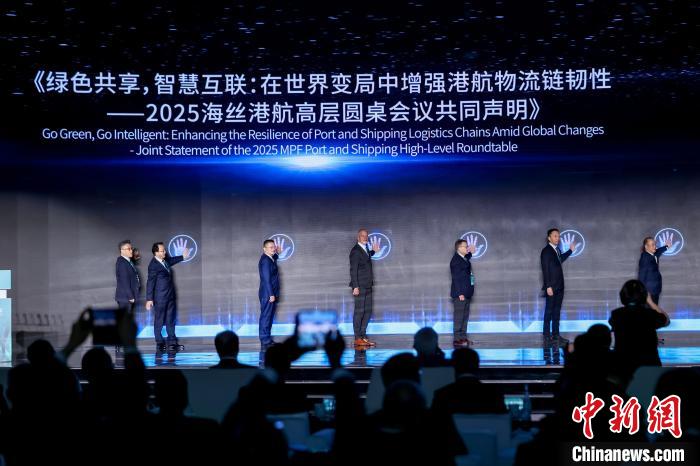
海丝港航高层代表发布《共同声明》 呼吁绿色共享智慧互联
Zhong Guo Xin Wen Wang· 2025-05-28 09:27
Core Viewpoint - The 2025 Maritime Silk Road Port Cooperation Forum emphasizes the need for consensus and collaboration in the maritime industry to promote high-quality development through green low-carbon initiatives, digital connectivity, and multilateralism [1][4]. Group 1: Forum Overview - The forum took place in Ningbo, Zhejiang, on May 27, 2025, and featured the release of a joint statement titled "Green Sharing, Smart Connectivity: Enhancing the Resilience of Port and Shipping Logistics Chains Amid Global Changes" [1][4]. - The joint statement was unanimously adopted during a high-level roundtable meeting attended by 47 representatives from key domestic and international port operators, shipping companies, international maritime organizations, and research institutions [4]. Group 2: Industry Challenges and Responses - The global maritime industry is currently facing multiple challenges, including pressure for green transformation and instability in supply chains, necessitating a search for cooperative consensus and new development paths [4]. - The joint statement asserts that the maritime industry, as a pillar of global trade, should contribute to global economic stability by achieving high-quality development and acting as a reliable "maritime anchor" [4]. Group 3: Commitments and Initiatives - The signatories of the joint statement commit to actively practicing green development principles and promoting low-carbon transformation in the maritime industry [4]. - There is a focus on deepening digital collaboration and innovation to integrate smart ports and intelligent shipping [4]. - The statement emphasizes the importance of strengthening supply chain risk warning and emergency cooperation mechanisms to ensure the stability and smoothness of global logistics chains [4]. - A commitment to multilateralism is highlighted, supporting a rules-based free trade system and resolving trade disputes through dialogue and consultation [4]. - The forum aims to build a platform for cooperative prosperity, promote knowledge sharing and capacity building, and oppose technological monopolies and market fragmentation, thereby fostering a maritime community of shared destiny [4].