社会基础设施

Search documents
2026年基础设施投资展望
罗兰贝格· 2026-01-24 00:55
Investment Rating - The report indicates a positive outlook for infrastructure investments in 2026, driven by renewed enthusiasm for large transactions and evolving value creation expectations [1][2]. Core Insights - The infrastructure investment landscape is expected to be shaped by two cross-industry trends: the revival of large transactions and the evolution of value creation [1]. - There is a robust demand for large transactions across various sectors, with optimism returning to the mid-market after years of stagnation [2]. - Value creation has become a fundamental expectation for both large and mid-sized infrastructure funds, reflecting a new standard in asset management [5][9]. Summary by Relevant Sections Investment Outlook - The report emphasizes a broad perspective on infrastructure investment trends for 2026, focusing on the impact of large transactions and value creation evolution [1]. M&A Hotspots - Key sectors driving M&A activity in 2026 include transportation, energy and utilities, digital infrastructure, and social infrastructure [12]. - Specific M&A hotspots identified are: - **Transportation**: Intermodal rail, bus operators, aviation equipment leasing [13]. - **Energy and Utilities**: District heating, midstream assets, water and wastewater assets [14]. - **Digital Infrastructure**: AI data centers, edge computing, subsea cables [15]. - **Social Infrastructure**: Healthcare equipment leasing, private hospitals [16]. Value Creation - Value creation is increasingly viewed as essential, with a shift from being optional to a core expectation for mid-sized infrastructure funds [5][6]. - The focus on exit strategies is becoming crucial, particularly for assets with lower capital costs [7]. Challenges and Strategies - Companies face complexities in balancing cash flow risk and organic revenue growth amid macroeconomic pressures [10]. - A targeted approach to value creation is necessary, involving detailed market analysis and prioritization of capital expenditures [11]. Hybrid Infrastructure - Hybrid infrastructure assets, which do not neatly fit into traditional categories, are gaining attention for their attractive qualities [17]. - Key characteristics of hybrid infrastructure include critical service provision, significant capital expenditure requirements, and high customer retention [17]. Evolving Investor Landscape - There is a growing trend of private equity firms preparing assets specifically for infrastructure funds, necessitating alignment with value creation expectations [20]. - The report anticipates an evolution in the investor ecosystem, with more funds crossing traditional boundaries between private equity and infrastructure [27].
巴西政府将投入超过390亿雷亚尔用于基础设施和设备投资
Shang Wu Bu Wang Zhan· 2025-12-17 16:44
Core Insights - The Brazilian government announced an investment of over 39 billion reais for infrastructure and equipment under the new "Accelerated Growth Program" (Novo PAC) [1] Group 1: Investment Details - The investment will be allocated to various sectors including education, health, water supply, and sewage [1] - The Social Infrastructure Investment Fund (FIIS) approved financing of 28.1 billion reais for 1,701 projects, which include the purchase of school buses and the construction or expansion of daycare centers, schools, sports fields, primary healthcare facilities, emergency care institutions, comprehensive clinics, and maternity hospitals [1] - Applicants can contact the Brazilian National Economic and Social Development Bank (BNDES) and authorized financial institutions to begin project analysis and formally submit loan applications [1] Group 2: Financing Terms - The financing will include favorable policies such as a 24-month grace period and a repayment term of up to 20 years [1]
全球基础设施需求正以前所未有的速度增长
Huan Qiu Wang· 2025-11-09 01:09
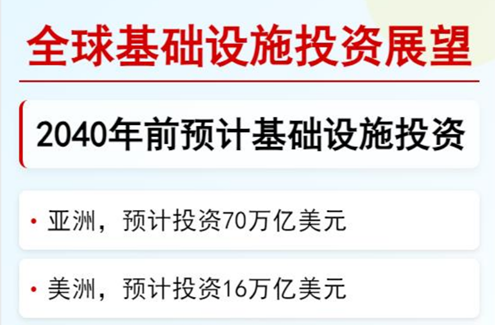
Core Insights - McKinsey's report predicts global infrastructure investment will reach $106 trillion from now until 2040, driven by rapid urbanization and digital transformation [1][3] Group 1: Regional Investment Insights - Asia is expected to lead with an estimated $70 trillion in infrastructure investments, primarily due to the sustained growth of economies like China and India [3] Group 2: Sector-Specific Investment Projections - The energy sector is projected to require significant capital inflow for renewable energy projects, grid modernization, and to meet growing energy demands, with total investments expected to reach $23 trillion by 2040 [3] - Social infrastructure, which includes healthcare, education, and public facilities, is anticipated to receive $16 trillion in investments [3] - Waste and water systems, along with agriculture, are expected to see an additional $11 trillion in investments [3]