绿碳包装

Search documents
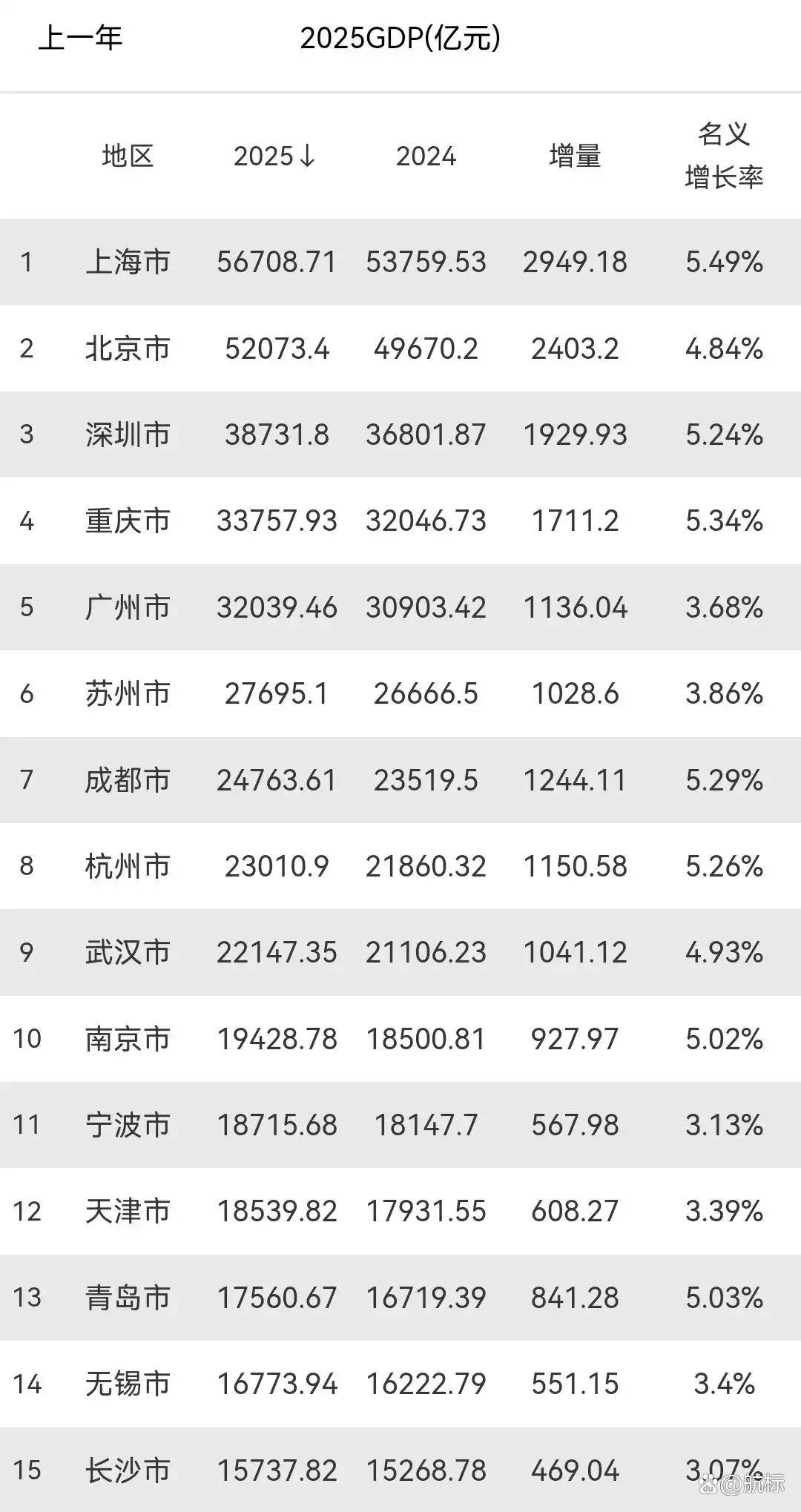
2025GDP15强榜单揭晓!5万亿城市仅3座,青岛逆袭、广州遇瓶颈,藏着你关心的机遇
Sou Hu Cai Jing· 2026-02-04 14:23
Core Insights - The 2025 GDP ranking of Chinese cities shows that five cities have surpassed 2 trillion yuan, with Shanghai, Beijing, and Shenzhen entering the 5 trillion yuan tier, collectively accounting for over 30% of the national GDP at 48.3 trillion yuan [1] Group 1: Top Cities Performance - Shanghai leads with a GDP of 56,708.71 billion yuan, an increase of 2,949.18 billion yuan, and a growth rate of 5.49%, benefiting from its status as a core of the Yangtze River Delta and strong sectors like integrated circuits and biomedicine [4] - Beijing follows with a GDP of 52,073.4 billion yuan, an increase of 2,403.2 billion yuan, focusing on high-end manufacturing and innovation, exemplified by the company TianKe HeDa's advancements in silicon carbide technology [4] - Shenzhen ranks third with a GDP of 38,731.8 billion yuan and a growth rate of 5.24%, driven by innovation, with significant patent activity supporting its industrial upgrades [4] Group 2: Emerging Cities - Chengdu ranks seventh with a GDP of 24,763.61 billion yuan, an increase of 1,244.11 billion yuan, and a growth rate of 5.29%, supported by infrastructure improvements and a strong electronics sector [6] - Hangzhou, with a GDP of 23,010.9 billion yuan, relies heavily on its digital economy, with the internet sector contributing 40% of its growth, and fostering cross-regional collaboration [8] - Qingdao, positioned at 13th, shows a notable growth rate of 5.03% and an increase of 841.28 billion yuan, attributed to specialized enterprises and effective government support [8] Group 3: Challenges and Opportunities - Guangzhou, despite a GDP of 32,039.46 billion yuan, has a lower growth rate of 3.68%, facing challenges in traditional manufacturing transformation, although recent policy incentives are expected to boost future growth [9] - The overall trend indicates that cities with growth rates exceeding 5% have clear leading industries and supportive policies, while those below 3.5% struggle with traditional industry constraints [11] - The shift from scale to quality in urban growth is evident, with only six cities achieving over 1,000 billion yuan in growth compared to the previous year, highlighting the importance of aligning policy incentives with industry needs and fostering innovation [11]