产业转型

Search documents
历史照进现实:70年代系列百页深度研究
CAITONG SECURITIES· 2026-03-20 03:34
Group 1: Economic Context - The 1970s experienced stagflation characterized by high inflation and economic stagnation, with CPI exceeding 10% and oil consumption nearing 2017 levels[2] - The "Great Society" programs initiated in the 1960s significantly increased total demand, contributing to inflationary pressures in the 1970s[12] - The U.S. transitioned from a net exporter to a net importer around 1965, exacerbating inflation due to increased reliance on foreign goods[16] Group 2: Policy Responses - The Federal Reserve's policies during the 1970s, including significant monetary expansion, failed to control inflation and were often influenced by political pressures[6] - Presidents Nixon, Ford, and Carter implemented fiscal policies aimed at stimulating the economy, often prioritizing employment over inflation control[55] - The introduction of price controls in 1971 by Nixon aimed to curb inflation but led to shortages and did not address underlying economic issues[39] Group 3: Market Dynamics - Gold emerged as the only major asset with positive real returns during the 1970s, while stocks and bonds faced significant adjustments due to high inflation[2] - The performance of various sectors was influenced by inflation cycles, with inflation-sensitive sectors outperforming during periods of rising prices[3] - The 1970s saw a shift in market valuation preferences, favoring high ROE companies during economic upturns and low PB companies during downturns[4] Group 4: Historical Lessons - The analysis draws parallels between the 1970s stagflation and current economic conditions, highlighting the importance of understanding historical policy mistakes[6] - The experiences of Japan during the 1970s, where it achieved significant economic growth through industrial transformation, provide insights for current economic strategies[4]
华联控股(000036) - 华联控股2026年3月18日投资者关系活动记录表
2026-03-18 09:40
Group 1: Real Estate Operations - The company is currently selling real estate projects including "Hualian Luanshanfu" and "Hualian City Business Center" in Shenzhen, and "Qiantang Mansion" in Hangzhou [2] - The current business strategy is "stabilizing real estate while promoting transformation" to address sustainable development issues [2] Group 2: Industry Transformation - The company is considering overseas acquisition of salt lake mines due to resource advantages and cost benefits, particularly in the South American "Lithium Triangle" [2] - The company has established a technical layout for lithium extraction through previous investments in Shenzhen Juneng and Zhuhai Juneng [2] Group 3: Acquisition Progress - The acquisition of the Arizaro project is currently progressing through necessary investment filings and legal due diligence [3] - The company will provide timely updates on the acquisition process as per the transaction agreement [3]

华联控股(000036) - 华联控股2026年3月6日投资者关系活动记录表
2026-03-06 07:42
Group 1: Real Estate Operations - In 2025, the company's real estate sales revenue is expected to increase compared to 2024, with slight growth in rental, property services, and hotel revenues [1] - Current projects for sale include "Hualian Luanshan Mansion" and "Hualian Urban Business Center" in Shenzhen, and "Qiantang Mansion" in Hangzhou [1] Group 2: Industry Transformation - The company has established a lithium extraction technology chain through investments in Shenzhen Juneng and Zhuhai Juneng, enabling low-cost and efficient lithium salt extraction [2] - To fund future development, the company plans to enhance cash flow through real estate sales and property management, and may consider phased construction, refinancing, or third-party partnerships based on market conditions [2] - The acquisition of the Arizaro project is in the early stages, pending necessary regulatory approvals and due diligence [2]
辽宁出台20条新政促进经济向新向好发展
Zhong Guo Fa Zhan Wang· 2026-02-27 09:09
Core Viewpoint - Liaoning Province has introduced a series of policies aimed at promoting economic growth and transformation, focusing on new industries and technologies to enhance development momentum and achieve qualitative and quantitative improvements in the economy [1][2]. Group 1: Policy Characteristics - The new policies emphasize new requirements, focusing on high-quality development areas such as artificial intelligence and low-altitude economy, accelerating the growth of new productive forces [1][2]. - The policies feature concrete measures, aiming for dual supply and demand efforts, and coordinating fiscal and financial strategies while balancing growth stability and quality improvement [1][2]. - The effectiveness of the policies is highlighted, with increased financial support through subsidies, interest discounts, and guarantees, optimizing conditions for implementation [1][2]. Group 2: Policy Measures - A total of 20 policy measures are outlined, targeting four key dimensions: industrial transformation, innovative development, demand expansion, and support for enterprises and citizens [2]. - For industrial transformation, eight measures include promoting intelligent upgrades, supporting artificial intelligence, and enhancing the mining industry [2]. - In innovative development, four measures focus on supporting cutting-edge technology research and encouraging innovation in standards and quality management [2]. - Demand expansion includes four measures aimed at supporting equipment upgrades and fostering cross-border e-commerce [2]. - The support for enterprises and citizens includes four measures to enhance financial products and reduce costs for industrial land [2]. Group 3: Implementation and Monitoring - The Liaoning Development and Reform Commission will work on refining policy implementation details, ensuring clarity on standards and timelines, and enhancing collaboration among departments [3]. - There will be a focus on policy promotion and funding assurance, shifting from "enterprises seeking policies" to "policies seeking enterprises" [3]. - Continuous evaluation of policy effectiveness will be conducted, with dynamic monitoring of implementation and adjustments based on assessment results [3].
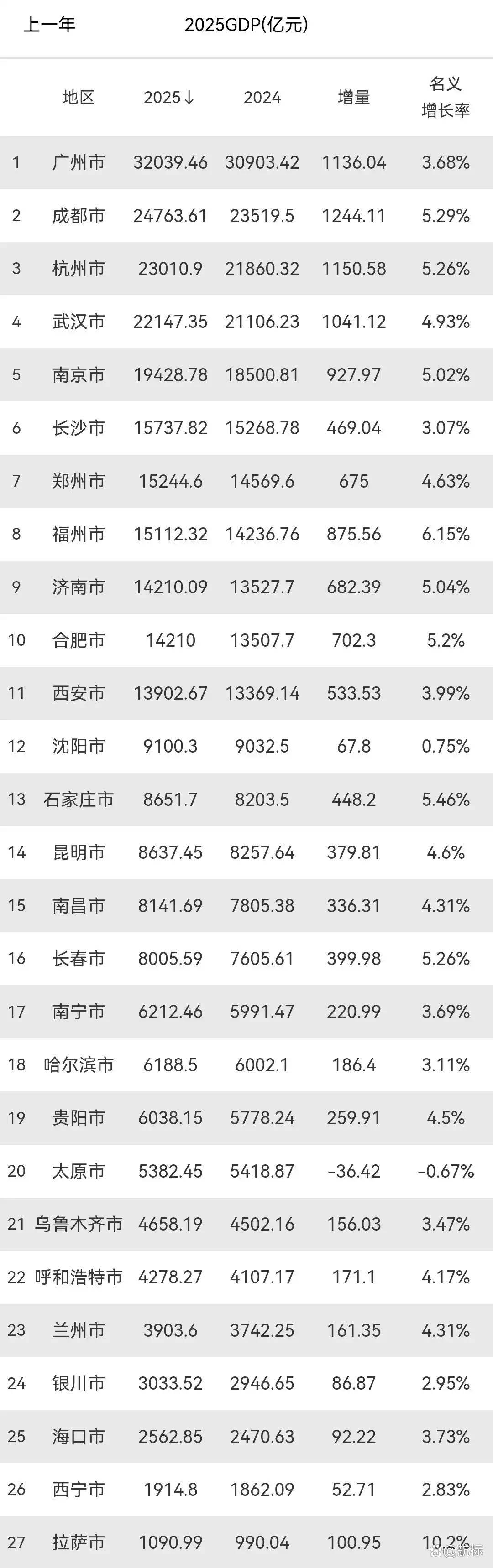
27个省会城市2025年GDP洗牌:成都增速增量领先广州,福州力压济南,南宁低于4%!
Sou Hu Cai Jing· 2026-02-27 06:29
Core Insights - In 2025, China's urban economy is experiencing a subtle reshuffle, with Guangzhou maintaining its top position and Chengdu following closely, reflecting both numerical growth and development momentum [1] Economic Performance - Guangzhou's GDP reached 32,039.46 billion yuan, showing a nominal growth rate of 3.68% compared to the previous year [2] - Chengdu's GDP hit 24,763.61 billion yuan, with a notable increase of 1,244.11 billion yuan and a growth rate of 5.29%, surpassing Guangzhou's growth in terms of increment [2][4] - Hangzhou and Wuhan also showed strong performances, with GDPs of 23,010.9 billion yuan and 22,147.35 billion yuan, respectively, and growth rates of 5.26% and 4.93% [2][4] Investment Trends - Chengdu's industrial investment growth reached 19.7%, significantly higher than the national average, indicating a robust investment climate [4] - In contrast, Guangzhou faces challenges in transitioning its traditional commerce and automotive industries, particularly in the shift from gasoline to electric vehicles [4] Competitive Dynamics - Fuzhou narrowly surpassed Jinan with a GDP of 14,210.09 billion yuan, leveraging its "Maritime Fuzhou" strategy and benefiting from infrastructure development and the digital economy [6] - Nanning's GDP reached 6,212.46 billion yuan, becoming the first city in Guangxi to exceed 6,000 billion yuan, but its growth rate was hampered by a significant decline in fixed asset investment [8] Notable Exceptions - Taiyuan was the only city among the 27 provincial capitals to experience negative growth at -0.67%, attributed to pressures from the coal cycle [10] - Lhasa, despite a GDP just over 1,000 billion yuan, achieved a rapid growth rate of 10.2% [10] - Shenyang's GDP of 9,100.3 billion yuan reflects ongoing challenges in revitalizing old industrial bases, with a low growth rate of 0.75% [10] Conclusion - The era of merely competing on total GDP is over, with cities like Chengdu and Fuzhou demonstrating that strategic investments and economic diversification are key to future growth [11]

人民币狂飙5600点!美元没跌,人民币却独自升值,谁在疯狂买入?
Sou Hu Cai Jing· 2026-02-27 02:32
Core Viewpoint - The offshore RMB exchange rate has strengthened significantly, reaching around 6.8 against the US dollar, with a cumulative increase of over 5600 basis points in the past 10 months, indicating a deliberate and sustained trend rather than a random fluctuation [1][3]. Group 1: RMB Strength and Market Dynamics - The RMB has steadily appreciated over the past 10 months without significant volatility, accumulating a total increase of 5600 basis points, driven by underlying market forces [3][5]. - The strengthening of the RMB is independent of the US dollar's performance, which has remained stable without signs of decline or significant upward movement [3][5]. - The recent surge in the bank's foreign exchange settlement surplus reached nearly $100 billion in December 2025, marking a historical peak, with January 2026 maintaining a high surplus of around $90 billion [7][8]. Group 2: Foreign Capital Inflow - The substantial foreign exchange surplus indicates that foreign capital is actively converting large amounts of US dollars into RMB, contributing to the currency's appreciation [8][10]. - In January 2026, a record surplus of $26 billion in securities investment further highlights foreign investors' ambitions in the RMB market, showcasing a shift in capital flow towards A-shares [10][12]. - The influx of foreign capital into the A-share market reflects a significant change in investor behavior, moving from passive observation to active participation with substantial investments [12][14]. Group 3: Market Conditions in Shanghai vs. Hong Kong - In Shanghai, the slowdown in new stock issuance has created a scarcity of quality assets, leading to increased valuations in the technology sector due to heightened liquidity [14][16]. - Conversely, Hong Kong has experienced a dramatic increase in IPO fundraising, reaching ten times the amount from the previous year, indicating a revitalization of its financial engine but also leading to liquidity challenges [16][17]. - The current IPO landscape in Hong Kong reveals a significant transformation in its industrial structure, with a notable focus on technology and high-end manufacturing, moving away from traditional financial and real estate sectors [19][21]. Group 4: Investment Sentiment and Market Outlook - The rapid development of the AI industry provides long-term growth prospects, while some assets have returned to reasonable valuation levels after experiencing a bubble [21][23]. - The evolving market dynamics suggest that the fundamentals will play a crucial role in determining whether foreign capital remains committed or withdraws, emphasizing the importance of identifying quality assets amidst market fluctuations [23][25]. - The RMB's stability at the 6.8 level reinforces expectations that RMB assets will become more valuable, further attracting foreign investment and signaling a new market cycle [25][27].
辽宁多部门联合发布新举措
Xin Lang Cai Jing· 2026-02-26 23:52
Core Viewpoint - The recent policy measures focus on high-quality development in new fields such as artificial intelligence, low-altitude economy, and technological breakthroughs, emphasizing practical effectiveness through financial support mechanisms [1]. Group 1: New Directions and Measures - The measures can be summarized into four main areas: new directions for industrial transformation, new models for innovative development, new fields for expanding demand, and new initiatives for benefiting enterprises and the public, totaling 20 specific measures [2]. Group 2: Digital Transformation and Support - The provincial industrial and information technology department will establish a provincial "Smart Transformation and Digital Upgrade" diagnostic service platform to provide free assessments for large-scale industrial enterprises, creating tailored transformation plans [3]. - The provincial science and technology department plans to allocate 10 million yuan from the fiscal science and technology special fund to support incubator construction by 2026 [4]. Group 3: Transportation and E-commerce Development - The provincial transportation department will continue the differentiated toll policy for highways until December 31, 2027, focusing on supporting the comprehensive integrated transportation network [5]. - The provincial commerce department aims to accelerate the development of cross-border e-commerce by leveraging industrial belts, parks, overseas warehouses, and key enterprises to cultivate a full-chain ecosystem [6].
广西“最失落”城市:曾比南宁、柳州还富裕,现如今却在四线挣扎?
Sou Hu Cai Jing· 2026-02-26 18:15
Economic Overview - Guangxi is located in South China and is bordered by several provinces and Vietnam, characterized by a subtropical monsoon climate that supports lush vegetation [1] - The region is classified as an autonomous region rather than a province, with Nanning as its capital [3] - Among its 14 prefecture-level cities, Nanning and Liuzhou are the most notable economically, while Guilin and Beihai are well-known for tourism [5] Historical Context of Wuzhou - Wuzhou was historically significant, once contributing over 60% of Guangxi's economic income during its peak, making it a major commercial hub [11] - The city was a prominent trading port in the Pearl River Delta, especially during the Ming and Qing dynasties, and was second only to Guangzhou in foreign trade during the Republic of China era [11] Recent Economic Developments - Wuzhou has been recovering from a period of stagnation and is now focusing on industrial development and quality improvement, with a GDP of 1490.97 billion yuan in 2023, projected to grow to 1634.06 billion yuan in 2024, reflecting a 7.2% increase [13] - The city is actively connecting with surrounding developed areas and enhancing its local industries, such as the production of Liubao tea, to extend its industrial chain [13] Tourism and Cultural Heritage - Wuzhou is home to historical sites and traditional architecture, including the "Eight Scenic Spots of Wuzhou" and a significant number of traditional arcade buildings, making it a potential tourist destination [14] - The city features the Longmu Temple scenic area, known for its 22 ancient arcade streets and 560 arcade buildings, highlighting its cultural significance [14] Future Prospects - Wuzhou is positioned to leverage its historical advantages and improve its business environment, attracting more enterprises and enhancing infrastructure for better living conditions [14] - With a strategic focus on its unique strengths and a commitment to steady progress, Wuzhou aims to reclaim its status as a prosperous city in Guangxi [14]

逐绿而行—普陀山海城乡织锦绣
Zhong Guo Huan Jing Bao· 2026-02-25 01:08
Core Viewpoint - The article highlights the ecological and economic transformation of Putuo District in Zhoushan, Zhejiang Province, emphasizing the integration of green development principles into industrial restructuring, pollution control, and ecological protection efforts. Environmental Improvement - By the end of December 2025, the average PM2.5 concentration in Putuo District is projected to be 15.6 micrograms per cubic meter, a year-on-year decrease of 14.8% from 2014 levels of 27 micrograms per cubic meter, reflecting significant air quality improvements [2][3] - The district has implemented comprehensive measures, including the elimination of 8 biomass boilers and the upgrade of 36 air-polluting enterprises, contributing to cleaner air [2] Water Management - Putuo District has received the highest honor for water management in Zhejiang Province, the "Dayu Ding," four times, and won the Silver Ding award for the first time in 2024, showcasing its commitment to water quality improvement [3] - Infrastructure enhancements include the completion of 300 kilometers of urban drainage networks and the establishment of a 5,000-ton wastewater treatment plant, achieving 100% compliance in surface water quality [3] Waste Management - The district has created 93 "waste-free cells" across various sectors, promoting solid waste management and achieving a zero landfill rate for hazardous waste [3] - Soil pollution monitoring and management have maintained a 100% safety utilization rate for key construction land [3] Public Satisfaction - Public satisfaction regarding the ecological environment in Putuo District has reached 91.12 points, an increase of 2.03 points from 2024 and 4.77 points from 2021, indicating improved community perception of environmental quality [4] Industrial Transformation - The shipbuilding industry in Putuo District has adopted green technologies, with over 90% of ship enterprises completing environmental compliance, showcasing a shift towards sustainable practices [5] - Technological innovations, such as smart spraying robots and AI maintenance systems, have increased operational efficiency by up to 30% [5] Clean Energy Development - The installed capacity for clean energy generation in Putuo District has reached 467,000 kilowatts, with future projects expected to exceed one million kilowatts [6] - LNG projects are anticipated to have an annual receiving capacity of 43 million tons, contributing to the region's clean energy goals [6] Marine Ecological Restoration - Putuo District has established the first marine public protection and release base in the province, enhancing marine biodiversity through the introduction of artificial reefs and fish stocks [8] - The district's efforts in marine ecological governance have led to a significant increase in the proportion of high-quality seawater, from an average of 5.0% in 2018-2020 to 30.4% in 2024 [7][8]
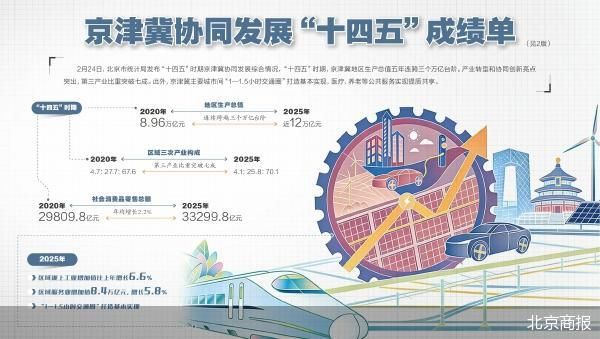
解构京津冀协同发展的“十四五”答卷
Bei Jing Shang Bao· 2026-02-24 16:56
Economic Growth - The GDP of the Beijing-Tianjin-Hebei region is projected to increase from 8.96 trillion yuan in 2020 to nearly 12 trillion yuan by 2025, crossing three trillion yuan milestones [1][3] - The average annual growth rates for the three areas during the "14th Five-Year Plan" period are expected to be 5.2% for Beijing, 4.4% for Tianjin, and 5.4% for Hebei [3] Industrial Transformation - The proportion of the tertiary industry in the region has surpassed 70%, with the three industries' structure changing from 4.7:27.7:67.6 in 2020 to 4.1:25.8:70.1 by 2025 [6] - The added value of high-tech manufacturing in Beijing and Tianjin is expected to account for 32.1% and 16.6% of the industrial output, respectively, by 2025 [6] Investment and Consumption - Fixed asset investments in the three regions are projected to grow by 5.5% in Beijing, 1.6% in Tianjin, and 6.1% in Hebei by 2025 [7] - The total retail sales of consumer goods in the region are expected to rise from 29,809.8 billion yuan in 2020 to 33,299.8 billion yuan by 2025, with an average annual growth rate of 2.2% [7] Innovation and Technology - The total value of technology contracts in the region is expected to reach 1.4 trillion yuan by 2025, which is 1.8 times that of 2020 [9] - The number of invention patents in the region is projected to reach 141,000 by 2025, which is 1.9 times that of 2020 [10] Infrastructure and Public Services - The construction of a "1-1.5 hour traffic circle" among major cities in the region has been largely achieved, with significant improvements in public transportation [11] - Collaborative projects in healthcare and elderly care have been established, enhancing the quality of public services across the region [12]