航空地面服务

Search documents
研判2026!中国地面综合服务行业政策汇总、产业链、发展现状、竞争格局及发展趋势分析:受益于国家政策持续推动,行业市场规模不断增长[图]
Chan Ye Xin Xi Wang· 2026-01-20 01:05
Core Viewpoint - The ground comprehensive service industry in China's civil aviation sector is experiencing rapid growth, driven by the recovery of air transport and supportive government policies, with the market expected to reach 230 billion yuan in 2024, reflecting a year-on-year increase of 2.2% [1][5]. Industry Overview - Ground comprehensive services encompass essential services provided when aircraft arrive and depart from airports, including management, passenger services, baggage handling, cargo services, and aircraft maintenance [3]. - The industry is crucial for aviation safety and significantly impacts the efficiency and quality of services provided to airlines and consumers [3]. Market Size and Trends - The market size of China's ground comprehensive services reached 250 billion yuan in 2019, fluctuated due to the pandemic from 2020 to 2022, and is recovering with a projected market size of 230 billion yuan in 2024 [1][5]. - The number of transport airports in China is expected to increase to 263 by the end of 2024, further driving demand for ground services [5]. Policy Support - The government has introduced various policies to enhance ground services, including guidelines for optimizing first-time passenger services and regulations for managing airport service operations [4]. Competitive Landscape - The ground comprehensive service market is highly competitive, with major players including large airlines like China Eastern Airlines and China Southern Airlines, specialized ground service companies, and airport management firms [6][7]. - Large airlines dominate the market due to their extensive service networks and operational experience, while specialized companies excel in specific service areas [6]. Development Trends - Digital transformation is reshaping the industry, enabling better demand forecasting and resource optimization through data analysis [9]. - The industry is moving towards green and sustainable practices, incorporating eco-friendly vehicles and energy-efficient equipment to reduce environmental impact [10]. - Service models are diversifying to meet individual passenger needs, introducing innovative services like exclusive transfers and smart baggage tracking [12]. - Market competition is intensifying as more companies enter the sector, leading to increased consolidation and a need for companies to enhance their competitiveness [13].







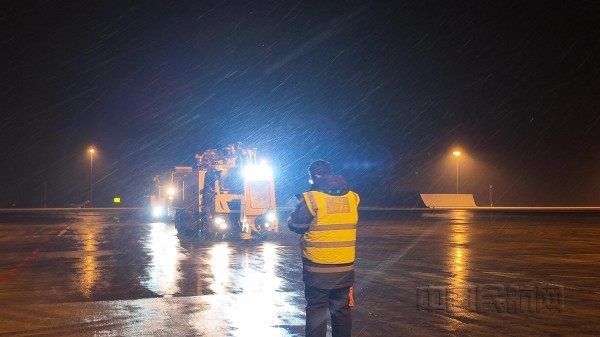
首新地服:护航今冬季首场降雪航班平稳运行
Zhong Guo Min Hang Wang· 2025-12-13 09:09
Core Viewpoint - Beijing Shouxin Ground Service Company efficiently executed de-icing operations at Beijing Daxing International Airport during the first snowfall of winter 2025, ensuring flight safety and maintaining a high on-time performance rate for passengers [1][10]. Group 1: Preparation and Planning - Shouxin Ground Service adopted a proactive approach by preparing early, completing training and equipment checks by the end of October, and holding a deployment meeting on December 10 to finalize resource allocation and responsibilities [2]. - The company implemented a dynamic scheduling mechanism to ensure balanced distribution of operational forces across three shifts, maintaining 24-hour seamless support [2]. - A comprehensive maintenance check was conducted on all 50 de-icing vehicles to ensure optimal performance under low temperatures and snowy conditions [2]. Group 2: Operational Efficiency - The de-icing operation commenced smoothly with the first flight requiring de-icing, showcasing organized and professional execution on-site [3]. - The operation utilized a "slow vehicle de-icing" and "four-vehicle collaboration" model to enhance efficiency while ensuring safety, with real-time communication among team members [5]. - The de-icing command center employed an advanced management system to monitor flight dynamics and snow conditions, optimizing resource allocation and enhancing overall efficiency [7]. Group 3: Collaborative Efforts - Shouxin Ground Service established a collaborative operational system, with a central control hub monitoring weather and flight dynamics to ensure smooth ground operations [9]. - Various departments, including ground handling, passenger services, and cargo, worked together to manage resources effectively and maintain order during adverse weather conditions [9]. - The successful execution of the de-icing operation served as a test of the company's emergency plans, team effectiveness, and equipment reliability, prompting a commitment to continuous improvement in training and technology [10].
创新开发员工作风画像小程序 构建安全服务作风管理新格局
Zhong Guo Min Hang Wang· 2025-07-23 05:44
Core Viewpoint - Yunnan Airport Ground Service Company has launched the "Employee Work Style Portrait" mini-program, which digitally innovates the management model of employee work style, achieving a dual breakthrough in safety foundation and service quality upgrade, providing a replicable practical sample for the digital transformation of ground service personnel's work style [1][9]. Group 1: Digital Innovation and Management Model - The mini-program's innovation stems from the Civil Aviation Administration's guidelines emphasizing the construction of a long-term mechanism for safety work style, reflecting the company's deep consideration of work style construction and quantitative assessment [3]. - Traditional management faced challenges such as data dispersion and delayed feedback, leading to the development of the mini-program and the "Employee Work Style Portrait Management Measures (Trial)" to ensure seamless integration of systems and technology [3][4]. - The core of the system is a graded intervention based on "negative behavior accumulation count + type," allowing for comprehensive control from verbal reminders to competency assessments [3]. Group 2: Data Collection and Execution - The program ensures that every regulation can be quantitatively tracked, with data collection adhering to institutional standards through real-time input by team leaders and regular company checks [4]. - The intervention execution is based on data analysis results from the mini-program, forming a management closed loop that solidifies safety norms and service standards [4]. Group 3: Five-Dimensional Assessment and Closed-Loop Management - The mini-program employs a "Five-Dimensional Assessment System" covering safety service style, work discipline, work quality, training assessment, and work performance, visualized through radar charts [6]. - The assessment scores range from 0 to 100, with different color codes indicating performance levels, allowing management to grasp employee performance intuitively [6]. - The closed-loop management consists of four functions: precise recording of safety operations, monthly collection of problem rectification, incentive declaration for improvements, and data analysis for risk trends, enhancing safety control and service optimization [6]. Group 4: Impact on Safety and Service Quality - The mini-program has significantly improved safety and service quality, with a reported 50% decrease in safety service issues and a 24% reduction in complaints, while passenger satisfaction increased from 96.70% to 97.83% [9]. - The collaboration of positive incentives and negative supervision has led to a 100% rectification rate, shifting the mindset from "post-event correction" to "prevention" among management and employees [9]. Group 5: Future Implications and Management Wisdom - Employees can view their scores in real-time through the mini-program, allowing for proactive improvement, while management can analyze data trends to anticipate potential risks [12]. - This digital transformation not only strengthens the safety service foundation but also provides valuable practical experience for the digital transformation of work style construction in aviation ground services, showcasing management wisdom characterized by robust system design, precise data management, and supportive employee growth [12].