
航道疏浚

Search documents
长江中游两处航道疏浚工程完工 航宽显著提升
Zhong Guo Xin Wen Wang· 2025-12-19 09:30
Core Viewpoint - The completion of emergency dredging projects in the Yangtze River has significantly improved navigation conditions and increased the navigable width of key waterways, addressing long-standing safety concerns for shipping traffic [1][2]. Group 1: Emergency Dredging Projects - The emergency dredging project in the Guanzhou waterway has increased the navigable width to 210 meters, ensuring a stable water depth of 4.5 meters during low water periods from the Zhongshui Gate to the Baoshan crossing [1]. - The dredging project in the Doulake waterway has removed underwater obstacles, increasing the navigable width from less than 150 meters to approximately 200 meters, thereby greatly enhancing the navigation capacity of the waterway [2]. Group 2: Navigation Safety Improvements - The Guanzhou waterway, which is 10.9 kilometers long and characterized by a curved and shallow structure, previously posed safety risks due to limited navigable width and shallow areas [1]. - The Doulake waterway, located in a complex navigation environment with dense terminal distribution, faced increasing threats from underwater rock piles, which have now been fully cleared to improve safety for passing vessels [2].
为太湖量身打造的清淤利器“太湖之光”投产
Xin Hua She· 2025-08-15 07:21
Core Insights - The article highlights the launch of the "Taihu Light," an eco-friendly intelligent integrated dredging platform designed by China Communications Tianjin Navigation Bureau, which will be deployed for ecological dredging in Taihu Lake [1][2] - The platform aims to complete over 10 million cubic meters of dredging tasks in the next six years, equivalent to reducing nearly 4,000 standard swimming pools' worth of sediment from Taihu Lake [1] Company Overview - The "Taihu Light" is a mobile ecological factory specifically tailored for Taihu Lake, addressing traditional dredging challenges such as large land occupation and poor adaptability [1] - The platform consists of five vessels, including the "Taihu Dredging No. 2," "Taihu Light No. 1," "Taihu Light No. 2," "Taihu Light No. 3," and a residual water treatment vessel, creating an ecological closed-loop system for dredging, screening, dewatering, and water purification [1][2] Technological Advancements - The residual water treatment vessel can stabilize water quality to meet Class III surface water standards, allowing for direct discharge into the lake [2] - The platform employs a smart construction system utilizing big data analysis and AI models for real-time monitoring and control, achieving a daily dredging capacity of 8,000 cubic meters [2] - The platform operates on clean shore power, resulting in zero oil consumption during operations, and the dredged sludge can be repurposed for wetland restoration and mine reclamation [2] Environmental Impact - In 2024, Taihu Lake is expected to achieve a historic breakthrough, with its water quality improving to Class III for the first time in 30 years [2] - However, the presence of nutrient-rich sediment accumulated over decades remains a significant challenge to the sustained improvement of water quality [2]
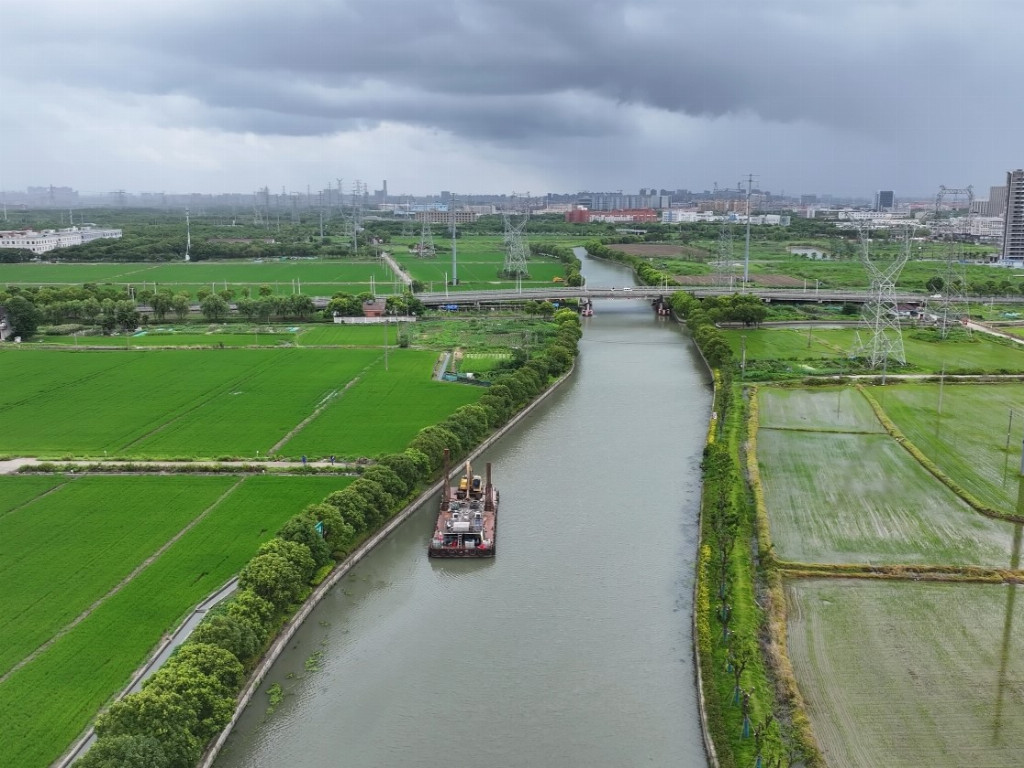
上海北泖泾航道疏浚整治工程完工
Zhong Guo Chan Ye Jing Ji Xin Xi Wang· 2025-07-30 02:31
Core Viewpoint - The project is a maintenance dredging operation in the inland waterways of Shanghai, specifically in the Songjiang District, aimed at enhancing navigation capacity and safety while optimizing ecological benefits [2][5]. Group 1: Project Overview - The dredging project spans a total length of 5.93 kilometers with a total volume of 101,300 cubic meters, primarily focused on removing sediment from the waterway [2]. - The North Maojing waterway has a unique geographical position and is classified as a Grade VII technical level, necessitating precise design standards to accommodate small vessel traffic [2]. Group 2: Construction Challenges and Solutions - The construction area has a dense network of underground pipelines, increasing the complexity and risk of the dredging operation [4]. - A specialized pipeline inspection team was established to conduct thorough surveys of underground pipelines, ensuring zero accidents during construction [4]. - The project team adopted self-propelled backhoe dredgers and dynamically adjusted vessel ratios to optimize the workflow, resulting in a 30-day reduction in the overall construction period [4]. Group 3: Environmental and Community Considerations - To minimize noise and pollution, the project team implemented reasonable work hour arrangements and reduced nighttime construction activities, thereby lessening the impact on local residents [4]. - An effective communication mechanism was established, including multiple coordination meetings and visits to local residents, ensuring a smooth feedback channel with the government [4]. Group 4: Project Outcomes - The completion of the project significantly improved the navigation capacity and safety of the North Maojing waterway, while also enhancing the ecological environment [5]. - The project serves as a model for Shanghai's green shipping development and high-level water environment management [5].

特写丨“新海凤”在马来西亚巴生港大显身手
Xin Hua Wang· 2025-04-27 08:50
Core Viewpoint - The article highlights the operational capabilities and significance of the Chinese dredging vessel "Xin Hai Feng" in the expansion project of Port Klang, Malaysia, emphasizing its advanced technology and contribution to local development [1][2][3] Group 1: Vessel Operations - The "Xin Hai Feng" is a large dredging vessel with a capacity of over 16,000 cubic meters, capable of handling 100 cubic meters of seabed sand per minute, and can fill its hold in about two hours [2] - The vessel operates 24 hours a day, alternating between sand extraction during the day and dredging at night, showcasing its efficiency and continuous operation [1][2] - The vessel's construction precision can reach centimeter-level, enabled by advanced intelligent dredging systems that allow for single-operator control [2] Group 2: Project Significance - The expansion of Port Klang's West Port is crucial as it will double the container throughput capacity, reinforcing its role as a key logistics hub for Malaysia's international trade [3] - The project not only employs local Malaysian workers but also fosters good relationships with surrounding communities, highlighting the collaborative nature of the China-Malaysia partnership [3] - The introduction of advanced technology by Chinese enterprises is expected to accelerate project progress and contribute to Malaysia's development [3]