
营养食疗

Search documents
营养诊疗干预慢性病的效果分析与社会意义
EqualOcean· 2026-02-06 15:15
Investment Rating - The report does not explicitly provide an investment rating for the industry. Core Insights - The report emphasizes the significant relationship between nutrition and health, highlighting that chronic non-communicable diseases have become a major public health issue in China, with cardiovascular diseases affecting approximately 330 million people [8][10]. - It underscores the importance of nutritional dietary therapy in managing chronic diseases, suggesting that proper nutritional interventions can effectively prevent the onset of these diseases and improve patients' health and quality of life [11][12]. - The report aims to evaluate the effectiveness of nutritional dietary therapy on health indicators, lifestyle habits, and quality of life among chronic disease patients, while also exploring its social significance [34][38]. Summary by Sections Part 1: Background and Overview - Chronic non-communicable diseases are a leading health threat in China, with cardiovascular diseases being the most prevalent [8][10]. - Poor dietary habits are identified as a primary risk factor for chronic diseases, with evidence supporting that nutritional interventions can prevent disease progression and improve health outcomes [11][12]. Part 2: Effect Evaluation Subjects - The study analyzed 152 cases from a clinical database, focusing on demographic characteristics and underlying health conditions of participants [40]. - The majority of participants were female (78.3%) and aged over 55, indicating a focus on middle-aged and older populations [51][54]. Part 3: Improvement and Evaluation of Core Metabolic Indicators - Participants showed significant weight loss and improvements in BMI after nutritional therapy, with an average weight reduction of 7.27 kg and a decrease in BMI of 2.76 [66][68]. - The report indicates that 84.3% of participants achieved a weight loss of over 5%, and 44.6% lost more than 10%, demonstrating the effectiveness of the intervention [69][70]. Part 4: Behavioral, Cognitive, and Quality of Life Changes - The report discusses changes in dietary habits, lifestyle, and overall quality of life among participants, emphasizing the role of nutritional therapy in promoting healthier living [34][36]. Part 5: Summary and Outlook - The report concludes that nutritional dietary therapy is a valuable non-pharmaceutical intervention for chronic disease management, aligning with national health strategies aimed at disease prevention [37][38].
以营养科学守护健康生活——长轻“4816营养食疗体系”的科学探索与实践突破
Huan Qiu Wang· 2025-12-16 12:29
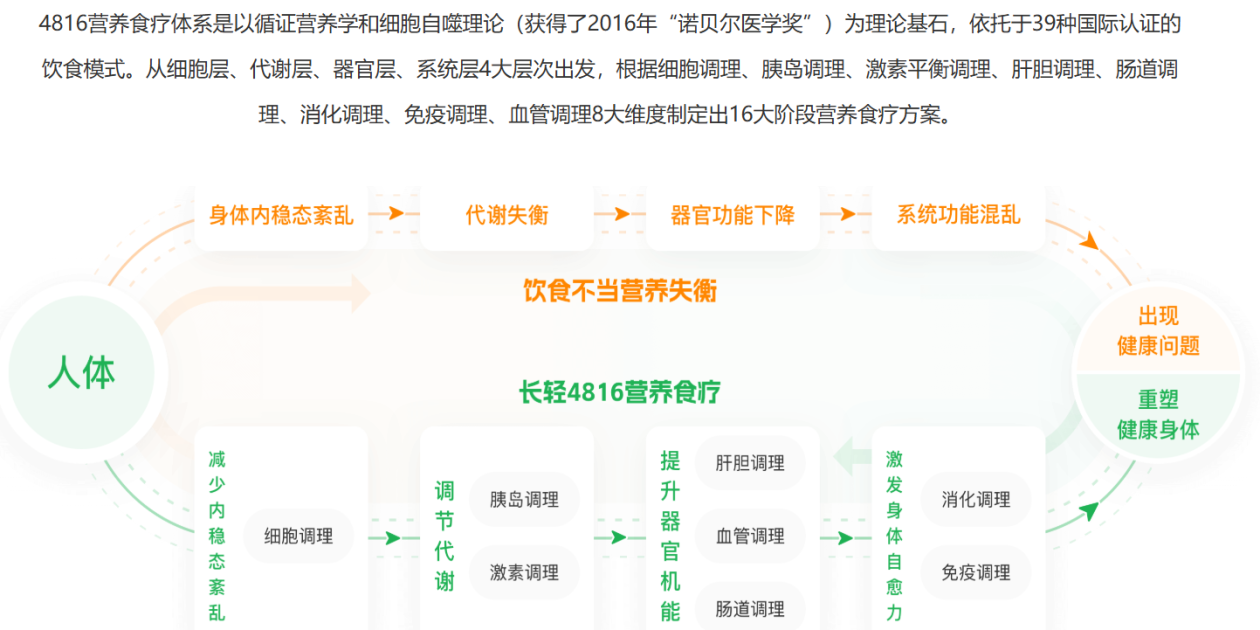
Core Insights - The article highlights the innovative approach of Changqing Group in health management, focusing on chronic disease prevention through the "4816 Nutritional Therapy System" which integrates scientific dietary solutions with health product e-commerce [1][10] - The system is based on evidence-based nutrition and autophagy theory, combining over 39 internationally recognized dietary patterns to provide personalized health management solutions [2][10] Group 1: System and Service Model - The "4816 Nutritional Therapy System" operates on four levels: cellular, metabolic, organ, and systemic, addressing eight major repair dimensions and offering quantifiable interventions across 16 stages, which have now expanded to over 30 stages [2] - The system has generated over 60 sub-paths to cater to a wider range of health scenarios and diverse needs [2] Group 2: Scientific Validation and Collaboration - The scientific efficacy of the system has been preliminarily validated through research published in the "International Journal of Clinical Research," showing significant improvements in key metabolic indicators for participants with obesity, type 2 diabetes, or hyperlipidemia after 12 weeks of intervention [4] - Ongoing collaboration with Peking Union Medical College Hospital aims to conduct randomized controlled trials to provide more effective solutions for obesity and related metabolic diseases [4] Group 3: Personalized Case Studies - A case study of a 61-year-old woman illustrates the effectiveness of the "4816 system" in addressing her long-term health issues, resulting in a weight loss of 6 kg and normalization of several health indicators after a tailored intervention [5] - Another case involving a 41-year-old man demonstrated a weight reduction of 9 kg and significant improvement in health metrics after a 10-week personalized nutritional plan focused on metabolic regulation and inflammation control [6][7] Group 4: Broader Implications for Health Management - The "4816 system" exemplifies a shift from traditional disease treatment to proactive health management, promoting the integration of scientific knowledge into daily dietary practices [8][10] - The approach aligns with the "Healthy China" initiative, encouraging individuals to take responsibility for their health and reducing the healthcare burden on society [8][10]

政策+科技双轮驱动:营养食疗产业如何守护3亿银发人群健康?
2 1 Shi Ji Jing Ji Bao Dao· 2025-08-18 09:38
Group 1 - The core viewpoint of the articles highlights the growing trend of "food therapy" as a response to the increasing health awareness among the elderly population in China, emphasizing the importance of dietary interventions in managing chronic diseases [1][2][3] - Data indicates that the average calcium intake among elderly individuals in China is only 400 mg/day, which is 50% below the recommended amount, suggesting a significant need for dietary improvements to reduce chronic disease risks [1] - The Ministry of Agriculture and Rural Affairs and the National Health Commission of China are set to release the "China Food and Nutrition Development Outline (2025-2030)" to establish a food-medicine quality database and expand the directory of food-medicine integration [1] Group 2 - Traditional nutritional therapy models are undergoing targeted innovations to better align with contemporary dietary habits, resulting in more balanced nutrient profiles and improved effectiveness [2] - The "sour mare's milk therapy," a traditional Mongolian dietary therapy, is being modernized through collaboration between local experts and institutions to enhance its application and promote the industrialization of ethnic medicine [2] - The industry faces risks, including instances of false advertising where ordinary foods are marketed as "health wines," highlighting the importance of regulatory compliance and the need for consumers to identify legitimate health products marked with the "blue hat" symbol [2]