
轨道交通装备等

Search documents
两个万亿元 标注国资央企创新刻度
Ren Min Ri Bao· 2026-01-29 01:42
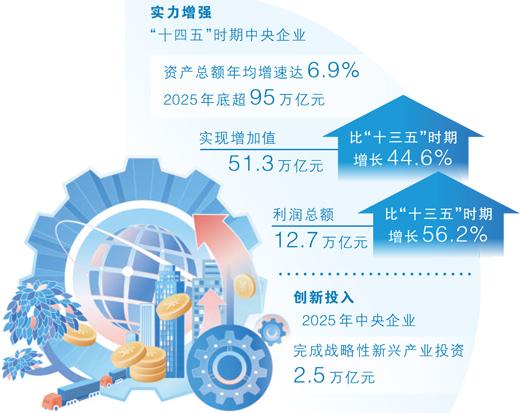
Core Insights - The central enterprises in China are projected to achieve a total profit of 2.5 trillion yuan and fixed asset investment of 5.1 trillion yuan by 2025, with total assets exceeding 95 trillion yuan by the end of 2025 [1] Group 1: Scale and Performance - During the 14th Five-Year Plan period, the total assets of central enterprises increased significantly, reaching over 90 trillion yuan with an average annual growth rate of 6.9% [2] - The added value of central enterprises reached 51.3 trillion yuan, a 44.6% increase compared to the previous five-year period, while total profits grew by 56.2% to 12.7 trillion yuan [2] - Key product outputs, such as crude oil and electricity generation, saw substantial increases of 24.7% and 38.2% respectively during the same period [2] Group 2: Innovation and R&D Investment - Central enterprises invested over 5 trillion yuan in R&D during the 14th Five-Year Plan, with R&D intensity increasing by 0.27 percentage points and a nearly 50% rise in the number of technology talents [4] - By 2025, R&D investment is expected to reach 1.1 trillion yuan, with significant achievements in major technological projects and innovations [4] - Central enterprises are leading or participating in all 22 national major science and technology projects, overcoming 121 key technologies [4] Group 3: Strategic Emerging Industries - Revenue from strategic emerging industries is projected to exceed 12 trillion yuan by 2025, with a continuous annual growth of 1 trillion yuan [5] - Investment in strategic emerging industries will account for 41.8% of total investments, reflecting a shift towards new industry structures [5][6] - Central enterprises are focusing on sectors such as integrated circuits, biotechnology, and new energy vehicles, while also enhancing their positions in high-end equipment manufacturing and artificial intelligence [6] Group 4: Traditional Industry Transformation - Central enterprises are actively transforming traditional industries by establishing smart factories and promoting green technologies [7] - The construction of intelligent factories and the implementation of advanced technologies are opening new development spaces for traditional sectors [7] Group 5: Future Goals and Regulatory Framework - In 2026, central enterprises will enhance procurement efforts for first sets and batches of products, aiming for continuous growth in value added and alignment with national GDP growth [9][10] - A more precise evaluation system will be implemented to improve the quality and internal value of state-owned enterprises [10] - The focus will be on increasing high-quality technological supply and advancing original technology development [11]

中国已进入全球制造强国行列 机器人等产业2035年有望世界领先
Xin Lang Cai Jing· 2025-12-30 10:50
Group 1 - The core viewpoint of the reports indicates that China has entered the ranks of global manufacturing powers, becoming the fourth country to achieve this status after the United States, Germany, and Japan [1] - The 2024 China Manufacturing Power Development Index is projected to be in the same range as Germany and Japan, with all sub-indices showing positive growth, solidifying China's position as the world's leading manufacturing country [1] - The "China Manufacturing Industry Key Areas Technology Innovation Green Paper - Technology Roadmap (2025)" analyzes and forecasts the progress and future development directions of 17 key areas and 35 priority development directions [1] Group 2 - By 2030, seven industries, including information and communication equipment, advanced rail transit equipment, and new energy vehicles, are expected to maintain a leading position globally, with breakthroughs in original innovation [2] - By 2035, six industries, including new display devices and robotics, are anticipated to reach world-leading status, while other sectors like aerospace equipment and integrated circuits will be in the advanced category [2] - The Manufacturing Power Development Index has been continuously published since 2015, and the 2025 version of the technology roadmap was developed with contributions from over 70 academicians and thousands of experts and corporate executives [2]
