
都市圈建设

Search documents
湖北打造世界级都市圈,如何“超常规”发力
Di Yi Cai Jing· 2026-01-28 09:40
Core Insights - The Wuhan metropolitan area aims to achieve an economic total of 3.8 trillion yuan by 2025, positioning itself as a significant growth pole in China and a world-class metropolitan area [1][2] - The metropolitan area consists of nine cities, with Wuhan being the central hub, and is expected to contribute over 60% to Hubei province's economy [1] - There are existing challenges in infrastructure connectivity, industrial collaboration, and equalization of public services that need to be addressed for deeper integration [2] Group 1 - The Wuhan metropolitan area is recognized as the seventh national-level metropolitan area in China, comprising nine cities: Wuhan, Huangshi, Ezhou, Xiaogan, Huanggang, Xianning, Xiantao, Tianmen, and Qianjiang [1] - The metropolitan area is projected to account for nearly 30% of the economic output of the Yangtze River middle reaches urban agglomeration [1] - The government aims to enhance planning coordination, cross-regional collaboration, and benefit-sharing mechanisms to strengthen the metropolitan area's role as a growth driver [2] Group 2 - Key challenges include the lack of a systematic platform for cross-administrative coordination, insufficient infrastructure connectivity, and a need for differentiated industrial guidance to avoid homogeneity and hidden competition [2] - The focus on "super-normal" development emphasizes the need for provincial-level leadership and regular meetings to address significant cross-regional issues [2] - The establishment of an industrial collaborative ecosystem is crucial, particularly in fostering deep industrial communities among cities within the metropolitan area [3] Group 3 - Recommendations include creating integrated development guidelines for characteristic industries in the Jianghan Plain and leveraging existing industrial clusters to build advanced manufacturing capabilities [4] - The metropolitan area should support Wuhan in becoming an international city while developing regional sub-centers in Huangshi, Ezhou, and Xiaogan to create a multi-polar structure [5] - The promotion of cross-city industrial parks and shared management models is suggested to drive overall industrial upgrades within the metropolitan area [5]
山东政商要情(12.1—12.7)
Jing Ji Guan Cha Bao· 2025-12-07 04:29
Group 1: Economic Development Plans - Shandong Province has released a roadmap for its 15th Five-Year Plan, focusing on a development pattern that includes "two circles linkage, three cores leading, land-sea coordination, and comprehensive efforts" [1] - Key initiatives include the enhancement of urban development capabilities, aiming for Qingdao's economic output to exceed 2 trillion yuan and adding one more city with over 1 trillion yuan in GDP by the end of the 15th Five-Year Plan [1] - The plan also targets the increase of counties with over 100 billion yuan in economic output from 28 to over 40 by the end of the 15th Five-Year Plan [1] Group 2: Land Utilization Policies - Shandong Province has introduced 18 policy measures aimed at promoting efficient land use to support green, low-carbon, and high-quality development [3] - The goal is to reduce the total area of newly constructed land by over 10% during the 15th Five-Year Plan and decrease the land use per unit of GDP by over 15% [3] - The province aims to create a new pattern of land-saving and efficient utilization by 2030, optimizing layout and improving efficiency [3] Group 3: Economic Growth in Qingdao - Qingdao's GDP is projected to exceed 1.7 trillion yuan in 2025, with an average annual growth rate of 5.9% [4] - Per capita GDP in Qingdao is expected to rise from 127,000 yuan in 2020 to 161,000 yuan by 2024, marking a cumulative growth of 21.3% [4] - The city has seen significant growth in retail sales and import-export volumes, with retail sales expected to surpass 650 billion yuan and import-export volumes exceeding 900 billion yuan [4] Group 4: Sports Industry Development in Dezhou - Dezhou has introduced 14 measures to strengthen its sports industry, focusing on expanding sports enterprises and enhancing consumer demand [6] - Key initiatives include planning for a regional sports industry belt and supporting the development of sports-related businesses [6] - The city aims to cultivate the sports industry into a pillar industry, with projected sports consumption reaching 11.53 billion yuan and total sports industry scale reaching 45.8 billion yuan by 2024 [6] Group 5: Green Development Initiatives - The 2025 Shandong Province Green Low-Carbon High-Quality Development Conference highlighted the signing of 32 projects worth a total of 57 billion yuan [7] - The conference served as a platform for showcasing achievements in green development and facilitating industry collaboration [7] - The focus is on creating a strong momentum for green, low-carbon, and high-quality development through significant project implementations [7]
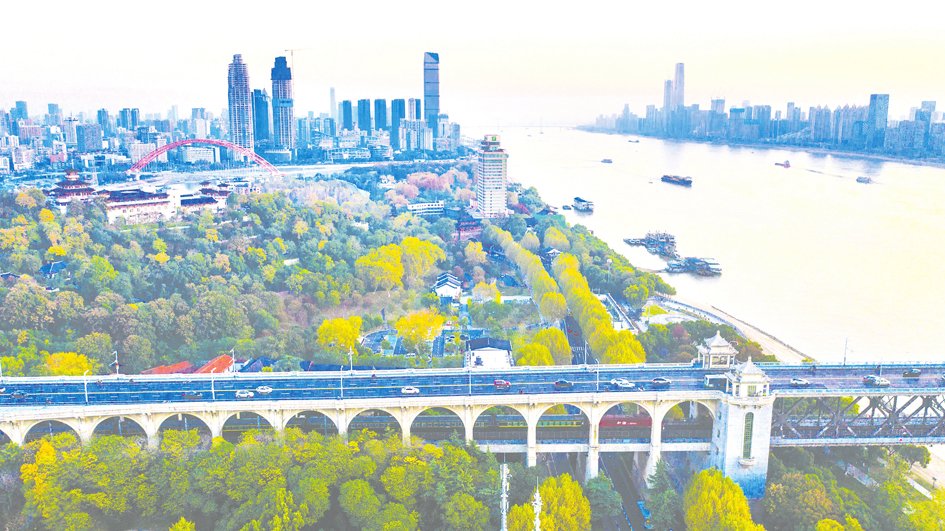
开启新一轮“组局”! 武汉都市圈发展提速
Mei Ri Jing Ji Xin Wen· 2025-11-20 13:02
Core Viewpoint - The "same city" concept is becoming a new trend in the Wuhan metropolitan area, emphasizing the need for collaborative development among surrounding cities to enhance the overall economic capacity and quality of growth in the region [1][3][5]. Economic Significance - By 2024, the economic output of the Wuhan metropolitan area is expected to exceed 3.6 trillion yuan, accounting for over 60% of Hubei's total economy and 29% of the Yangtze River middle reaches urban agglomeration [3][13]. - The goal for 2025 is to achieve a GDP of 4 trillion yuan, necessitating an increase of approximately 400 billion yuan this year, which relies on the collective efforts of the "1+8" member cities [3][4]. Development Strategy - The recent emphasis on "same city" development indicates a strategic shift towards enhancing collaboration and connectivity among Wuhan and its surrounding cities, aiming to create a more integrated urban area [5][12]. - The focus on transportation, innovation, and industrial collaboration is crucial for achieving this goal, with various projects already underway to facilitate these connections [7][8]. Collaborative Projects - Numerous projects, such as the Huangshi New Port Expressway and the Hanjin Xinglong Hub, highlight the involvement of Wuhan in regional development efforts, showcasing the metropolitan area's commitment to collaborative growth [8][9]. - The establishment of cross-border e-commerce parks and high-tech zones in neighboring cities further illustrates the industrial cooperation and resource sharing within the metropolitan area [12][14]. Future Directions - The Wuhan metropolitan area is set to enhance its role as a regional leader by fostering deeper cooperation with neighboring provinces, particularly in transportation, technology, and industry [16][17]. - The upcoming "14th Five-Year Plan" will focus on promoting regional interconnectedness and collaborative development, aiming to strengthen the metropolitan area's influence within the Yangtze River middle reaches urban agglomeration [15][18].

深度融合空间的“形”功能的“神” 推动长三角都市圈同城化发展研讨会举行
Jie Fang Ri Bao· 2025-10-10 02:04
Core Viewpoint - The "Action Plan for Establishing and Improving the System and Mechanism for the Integrated Development of Urban Agglomerations" has been officially issued, aiming to enhance the integration level of the Yangtze River Delta urban agglomeration and promote it as a significant space unit for regional growth and global competition [1] Group 1: Specific Tasks and Measures - The Action Plan outlines 30 specific tasks focusing on achieving "seven ones" and strengthening organizational implementation across eight areas [2] - It emphasizes the establishment of a coordinated development "one group" through the construction of various innovation corridors and ecological economic belts, enhancing cooperation and interaction among urban agglomerations [2] - The plan also aims to create an interconnected infrastructure "one network" by improving road networks and integrating various rail systems to facilitate commuting within the urban agglomeration [2] Group 2: Market Environment and Cooperation - The Action Plan includes measures to optimize the market environment, promote high-level open cooperation, and enhance shared ecological protection and public services [3] - It emphasizes the importance of collaborative efforts in creating a favorable market environment and shared resources among urban areas [3] Group 3: Potential and Efficiency Enhancement - The development of urban agglomerations is crucial for global city clusters, with the Yangtze River Delta facing challenges such as operational efficiency and the need for improved legislative and governance frameworks [4] - The plan aims to enhance spatial organization efficiency and release structural potential within the urban agglomeration, supporting the construction of a world-class city cluster [4] - Key strategies include better consensus on development, legislative support for unified actions, collaborative governance mechanisms, and focused breakthroughs in specific areas [4]