醋酸

Search documents
我国醋酸产业实现新突破
Zhong Guo Hua Gong Bao· 2026-01-13 07:05
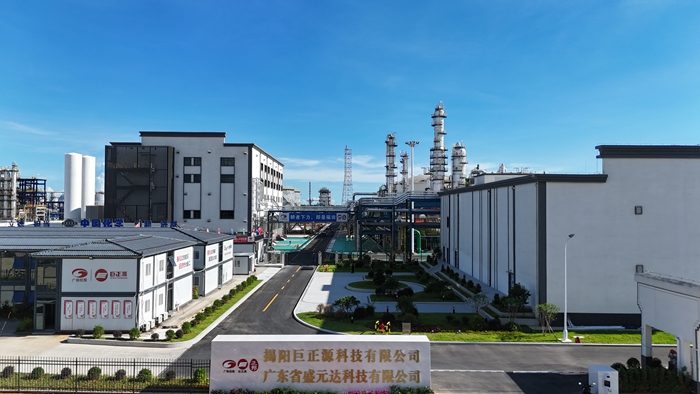
Core Viewpoint - The project of 1.5 million tons/year acetic acid at the Juzhengyuan (Jieyang) New Materials Base has officially entered the trial production phase, marking it as one of the largest single-unit acetic acid production facilities globally, which will significantly impact China's acetic acid industry chain and promote the formation of a new materials industry cluster in the region [1][4]. Technical Aspects - The project utilizes methanol and carbon monoxide as raw materials, employing a rhodium-based catalyst for low-pressure carbonylation to produce acetic acid, achieving high conversion rates, good selectivity, and mild reaction conditions, which effectively enhance thermal efficiency and reduce energy consumption [1][3]. - The main technical indicators of the project meet international advanced levels, with core metrics such as single-unit scale, energy consumption control, and environmental emissions comparable to leading international technologies [3]. Industry Impact - The project will further increase China's annual acetic acid production capacity, solidifying the country's leading position in the global acetic acid industry, and filling the production gap in South China, which previously relied on external supplies [2][4]. - Acetic acid serves as a "universal intermediate" in the chemical industry, widely used in the production of PTA, vinyl acetate, and acetate esters, thus the project is expected to stimulate downstream industries like vinyl acetate and butanol, enhancing the vitality of the new materials industry chain in Jieyang [5]. Regional Development - The project is expected to change the consumption-only status of South China in the acetic acid market, achieving a balanced capacity layout that meets the growing demand for high-end chemical raw materials in the Greater Bay Area, thereby reducing procurement and logistics costs for downstream enterprises [4]. - Future plans include forming a complete industrial chain from basic raw materials to high-end new materials, contributing to the establishment of a regional new materials industry cluster in Jieyang [4]. Talent and Innovation - The project has attracted a high-quality professional talent pool and technical teams, promoting regional technological innovation capabilities and talent development, while collaborations with universities and research institutions will enhance the integration of industry, academia, and research [5]. - As a key project under Guangdong's "Hundred Million Project," it employs domestic technology to achieve self-sufficiency in key chemical raw materials, reducing reliance on external supplies and enhancing the autonomy of China's chemical industry chain [5]. Project Management - The construction faced multiple challenges, including tight schedules, adverse weather, limited space, and complex technologies, which were successfully overcome through innovative processes, optimized construction organization, and strengthened process control [6]. - The project team aims to ensure stable and efficient operation of the facility, contributing to the high-quality development of the regional economy [6].