量化金融

Search documents
这个AI炒股年化收益27.75%!用自进化Agent挖掘穿越牛熊的量化因子
量子位· 2026-02-11 12:49
Core Insights - The article discusses the QuantaAlpha framework, which aims to combine the strengths of genetic programming and large language models (LLMs) for effective alpha factor mining in quantitative finance [1][2][35] - QuantaAlpha introduces a trajectory-based self-evolution paradigm that allows for adaptability in volatile market conditions, marking a significant advancement in AI's role in financial research [2][35] Group 1: Framework Overview - QuantaAlpha's core innovation is viewing the factor mining process as a complete trajectory, enhancing resilience during market shifts [2] - The framework emphasizes trajectory-level evolution rather than single-instance success, focusing on systematic exploration and logical integrity [3] Group 2: Methodology - The framework employs diversified planning initialization to mitigate factor crowding from the outset, generating multiple distinct research paths [5] - It utilizes mutation to target and correct specific decision failures in non-stationary markets, allowing for local refinement while preserving effective components [6][7] - Crossover operations are designed to reuse successful experiences by identifying and recombining high-value segments from different trajectories [8][9] - Structured constraints are implemented to prevent semantic drift and ensure that generated factors maintain economic logic and clarity [10][11] Group 3: Case Study - The evolution of a specific factor, starting from a reversal logic to a nested momentum alignment, demonstrates the framework's ability to adapt and improve performance metrics [17][20] - The final factor, Institutional Momentum Score 20D, integrates insights from both institutional momentum and retail herding, showcasing the framework's capacity for logical synthesis [23][24] Group 4: Performance Metrics - The framework's predictive power is evidenced by an information coefficient (IC) of 0.1501 and an annualized excess return (ARR) of 27.75%, with a maximum drawdown (MDD) of only 7.98% [28][29] - Factors derived from QuantaAlpha have shown strong out-of-distribution (OOD) transferability, generating cumulative excess returns of 160% and 137% on CSI 300 and CSI 500, respectively [31] Group 5: Resilience Testing - QuantaAlpha has maintained high signal strength during market volatility, outperforming traditional factor libraries by adapting to new market dynamics [33]


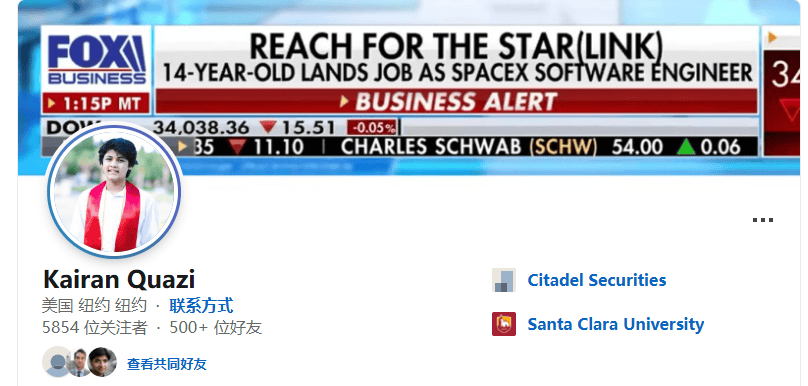
搞AI不如搞量化?16岁炒了马斯克,转身华尔街顶流Quant!
Sou Hu Cai Jing· 2025-09-12 11:50
Core Insights - Kairan Quazi, a 16-year-old prodigy, left SpaceX to join Citadel Securities, a leading quantitative firm on Wall Street, highlighting a significant career transition for a young talent [1][13][20] - Quazi's educational background includes being the youngest graduate of Santa Clara University, where he studied Computer Science and Engineering, and his early involvement in AI projects at Intel [4][5][6] Group 1: Educational Background - Kairan Quazi was born in 2009 and demonstrated exceptional intelligence from a young age, joining Mensa and skipping traditional K-12 education to enter college early [3][4] - He graduated from Santa Clara University at the age of 16, making history as the youngest graduate in the institution's 172-year history [5][6] - The university is located in Silicon Valley and is known for its strong programs in Computer Science and Engineering, attracting students interested in practical applications [8][10] Group 2: Career Transition - After graduating, Quazi faced challenges in securing a job due to his age, but eventually joined SpaceX, where he worked on the Starlink project as the youngest software engineer [5][20] - His move to Citadel Securities as a quantitative developer reflects a strategic choice to work in an environment where he can see quicker results from his efforts in AI and quantitative finance [13][20] - Citadel Securities is known for its rigorous demands for mathematical and programming skills, aligning with Quazi's educational background [16][18] Group 3: Industry Insights - The quantitative finance industry increasingly seeks individuals with strong backgrounds in mathematics, computer science, and engineering, as these skills are essential for developing and implementing complex financial models [16][17] - Kairan's story illustrates the importance of aligning educational choices with career aspirations, particularly in fields driven by technology and data analysis [22][24] - The narrative emphasizes that success is not solely determined by academic performance but by self-awareness and the ability to navigate challenging environments [23][24]