金融云

Search documents
新三板掘金周报第七期:全球领先的全龄人工饲料工厂化养蚕技术-20260125
KAIYUAN SECURITIES· 2026-01-25 13:11
Group 1: New Companies Listed - Six new companies were listed on the New Third Board, with average revenue of 624 million and median revenue of 363 million, and average net profit of 83.84 million with median net profit of 48.64 million [4][16] - Moshang High-Tech (875070.NQ) is a leader in full-age artificial feed factory silkworm breeding technology, achieving a 100% market share in this segment in China, with a projected fresh cocoon output of 29,400 tons in 2024 [4][18] - Tianjiao Bio (875025.NQ) is a major producer of powdered oils, benefiting from the rapid growth of the new tea beverage market, with the pre-packaged coffee market expected to grow at a CAGR of 14.47% from 2021 to 2025 [5][40] Group 2: Market Dynamics - The New Third Board has sent a total of 862 companies to the Shanghai and Shenzhen stock exchanges, indicating its role in supporting small and medium enterprises [3] - The total market value of listed companies on the New Third Board reached 25,181.94 billion by the end of 2025, with a decrease of 35 companies in December 2025 [6][13] - The trading volume for the week of January 19 to January 25, 2026, included 190 block trades, with significant trading amounts for companies like Sanying Precision and Yinggu Laser [6][12] Group 3: Industry Insights - The global powdered oil market is projected to reach USD 4.476 billion by 2025, driven by increasing disposable income and consumption upgrades in developing countries [37] - The financial cloud market in China is rapidly growing, with market sizes of USD 6.56 billion in 2021, USD 8.05 billion in 2022, and USD 8.82 billion in 2023, indicating a strong demand for digital transformation in financial institutions [47][50] - The industrialized silkworm breeding sector is undergoing a transformation from traditional agriculture to modern biological manufacturing, with companies like Moshang High-Tech leading the way [26][24]
21对话|腾讯云胡利明:金融科技出海2.0 智能体元年怎么干
2 1 Shi Ji Jing Ji Bao Dao· 2025-11-06 12:57
Core Insights - The article discusses the transformation of China's fintech industry from a "single technology output" model to becoming "industry standard setters" as it enters the 2.0 phase of going global [2] - Tencent Cloud is accelerating its overseas market strategy, particularly in Hong Kong, which serves as a key entry point for Chinese technology to showcase its capabilities [2][4] Industry Trends - Shenzhen's financial technology influence is growing, with the city ranking ninth globally and second in fintech according to the GFCI38 report [2] - The collaboration between Shenzhen and Hong Kong is fostering a conducive environment for fintech companies to explore international markets [2] Company Strategy - Tencent Cloud is providing digital transformation support to nearly 400 financial clients across over 20 countries and regions [2] - The company has established deep partnerships with two digital banks in Hong Kong, offering both private and public cloud solutions [4][5] Market Opportunities - The demand for cloud services is increasing among both traditional and digital banks, with digital banks showing a higher dependency on cloud infrastructure due to their online business models [5][11] - Tencent Cloud's overseas business is experiencing double-digit growth annually, with significant breakthroughs in markets like Hong Kong and Southeast Asia [8] Challenges and Solutions - Tencent Cloud faces challenges in aligning with the existing traditional systems of overseas financial institutions, which require significant upgrades for digital transformation [9][10] - The company is addressing these challenges by collaborating with industry application developers to create tailored solutions for clients [10] AI and Future Prospects - The current year is referred to as the "Year of the Intelligent Agent," with significant opportunities for cloud service providers to develop AI capabilities [12][14] - Tencent Cloud aims to leverage its extensive internet ecosystem to integrate AI capabilities into financial applications, enhancing business value for financial institutions [17]

金融云领域核心洞察:现状、竞争格局及数字化转型下的发展方向
Xin Lang Cai Jing· 2025-10-13 01:00
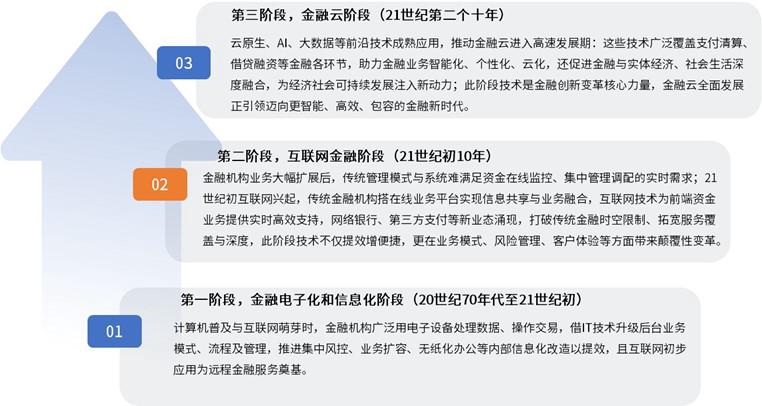
Group 1: Overview of Financial Cloud Development - Financial cloud refers to the use of cloud-native, artificial intelligence, and big data technologies to enhance the efficiency and service quality of financial institutions by migrating data and processes to the cloud [1][3] - The financial cloud industry has rapidly developed, becoming a key driver for the digital transformation of the financial sector, with significant growth in market size observed in recent years [3][4] Group 2: Current Status of Financial Cloud - The Chinese financial cloud market reached a size of $6.56 billion in 2021, with projections of $8.05 billion in 2022 and $8.82 billion in 2023, indicating a continuous growth trend [3][4] - Different scales of financial institutions exhibit varying demands for financial cloud technology, with larger institutions focusing on hybrid cloud platforms and smaller institutions leveraging cost advantages for digital transformation [3][4] Group 3: Competitive Landscape - The financial cloud market is characterized by diversification and specialization, led by integrated cloud vendors, product-focused cloud vendors, traditional IT service providers, and fintech subsidiaries [4][10] - The emergence of financial cloud hosting services has become a new competitive direction, providing operational cost reduction and enhanced business agility for financial institutions [10] Group 4: Development Trends - The digital transformation of financial institutions is expected to accelerate, driven by the application of advanced technologies such as big data, artificial intelligence, and blockchain [6] - Financial institutions are increasingly adopting cloud services to replace traditional information systems, allowing for cost reduction and efficiency improvements [7] - The security framework in the financial sector is continuously improving, with a focus on building a robust ecosystem based on domestic technology [8] Group 5: Industry Interconnections - The upstream supply chain consists of core hardware suppliers and supporting software vendors, while the downstream includes various financial institutions such as banks and leasing companies [9] - The financial cloud sector is closely linked to both upstream and downstream industries, with software development reliant on upstream hardware and software platforms, and downstream demand influencing market dynamics [9] Group 6: Key Players in the Market - Notable companies in the financial cloud sector include: - Industrial Digital Financial Services (Shanghai) Co., Ltd., focusing on banking cloud solutions [11] - Shandong Urban Commercial Bank Cooperation Alliance, providing cloud services to member banks [11] - Jindian Cloud Digital Technology Co., Ltd., offering comprehensive services to small and medium financial institutions [11] - Shenzhou Rongxin Cloud Technology Co., Ltd., specializing in digital cloud platform services for the financial industry [11] - Jinzheng Co., focusing on financial technology and providing a full range of solutions for the financial sector [11]