金融分析服务

Search documents
全球资金流向生变!“Anthropic风暴”重创科技 价值股与债基成“新避风港”
智通财经网· 2026-02-06 11:40
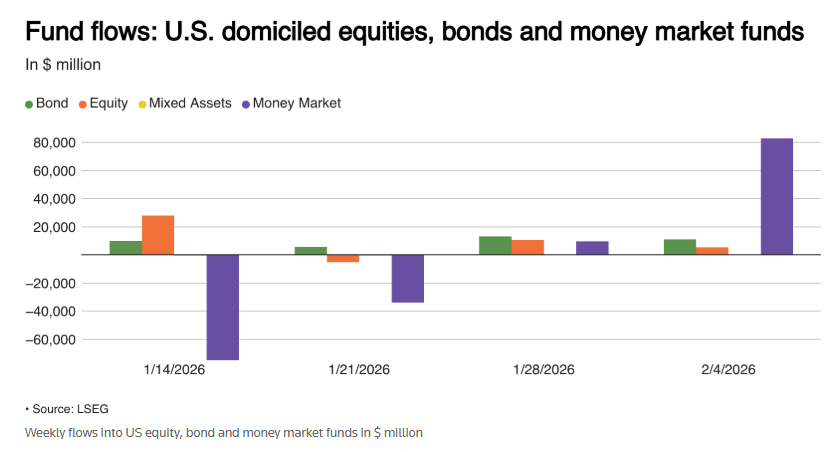
Core Viewpoint - The recent statistics indicate a significant decline in investment demand for U.S. equity funds, attributed to fears surrounding AI's potential to disrupt the software industry, despite strong earnings reports from major companies like Eli Lilly and Super Micro Computer [1] Group 1: Market Trends - U.S. equity funds saw a net inflow of approximately $55.8 billion for the week ending February 4, a sharp decrease of about 48% from the previous week's inflow of $108.2 billion [1] - The introduction of new AI tools by Anthropic has intensified market fears regarding the disruption of the SaaS software industry, leading to a collective crash in software stocks [4] - Major U.S. indices experienced a significant drop following the announcement of advanced AI capabilities that threaten traditional software services [4] Group 2: Fund Flows - Large-cap equity funds recorded a surprising net inflow of about $11 billion, indicating ongoing bullish sentiment towards major tech companies like Google, Nvidia, and Apple [5] - Mid-cap and small-cap equity funds experienced outflows of approximately $15.9 billion and $16.7 billion, respectively, reflecting a shift in investor sentiment [5] - Investors directed $21.1 billion into undervalued industrial sectors and approximately $14.4 billion into metals and mining, while withdrawing about $23.4 billion from the tech sector [5] Group 3: Bond and Cash Market Activity - U.S. bond funds achieved a net inflow of $111.1 billion over the latest week, marking the fifth consecutive week of significant inflows [8] - Short- to medium-term investment-grade bond funds received net investments of about $63.4 billion, the largest weekly inflow since at least 2022 [8] - Money market funds recorded a net inflow of $830.9 billion, the highest since early December, indicating a shift towards cash and bonds amid declining risk appetite [11]

2025年塑造金融分析的关键趋势
Refinitiv路孚特· 2025-06-16 04:17
Core Viewpoint - The article emphasizes that AI is transforming the financial analysis landscape by enhancing automation, predictive capabilities, and personalized insights, which are crucial for navigating the complexities of the financial market in 2025 [4][5]. Group 1: AI Integration in Financial Analysis - AI is no longer a future concept but a key element in financial analysis, expected to play a significant role in automating complex tasks, improving decision-making, and providing real-time insights by 2025 [5]. - LSEG's analysis business is at the forefront of integrating AI into financial analysis, offering various AI-driven solutions, including an AI analysis assistant and predictive AI models like StarMine and Yield Book [6]. Group 2: Political Landscape and Regulatory Changes - Political uncertainty continues to drive market volatility, with the potential for significant fluctuations in interest rates, currency values, and stock prices due to policy shifts and international trade disputes [7]. - The Trump administration's regulatory rollbacks aim to stimulate economic growth, particularly in the financial sector, but may also introduce new risks by weakening investor protections [8]. Group 3: Real-Time Risk Management - The demand for intraday analysis is increasing, as financial professionals require real-time monitoring and assessment of risks rather than waiting for end-of-day reports [11]. - LSEG provides over 200 real-time curves covering government bonds and swap curves, enhancing clients' ability to assess mortgage holdings' risk multiple times a day [11]. Group 4: Client Solutions and Support - LSEG's solutions cater to various client types, including traders, portfolio managers, and risk management professionals, offering tools for pricing, performance insights, and regulatory compliance [20][21][24].