
监管放松

Search documents
美联储巴尔金:利率需“精细调整” 2026年经济前景审慎乐观
Xin Hua Cai Jing· 2026-01-06 16:35
Core Viewpoint - The Federal Reserve's Richmond President Thomas Barkin emphasizes the need for a "fine-tuning" strategy in future monetary policy due to uncertainties surrounding inflation and employment targets [1] Group 1: Monetary Policy - Current policy interest rates are in a neutral range, but decisions will heavily rely on subsequent economic data without pre-setting a direction [1] - Despite a significant decline in U.S. inflation rates from previous highs, they remain above the Fed's long-term target of 2% [1] Group 2: Employment and Economic Risks - The unemployment rate remains low, but policymakers are cautious about further deterioration in the labor market [1] - Barkin warns of the "bear market" risk, highlighting the need to control inflation without triggering a deep economic contraction [1] Group 3: Economic Outlook - In assessing the economic performance for 2025, Barkin acknowledges overall resilience but points out structural concerns, such as demand and job growth being overly concentrated in a few sectors, which may weaken the breadth and sustainability of recovery [1] - For 2026, Barkin expresses cautious optimism, suggesting that uncertainties that troubled the market last year are likely to dissipate, potentially boosting consumer and business confidence [1] - He mentions that tax reforms, regulatory easing, and potential interest rate cuts could support economic growth this year [1]
美联储巴尔金:利率需“精细调整”,2026年经济前景审慎乐观
Sou Hu Cai Jing· 2026-01-06 15:43
Core Viewpoint - The Federal Reserve's Richmond President Thomas Barkin emphasizes the need for a "fine-tuning" strategy in future monetary policy due to uncertainties surrounding inflation and employment targets [1] Group 1: Monetary Policy - Current policy interest rates are at a neutral range, but decisions will heavily rely on subsequent economic data without pre-setting a direction [1] - Despite a significant decline in the U.S. inflation rate from previous highs, it remains above the Federal Reserve's long-term target of 2% [1] Group 2: Employment and Economic Risks - The unemployment rate remains low, but policymakers are cautious about further deterioration in the labor market [1] - Barkin warns of the "bear market" risk, which involves suppressing inflation while avoiding a deep economic contraction [1] Group 3: Economic Outlook - In assessing the economic performance for 2025, Barkin acknowledges overall resilience but highlights structural concerns, such as demand and job growth being overly concentrated in a few industries, with a noticeable decline in market sentiment [1] - Looking ahead to 2026, Barkin expresses cautious optimism, suggesting that multiple uncertainties that troubled the market last year are expected to gradually dissipate, potentially boosting consumer and business confidence [1] - He mentions that tax reforms, regulatory easing, and potential interest rate cuts could support economic growth this year [1]
资深金融记者:人工智能热潮恐是泡沫前兆,市场崩盘终将到来
美股IPO· 2025-10-13 10:19
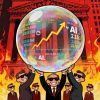
Core Viewpoint - The current AI-driven market may resemble the 1929 crash, indicating a potential bubble that could lead to a market collapse, with the situation being either an "extraordinary boom" or an "overvaluation" [3][4]. Group 1: AI Market Dynamics - The economic landscape is heavily reliant on massive investments in artificial intelligence, with "hundreds of billions" currently being invested in the sector, which is supporting overall economic performance [5]. - There is significant uncertainty regarding whether the optimism surrounding AI is due to a long-term technological revolution or merely a temporary speculative frenzy [5]. Group 2: Historical Comparisons - The current market environment is compared to the 2000 internet bubble and the 2008 real estate bubble, both of which were driven by new technologies or financial instruments leading to irrational exuberance and subsequent market crashes [5][6]. Group 3: Market Vulnerabilities - Key factors exacerbating market fragility include regulatory relaxations during the Trump administration, increasing reliance on debt, and recent policy changes allowing private equity investments in 401(k) retirement accounts [6]. - The combination of speculation, rising debt, and dismantled regulatory safeguards creates a precarious market environment [7]. Group 4: Predictions of Market Collapse - While the exact timing and depth of a potential market collapse cannot be predicted, there is a strong belief in the inevitability of such an event due to the nature of financial markets being driven by confidence, which can collapse suddenly [7].

美国SEC主席呼吁放松监管:将评估以半年报代替季报
Hua Er Jie Jian Wen· 2025-09-29 06:55
Core Viewpoint - The SEC plans to significantly relax financial regulations by evaluating the option for public companies to replace quarterly reports with semi-annual reports, emphasizing a market-driven approach to disclosure practices [1][2]. Group 1: Regulatory Changes - SEC Chairman Paul Atkins is advancing a proposal that allows companies to choose semi-annual reporting instead of mandatory quarterly reports, arguing that quarterly reports are not essential for market vitality [2]. - The SEC under Atkins is shifting towards a "minimal effective dose" of regulation, focusing on protecting investors while allowing companies to thrive [3]. Group 2: Critique of Previous Administration - Atkins criticizes the aggressive regulatory stance of his predecessor, Gary Gensler, and has taken steps to overturn key aspects of the previous agenda, including halting court defense for climate risk disclosure rules [4]. - The SEC's new direction contrasts sharply with European regulations, which Atkins believes impose unnecessary costs on U.S. investors without providing significant benefits [4]. Group 3: Investor Concerns - Investor advocacy groups express concerns that reducing the frequency of financial disclosures from quarterly to semi-annual could significantly undermine market transparency [5]. - There are fears that decreased information disclosure may harm retail investors who rely on public information for decision-making, potentially affecting the efficiency of U.S. capital markets [6].
Big banks should all benefit from a more conducive economic backdrop, says Barclays' Jason Goldberg
Youtube· 2025-09-17 12:26
Group 1 - The financial sector is performing well, with expectations of the Federal Reserve initiating an easing cycle, which could further benefit banks [1][2] - The anticipated economic growth and potential Fed rate cuts are expected to spur loan growth and increase capital markets activity, aiding M&A and IPO activities [2][4] - Lower interest rates may lead to increased mortgage refinancing activity and improve banks' book values by reducing unrealized losses [5] Group 2 - Larger banks are favored in the current economic backdrop due to their potential benefits from capital markets activity and regulatory reductions [6] - Major banks such as Bank of America, JP Morgan, Goldman Sachs, and Morgan Stanley are expected to thrive in a more favorable economic environment [7] - JP Morgan is highlighted as a top performer with consistent returns on tangible common equity exceeding 20% [8] Group 3 - Bank of America has lagged behind other money center banks but is seen as having potential for growth in the coming years [9] - Citigroup has returned to a price of 100 after a stock split, indicating room for further price appreciation [9]



2025年塑造金融分析的关键趋势
Refinitiv路孚特· 2025-06-16 04:17
Core Viewpoint - The article emphasizes that AI is transforming the financial analysis landscape by enhancing automation, predictive capabilities, and personalized insights, which are crucial for navigating the complexities of the financial market in 2025 [4][5]. Group 1: AI Integration in Financial Analysis - AI is no longer a future concept but a key element in financial analysis, expected to play a significant role in automating complex tasks, improving decision-making, and providing real-time insights by 2025 [5]. - LSEG's analysis business is at the forefront of integrating AI into financial analysis, offering various AI-driven solutions, including an AI analysis assistant and predictive AI models like StarMine and Yield Book [6]. Group 2: Political Landscape and Regulatory Changes - Political uncertainty continues to drive market volatility, with the potential for significant fluctuations in interest rates, currency values, and stock prices due to policy shifts and international trade disputes [7]. - The Trump administration's regulatory rollbacks aim to stimulate economic growth, particularly in the financial sector, but may also introduce new risks by weakening investor protections [8]. Group 3: Real-Time Risk Management - The demand for intraday analysis is increasing, as financial professionals require real-time monitoring and assessment of risks rather than waiting for end-of-day reports [11]. - LSEG provides over 200 real-time curves covering government bonds and swap curves, enhancing clients' ability to assess mortgage holdings' risk multiple times a day [11]. Group 4: Client Solutions and Support - LSEG's solutions cater to various client types, including traders, portfolio managers, and risk management professionals, offering tools for pricing, performance insights, and regulatory compliance [20][21][24].

对于芯片,特朗普打什么算盘?
半导体行业观察· 2025-04-21 00:58
特朗普效仿拜登的半导体政策,但重塑其形象。 在试图振兴国内制造业之际,特朗普总统明确表达了他对关税的热爱——以及他对《芯片法案》的 蔑视。他称2022年的法律是"极其糟糕的事情",并敦促国会废除它,同时对这项旨在将半导体制 造业带回美国的百年一遇的390亿美元赌注的未来表示怀疑。 尽管特朗普政府言辞激烈,但其并非袖手旁观,而是在重塑其形象。"投资加速器"项目由商务部长 霍华德·卢特尼克(Howard Lutnick)负责。该项目并非废除或取代《芯片法案》,而是在其基础 上加了一层:一位尚未公布姓名的执行董事,将直接向卢特尼克先生汇报工作,并协调其实施,赋 予其更广泛的权力,以减轻监管负担,吸引国内外投资。 这使得政府能够以新的名称继续推行半导体激励措施。从政治上讲,这让特朗普得以推行一项至关 重要的产业战略——半导体制造回流——而无需赞扬拜登总统或前商务部长吉娜·雷蒙多,后者发 起了这项计划,并在未来十年内安排了5000亿美元的私营部门投资。 投资加速器还为"美国优先"的保守派人士提供了政治掩护,以支持半导体补贴。设立该办公室的行 政命令称,新的架构旨在获得"交易的好处"并确保"比上届政府的协议更好得多"。虽 ...
