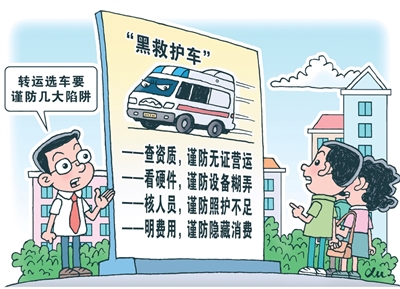
非急救转运

Search documents
非急救转运 成都将有准入标准 多地将建统一服务平台
Xin Lang Cai Jing· 2025-12-24 22:54
Core Viewpoint - The non-emergency medical transport market in China is facing significant demand and regulatory challenges, with a push for standardized services and platforms to address the needs of patients while managing illegal operations [11][12][14]. Group 1: Industry Overview - The non-emergency transport sector has long operated in a gray area, with unclear entry standards and fragmented regulatory responsibilities [12][13]. - Recent media coverage has heightened public awareness and prompted local governments to assess the non-emergency transport situation [11][14]. Group 2: Government Initiatives - The National Health Commission has encouraged local governments to explore and standardize non-emergency transport services, aiming to improve patient experience and service availability [12][13]. - A one-year special rectification campaign has been launched to address illegal ambulance services, focusing on vehicles registered as "ambulance" and those providing unauthorized transport [13][14]. Group 3: Local Government Actions - Cities like Chengdu, Mianyang, and Luzhou are developing unified service platforms and management standards for non-emergency transport, with Chengdu planning to establish a centralized service number (96120) [14][15]. - Local health departments are actively drafting regulations to ensure transparent pricing and service quality in non-emergency medical transport [15].

阳光越多 灰色越少(新视野)
Ren Min Ri Bao Hai Wai Ban· 2025-07-18 02:18
Core Viewpoint - The article highlights the increasing demand for non-emergency medical transportation services due to an aging population and uneven distribution of medical resources, while emphasizing the current inadequacies in service supply and regulatory clarity, leading to the prevalence of unregulated "black ambulances" that pose safety and financial risks to patients and families [1][2]. Group 1: Demand and Challenges - The demand for non-emergency transportation is growing as elderly patients and those recovering from surgery require safe and familiar environments for recovery [1]. - The existing emergency medical system primarily focuses on urgent care, leaving a gap in resources and institutional design for necessary non-emergency services [1]. - There is a lack of clear legal definitions, service standards, qualification requirements, and pricing regulations for non-emergency medical transportation, which allows for non-compliant operations to thrive [1]. Group 2: Solutions and Regulatory Measures - Various cities are exploring solutions by enhancing existing emergency dispatch platforms to include non-emergency functions, aiming for standardized service delivery [2]. - Some regions are introducing state-owned professional transport services to ensure transparency and reliability in pricing and service content [2]. - It is essential for health, transportation, and market regulation departments to establish regular information sharing and joint enforcement mechanisms to combat unqualified operations and protect patient rights [2].