High Performance Computing

Search documents
X @Easy
Easy· 2026-03-05 00:08
Bitcoin Mining Companies are pivoting to AI Infrastructure...> IREN - holds 0 bitcoin, focused on high performance computing> CIFR - down to 1,500 Bitcoin from 2,284 highs. && announcing their focus on HPC infra> RIOT - holds 18,005 Bitcoin, have historically used Bitcoin as a funding tool, held 19,368 coins at peak> HUT - No longer has a long-term strategic focus on Bitcoin, which they announced in their Q4 earnings. They are pivoting focus to their equity investment in ABTC (eric trumps company)> CORZ - S ...
SharonAI(SHAZ) - Prospectus(update)
2026-01-31 01:31
Filed with the Securities and Exchange Commission on January 30, 2026. Registration No. 333-292398 UNITED STATES SECURITIES AND EXCHANGE COMMISSION Washington, D.C. 20549 AMENDMENT NO. 1 to FORM S-1 REGISTRATION STATEMENT UNDER THE SECURITIES ACT OF 1933 SHARONAI HOLDINGS INC. (Exact name of registrant as specified in its charter) (State or other jurisdiction of incorporation or organization) (Primary Standard Industrial Classification Code Number) Delaware 7370 41-2349750 (I.R.S. Employer Identification Nu ...
Bit Digital spins out AI unit as banks shy away from crypto exposure, CEO says
Yahoo Finance· 2026-01-29 22:58
Core Viewpoint - Bit Digital has decided to separate its AI infrastructure business, now operating as WhiteFiber, to better align with investor expectations and improve access to credit [1][2]. Group 1: Reasons for Separation - The separation was driven by two main factors: alignment with investors and access to financing [2][5]. - High performance computing (HPC) is viewed as an institutional product, while digital assets are seen as more retail-oriented, necessitating different investor bases [3][4]. Group 2: Impact on Financing - After the spinout, WhiteFiber's shareholding became primarily institutional, which has led to a better understanding of the economics of data centers and HPC [4]. - Traditional banks are more willing to finance data center developments when they are not associated with digital assets, leading to expanded financing options for WhiteFiber [5][6]. - The cost of capital for WhiteFiber has decreased since the separation, as it no longer has any digital assets involved [6].

Applied Digital to Spin Out Cloud Business, Proposes Business Combination with EKSO to Launch ChronoScale
Globenewswire· 2025-12-29 21:45
Core Viewpoint - Applied Digital and EKSO Bionics announced a proposed business combination to form ChronoScale Corporation, aimed at creating a focused GPU platform for next-generation AI workloads, addressing the growing demand for GPU-accelerated cloud infrastructure [1][2]. Group 1: Proposed Transaction Details - The proposed transaction involves merging Applied Digital's cloud computing business with EKSO, resulting in ChronoScale, which will focus on delivering high-performance compute solutions tailored for AI workloads [1][2]. - Upon completion, Applied Digital is expected to own approximately 97% of the combined entity, with both Applied Digital Cloud and EKSO continuing to operate independently [3]. Group 2: Strategic Rationale - The separation of the accelerated compute platform from Applied Digital's data center operations will allow both businesses to scale independently and pursue distinct growth strategies [2]. - ChronoScale is designed for customers needing predictable performance and rapid deployment, without the limitations of generic cloud environments [2]. Group 3: Financial Performance - Applied Digital Cloud generated approximately $75.2 million in revenue over the twelve months ending August 31, 2025, indicating strong demand for dedicated accelerated compute services [4]. Group 4: Future Outlook - The proposed transaction is expected to close in the first half of 2026, pending customary due diligence and regulatory approvals [6]. - ChronoScale aims to leverage Applied Digital's existing infrastructure to enhance deployment timelines and reduce execution risks as GPU demand increases [5].




SharonAI(SHAZ) - Prospectus
2025-12-23 17:23
Filed with the Securities and Exchange Commission on December 22, 2025. Registration No. 333- UNITED STATES SECURITIES AND EXCHANGE COMMISSION Washington, D.C. 20549 FORM S-1 REGISTRATION STATEMENT UNDER THE SECURITIES ACT OF 1933 SHARONAI HOLDINGS, INC. (Exact name of registrant as specified in its charter) (State or other jurisdiction of incorporation or organization) Delaware 7370 41-2349750 (Primary Standard Industrial Classification Code Number) (I.R.S. Employer Identification Number) 745 5th Ave, Suit ...
HPC市场迎来十年最快增长
半导体行业观察· 2025-11-23 03:37
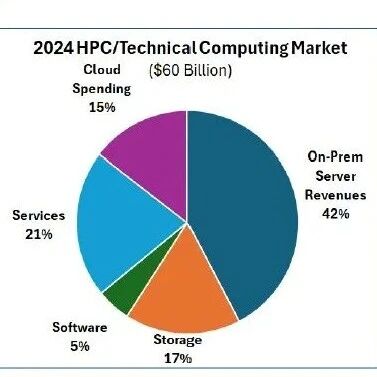
Core Insights - The article discusses the significant growth in data center infrastructure spending driven by AI training and inference cluster architectures, which also positively impacts the HPC (High-Performance Computing) architecture [1][2]. HPC-AI Market Overview - According to Hyperion Research, the global HPC spending over the past three years and future five-year forecasts indicate a robust market [2]. - The HPC-AI market is projected to generate $59.93 billion in total sales in 2024, reflecting a 23.5% growth compared to 2023, with on-premises HPC-AI systems contributing $50.39 billion (up 22.9%) and cloud HPC-AI systems contributing $9.54 billion (up 4.9%) [4][5]. Future Projections - For 2025, the overall HPC-AI market is expected to bring in $58.963 billion, a 17% increase from 2024, with cloud consumption at $12.38 billion and on-premises systems at $57.75 billion [5][6]. - The growth rate is anticipated to stabilize at around 7% to 8% annually by the end of the decade, which is still double the historical average [6]. Spending Breakdown - In 2024, cloud computing consumption will account for 15.9% of the HPC-AI product spending, with 30% of cloud spending allocated to storage, compared to 21.7% for on-premises HPC-AI centers [8]. - Services constitute a significant portion of the HPC-AI budget, primarily for system installation, maintenance, and technical support, while software accounts for only 5% of the total budget [8]. Revenue by Vendor - In 2024, the leading vendors in the HPC-AI market include HPE with $7.151 billion (28.2% market share), Dell Technologies with $3.916 billion (15.5%), and Lenovo with $1.450 billion (5.7%) [13][14]. - Non-traditional suppliers, referred to as Original Design Manufacturers (ODMs), have revenue nearly equal to HPE, indicating a competitive landscape [14]. Market Segmentation - The HPC-AI market is segmented into various price ranges, with the largest share (27.9%) coming from large HPC systems priced between $1 million and $10 million, while entry-level HPC systems (under $250,000) account for 24.3% [15]. Investment Trends - Investment in HPC-AI systems is accelerating, as evidenced by new supercomputers announced by the US Department of Energy, which are expected to stabilize revenue over time due to a shift towards cloud models [17].




Cipher Mining Inks New 10-Year HPC Deal With Fluidstack; Shares Rise 13%
Yahoo Finance· 2025-11-20 14:30
Core Insights - Cipher Mining has entered a 10-year HPC hosting agreement with Fluidstack, adding 56 MW of capacity at its Barber Lake site in Texas, securing approximately $830 million in contracted revenue over the initial term [1] - The agreement could potentially increase in value to about $2.0 billion with two optional five-year extensions and approximately $9.0 billion across the broader partnership [1] Financial Performance - Cipher will deliver 39 MW of additional critical IT load, supported by the 56 MW of gross capacity [2] - Google has increased its backstop of Fluidstack's lease obligations by $333 million, totaling $1.73 billion in support [2] - Cipher plans to fund the buildout through project-related debt and approximately $118 million in additional equity contributions [2] Operational Outlook - The company anticipates strong financial performance from the Barber Lake site, forecasting a net operating income margin of 85% to 90% and project costs of $9 million to $10 million per MW [3] - The expansion is expected to strengthen Cipher's position in high-performance computing and support its growing 3.2 GW development pipeline [3] - Following strong results and outlook from Nvidia, shares of Cipher Mining increased by more than 10%, with the latest news pushing gains to 13% [3]

HIVE Q2 Loss Increases Year Over Year, Revenues Rise, Shares Fall
ZACKS· 2025-11-19 19:31
Core Insights - HIVE Digital Technologies' shares have decreased by 2.2% following the release of its second-quarter fiscal 2026 results, primarily due to fluctuations in Bitcoin prices [1] Financial Performance - In the second quarter of fiscal 2026, HIVE reported a revenue increase of 285% year over year, reaching $87.3 million, with a sequential increase of 91% [2] - Digital currency mining revenues, which accounted for 94.1% of total revenues, surged by 295.2% year over year to $82.1 million, and increased by 101.2% sequentially [3] - High-performance computing (HPC) revenues, making up 5.9% of total revenues, rose by 175% year over year to $5.2 million, reflecting a 7.6% quarter-over-quarter increase [5] Operational Highlights - HIVE produced 719 Bitcoin in the reported quarter, a significant increase from 406 Bitcoin in the same quarter of the previous fiscal year [4] - The gross operating margin for the second quarter was $42.4 million, a substantial rise from $1.2 million in the year-ago quarter [6] - Adjusted EBITDA was reported at $31.5 million, compared to $5.6 million in the previous year [7] Balance Sheet Overview - As of September 30, 2025, HIVE had cash reserves of $22.6 million, down from $24.6 million as of June 30, 2025 [8] - The net cash used in operating activities was $384,000, contrasting with net cash provided of $10.22 million in the previous quarter [8] Strategic Developments - The expansion in Paraguay contributed to increased Bitcoin production and was a key driver of revenue growth [3][10] - The growth in HPC services was supported by the deployment of over 5,000 GPUs, new AI compute contracts, and upgrades to Tier-3 data centers [5][10]


Eviden-built JUPITER Supercomputer Hits Exascale Milestone According to the TOP500, a First in Europe
Globenewswire· 2025-11-17 21:19
Core Insights - Eviden, a product brand of Atos Group, has announced the rankings of its 58 supercomputers in the TOP500 and Green500 lists, highlighting its leadership in advanced computing and energy efficiency [1][3]. Group 1: Supercomputer Rankings - JUPITER, through its Booster partition, is ranked as the 4th most powerful supercomputer globally and the 1st in Europe, marking a historic achievement as the first European system to surpass the ExaFlop barrier, performing one billion billion calculations per second [2][5]. - JUPITER is recognized as the most energy-efficient exascale-class supercomputer, achieving 63 GigaFlops per watt, which demonstrates superior performance-per-watt compared to its competitors [6][9]. Group 2: Green500 Leadership - Eviden has maintained its lead in the Green500 rankings for the fourth consecutive edition, with KAIROS, ROMEO, and Levante GPU extension occupying the top three positions, achieving 73, 70, and 69 GFlops per watt respectively [3][8]. - The Green500 ranking emphasizes the importance of energy efficiency in high-performance computing, with higher GFlops per watt indicating lower energy consumption and costs [8]. Group 3: Innovation and Sustainability - The achievements of Eviden underscore its commitment to innovation, performance, and sustainability, facilitating the adoption of AI and large-scale simulations for various scientific and technological advancements [4][9]. - JUPITER's development involved sustainable design practices and aims to set global efficiency standards, forming the core of the JUPITER AI Factory, which will provide secure access to AI models for research and industry [7][9]. Group 4: Company Overview - Eviden operates in 36 countries with approximately €1 billion in revenue, focusing on advanced computing, cybersecurity products, mission-critical systems, and vision AI [10]. - The company employs over 4,500 professionals and holds more than 2,100 patents, offering a robust portfolio of innovative and eco-efficient solutions in AI, computing, security, data, and applications [11]. Group 5: Atos Group Context - Atos Group, with around 67,000 employees and annual revenue of approximately €10 billion, is a global leader in digital transformation, emphasizing a secure and decarbonized future [12]. - The Group operates under two brands, Atos for services and Eviden for products, and is committed to providing tailored AI-powered solutions across various industries [12][13].


CoreWeave beats on revenue, sets new revenue records according to CEO
Youtube· 2025-11-10 21:53
Core Weave Overview - Core Weave's backlog has increased significantly to $55 billion from $30 billion at the end of the second quarter, largely due to $20 billion worth of contracts signed with OpenAI and Meta [2] - The operating income margins showed better-than-expected performance, alleviating previous concerns about potential underperformance [3][4] Market Position and Demand - The company is positioned to provide swing capacity to hyperscalers like Microsoft, Amazon, and Google, which may rely on Core Weave when they cannot meet their own capacity needs [6] - Core Weave's contracted revenue is expected to remain stable even if AI demand pulls back, as contracts are typically multi-year in nature [7] Challenges and Opportunities - The failure of the Core Scientific deal, which would have accelerated Core Weave's access to additional capacity, poses a challenge for the company [9][10] - Without the Core Scientific acquisition, Core Weave will need to seek other partnerships to fill its pipeline, such as deals with other crypto miners [11]