
Housing Construction

Search documents
Trump signs executive orders aimed at home affordability ahead of midterms
PBS News· 2026-03-13 22:37
Core Perspective - The Trump administration is emphasizing home ownership through executive orders aimed at improving housing affordability, a critical issue for voters ahead of the upcoming elections [1][3]. Regulatory Changes - The first executive order seeks to reduce federal housing regulatory burdens and incentivize state and local governments to adopt best practices, facilitating home construction [2][6]. - The second order aims to streamline the mortgage process, making it easier for smaller community banks to provide home loans by reducing regulatory burdens [12][13]. Legislative Context - A bipartisan housing bill passed in the Senate aims to increase construction and limit institutional ownership of home development, although its future in the House remains uncertain [4]. Economic Implications - The ongoing construction shortage has kept housing prices high, with the median price of an existing home reaching $398,000, nearly five times the median household income [14]. - The average 30-year mortgage rate was 6.05% in February, down from 6.84% a year ago, but still significantly higher than the sub-3% rates seen during the pandemic [15]. Environmental and Efficiency Regulations - The orders propose cutting environmental regulations and simplifying the mortgage process, with the aim of reducing construction costs by up to $9,000 due to energy efficiency mandates [9][10]. - Federal agencies are directed to eliminate regulations that hinder residential development, including those related to energy efficiency and environmental standards [8]. Market Dynamics - The administration believes that changes to mortgage regulations will increase competition among financial institutions, potentially lowering borrowing costs for homebuyers [13]. - The approach aims to balance the need for increased home ownership while maintaining the value of existing homes, reflecting a cautious stance on construction increases [17][18].


Housing Supply Gap Surpasses 4 Million Homes in 2025 as Construction Fails to Keep Pace With Demand
Prnewswire· 2026-03-03 11:00
Core Insights - The U.S. housing supply gap has widened to an estimated 4.03 million homes in 2025, up from 3.8 million in 2024, indicating a persistent shortage driven by underbuilding and high demand from younger households [1][2][3] Housing Supply and Demand - In 2025, approximately 1.41 million households were formed, while only 1.36 million housing starts occurred, resulting in an annual shortfall of about 50,000 units [2] - The supply gap exceeding 4 million homes highlights the deep-rooted nature of the housing shortage, which has been exacerbated by over a decade of underbuilding [3] - 2025 marks the third-largest annual deficit since 2012, with structural imbalances between supply and demand becoming more pronounced [3] Young Households and Affordability - The report identifies 1.82 million Millennial and Gen Z households as "missing" in 2025, the highest count in four years, largely due to high housing costs and limited supply [4] - The minimum recommended income to purchase a median-priced starter home in 2025 was approximately $86,000, which remains above the earnings of many younger households [5] Regional Supply Gaps - The South has the largest cumulative deficit at 1.62 million homes, followed by the Northeast (952,000), Midwest (865,000), and West (660,000) [9] - The Northeast, despite facing the most acute shortage relative to construction since 2012, saw improvements in both missing young households and overall supply gap in 2025 [10] Construction Trends - Approximately 1.5 million homes were completed in 2025, which is elevated by historical standards but below the pace of 2024 [12] - Builders are facing challenges such as zoning restrictions, permitting hurdles, labor shortages, and elevated material costs, which continue to limit construction activity [13] Long-term Outlook - Even under an optimistic scenario where construction increases by 50% from the 2025 pace, it would take roughly seven years to eliminate the current housing deficit [14][15] - The "Let America Build" campaign by Realtor.com emphasizes the need for policy and regulatory reform to expand housing supply and address affordability challenges [15]


Tech Stocks Retreat as NASDAQ 100 Slides 1%; MicroStrategy Expands Bitcoin Trove
Stock Market News· 2026-02-17 15:08
Market Overview - The NASDAQ 100 declined by 1%, reflecting investor skepticism about the returns on capital expenditures for artificial intelligence, impacting major tech stocks like Apple, Microsoft, and Nvidia [2][9] - The S&P 500 fell by 12.68 points (0.19%) to 6,823.49, while the Dow Jones Industrial Average gained 79.03 points (0.16%) to reach 49,579.96, indicating a rotation from high-valuation tech stocks to more defensive sectors [3] Cryptocurrency Regulation - The White House supports the Digital Asset Market Clarity Act, aiming to establish a regulatory framework for the digital asset industry and resolve disputes over stablecoin yields [4][9] - MicroStrategy continued its Bitcoin accumulation, purchasing 2,486 BTC for approximately $168.4 million, bringing its total holdings to 717,131 BTC, which is over 3% of the total Bitcoin supply [5][9] Housing Market Sentiment - The NAHB/Wells Fargo Housing Market Index fell to 36 in February, below the expected 38, marking a second consecutive month of declining builder confidence due to affordability issues [6][9] - 36% of builders reported cutting prices to stimulate demand, with an average reduction of 6% [7] Defense Industry Developments - Rheinmetall secured approval to expand munitions production in Italy, aiming to produce up to 1.1 million artillery shells annually by 2027 to support European stockpiles and Ukraine [10][9]



Pure Cycle Regains Momentum From Oil And Gas And A Clearer Strategy
Seeking Alpha· 2026-01-28 05:56
Core Insights - The article discusses the impact of macroeconomic factors on Pure Cycle Corporation (PCYO), particularly how lower oil prices have led to reduced water demand from oil and gas operators [1] - The housing sector is experiencing a slowdown due to high mortgage rates, which has implications for PCYO's business [1] Group 1: Company Analysis - PCYO's management has noted the effects of external economic conditions on their operations, particularly in relation to oil prices and housing market dynamics [1] - The company operates in a sector that is sensitive to macroeconomic changes, highlighting the importance of understanding broader economic trends for investment decisions [1] Group 2: Investment Strategy - The investment strategy discussed emphasizes a top-down approach, starting with macroeconomic indicators to identify strong economies and sectors likely to perform well [1] - Following the identification of promising sectors, the focus shifts to selecting quality companies with solid momentum and consistent results, which is crucial for investment success [1]


Positive Reaction To Jobs Data May Lead To Early Strength On Wall Street
RTTNews· 2026-01-09 13:57
Economic Indicators - The U.S. non-farm payroll employment rose by 50,000 jobs in December, following a downwardly revised increase of 56,000 jobs in November, which was below economists' expectations of a 60,000 job increase [2][22] - The unemployment rate decreased to 4.4 percent in December from a revised 4.5 percent in November, contrary to expectations of a drop to 4.5 percent from the originally reported 4.6 percent [2][3][23] Stock Market Performance - Major U.S. stock indexes showed mixed performance, with the Dow increasing by 270.03 points (0.6 percent) to 49,266.11, while the Nasdaq fell by 104.26 points (0.4 percent) to 23,480.02 [4][5] - Energy stocks experienced significant gains, with the Philadelphia Oil Service Index rising by 4.3 percent and the NYSE Arca Oil Index increasing by 3.6 percent due to a spike in crude oil prices [6] Commodity and Currency Markets - Crude oil futures rose by $0.26 to $58.02 per barrel, following a previous spike of $1.77 [8] - The U.S. dollar strengthened against the yen, trading at 157.46 yen, and was valued at $1.1647 against the euro [9] Asian Market Trends - Asian stocks rose broadly, with China's Shanghai Composite Index advancing by 0.9 percent to 4,120.43, driven by consumer inflation data [13] - Japan's Nikkei 225 Index jumped by 1.6 percent to 51,939.89, supported by strong earnings from Fast Retailing [14] European Market Developments - European stocks moved mostly higher, with the French CAC 40 Index up by 1.1 percent and the U.K.'s FTSE 100 Index up by 0.8 percent, following positive industrial output data from Germany [18] - Mining giant Glencore surged amid preliminary discussions for a possible merger with Rio Tinto, which saw a decline in its stock [19]


评论:房屋品质提升工程该如何推进
Jing Ji Ri Bao· 2026-01-04 03:59
Core Viewpoint - The concept of "good houses" has become a key focus in China's housing policy, with the government emphasizing the need for quality improvement in housing construction and the implementation of a housing quality enhancement project during the 14th Five-Year Plan period [1][4]. Group 1: Housing Quality Enhancement - The housing quality enhancement project is a significant task for the 14th Five-Year Plan, aiming to improve housing standards, design, materials, construction, and operational levels over the next five years [1]. - The project will prioritize the construction of "good houses" in affordable housing, ensuring that commercial housing meets both rigid and improvement demands, and making notable progress in the renovation of old houses [1]. - A comprehensive policy, standard, technical, and industrial system will be established to support the enhancement of housing quality [1]. Group 2: Design and Construction Standards - Improved housing construction standards are essential for the "good houses" initiative, with the "Residential Project Standards" set to be implemented on May 1, 2025, establishing baseline requirements [1]. - Housing design should focus on functionality, safety, performance, quality, and experience, with an emphasis on optimizing layouts to maximize space utility [2]. - New construction methods, including smart, green, and prefabricated building techniques, will be promoted, marking a shift towards high-quality development in the construction industry [2]. Group 3: Renovation of Old Houses - The renovation of old houses is a key component of the "good houses" initiative, with plans to steadily advance the transformation of urban villages and dilapidated buildings [3]. - The use of modern technologies and methods, such as modular construction and integrated kitchen and bathroom designs, will facilitate the renovation process and improve maintenance efficiency [3]. - The government will support technological innovation in the housing sector, encouraging enterprises to establish innovation platforms and integrate research with practical applications [3]. Group 4: Property Management and Services - There is significant potential for improvement in housing operation and maintenance services, with plans to establish a long-term safety management mechanism for housing throughout its lifecycle [2]. - The scope of property services will expand to include various community services, addressing the growing demand for quality living services among residents [2]. - The transformation of real estate and construction companies into integrated service providers for "good houses" will enhance the entire housing industry chain, fostering new production capabilities [3].
2030年我国房屋品质提升 工程将取得显著进展
Xin Lang Cai Jing· 2026-01-01 17:42
Core Viewpoint - The Ministry of Housing and Urban-Rural Development has issued opinions aimed at enhancing housing quality, focusing on providing better housing for the public and establishing a new model for real estate development [1] Summary by Relevant Sections Goals - By 2030, significant progress is expected in housing quality enhancement, with improvements in housing standards, design, materials, construction, and operation levels [1] - The goal includes ensuring that affordable housing is prioritized as "good housing," better meeting both rigid and improvement demands for commercial housing, and making noticeable advancements in the renovation of old houses [1] Key Tasks - Eight key tasks have been outlined, including: - Improving housing construction standards - Enhancing architectural design levels - Promoting the use of quality materials - Developing new construction methods - Improving operation and maintenance service levels - Promoting the renovation of existing housing - Strengthening technological empowerment - Enhancing industrial support [1] Implementation - The opinions call for establishing a sound working mechanism to implement housing quality enhancement projects tailored to local conditions [1] - It emphasizes the need to utilize urban renewal and support policies to continuously promote the development of "good housing" [1] - There is a push for guiding enterprises to accelerate the construction of housing projects that meet market demands [1]
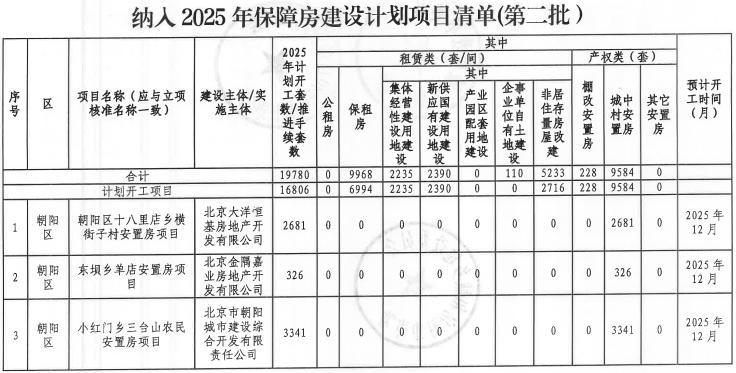
北京保障房又有2万多套列入计划
3 6 Ke· 2025-11-11 06:14
Group 1 - Beijing has completed its annual target of constructing 50,000 rental housing units and finishing 80,000 various types of affordable housing by the end of October [1] - The second batch of affordable housing construction plans includes 17 projects, providing a total of 19,780 housing units, with 10 rental housing projects offering 9,968 units and 7 resettlement housing projects providing 9,812 units [1][3] - The total number of affordable housing units planned for completion this year is 2,366, all of which are rental housing projects [4] Group 2 - The focus of the new batch of affordable housing projects is on rental housing, with a significant increase in supply for young talents and specific groups, with rental housing products making up 98% of the total, including 40% dormitory-type units [5] - The project in the Economic Development Zone aims to provide 2,390 units for blue-collar workers, enhancing the living conditions for technical workers [5] - Other projects in Changping and Shunyi districts are designed to support local enterprises by providing housing for employees, with a total of 2,235 units available in Shunyi [5]
New Podcast Spotlights Innovative Housing Solutions in Canada’s Rural, Remote, and Indigenous Communities
Globenewswire· 2025-10-16 17:00
Core Insights - The podcast "Can I Stay? Rural, Remote, and Ready to Build" focuses on community-led innovations addressing Canada's housing crisis, particularly in rural and Indigenous areas [1][3][4] - The initiative is supported by Foresight Canada and funded by the Canadian Mortgage and Housing Corporation (CMHC), highlighting the importance of grassroots solutions in overcoming systemic barriers [2][11] Group 1: Podcast Overview - The podcast is hosted by Lindsay Blair and Candace Larsen, featuring stories from community leaders and experts involved in the $300 million CMHC Housing Supply Challenge [2][3] - Each episode provides firsthand accounts of the housing crisis, emphasizing the need for innovative financing and community-driven approaches to tackle the national housing deficit [3][4] Group 2: Episode Highlights - Episode 1 introduces personal stories from individuals affected by the housing crisis, setting the stage for the challenges faced in rural Ontario [4] - Episode 2 discusses systemic challenges in housing development, including issues like "drag-and-drop" homes and bureaucratic red tape, featuring insights from local leaders [5] Group 3: Organizations Involved - Rural Impact Canada aims to unlock development potential in small municipalities by addressing challenges such as infrastructure, providing guidance for implementing housing solutions [7] - One Bowl Housing Corporation focuses on Indigenous-led housing solutions, utilizing local materials and technology to create affordable, culturally appropriate homes while fostering local employment [8]

HousingWire's Logan Mohtashami: Whenever mortgage rates head near 6%, housing data improves
Youtube· 2025-09-24 17:01
Group 1: Housing Market Overview - New home sales in August increased by over 20% month-over-month, indicating strong demand and a potential turning point for the housing market [1] - Mortgage rates below 6.64% and down to 6% have historically led to improved housing data, with recent purchase application data showing the best performance in eight weeks [2] - The stability of mortgage rates around 6% is crucial for the growth of housing permits and starts, as fluctuations above 7% have historically dampened demand [3][4] Group 2: Builder Dynamics - Publicly traded builders are managing to maintain gross margins despite challenges, while smaller builders face greater risks due to recent job losses in residential construction [7] - Builders are currently focused on selling completed units, which are at historically low levels, prompting a pullback in construction activity [9][10] - The efficiency of builders in selling products contrasts with the existing home sales market, which involves more complex negotiations between sellers and buyers [9] Group 3: Labor Market Implications - The recent surge in single-family home sales occurs amidst a backdrop of job losses in manufacturing and residential construction, raising concerns about the labor market [11][12] - The ability to grow housing permits is essential for stabilizing the labor market related to single-family homes, emphasizing the importance of duration in housing data [12][13] - The current low mortgage rates are attributed to a softer labor market, highlighting the interconnectedness of these economic factors [13]