Laptops

Search documents
每周观察 | 4Q25全球智能手机产量;主流笔电售价或将上调40%;全球前十大晶圆代工产值;CPO在AI数据中心的渗透率;前五大企业级SSD营收…
TrendForce集邦· 2026-03-14 02:09
Smartphone Industry - Global smartphone production is projected to reach 1.25 billion units by 2025, with Apple and Samsung both expected to produce approximately 240 million units each, ranking them first globally [2][3] - In Q4 2025, global smartphone production is estimated at 337 million units, reflecting a quarter-over-quarter increase of 2.7% [2] Laptop Market - The global laptop market is facing dual pressures of weak demand and rising costs, with memory and CPU prices increasing significantly [2] - It is estimated that the retail price of mainstream laptops, originally priced at $900, may rise by nearly 40% to maintain existing profit margins [2] Semiconductor Industry - The global revenue of the top ten foundries is expected to increase by 2.6% in Q4 2025, reaching approximately $46.3 billion, driven by demand from AI server GPUs and smartphone chip production [6][7] - TSMC remains the market leader with a revenue of $33.7 billion in Q4 2025, holding a market share of 70.4% [7] SSD Market - The revenue of the top five enterprise SSD manufacturers is projected to increase by 51.7% in Q4 2025, surpassing $9.9 billion, due to the growing demand for AI inference applications and server upgrades [11][12] - Samsung leads the enterprise SSD market with a revenue of $3.66 billion, accounting for 33.8% market share [12] Display Panel Industry - The panel industry is undergoing a shift towards higher generation production lines, with the 8.6 generation expected to account for 26% of global LCD capacity by 2026 [14]


X @Bloomberg
Bloomberg· 2026-03-04 14:22
Apple Inc. rolled out the $599 MacBook Neo in its biggest push yet into low-end laptops, aiming to challenge Windows PCs and Chromebooks for budget-minded shoppers. https://t.co/h25VGmEhAU ...

TrendForce集邦咨询:预计2026年第一季度存储器涨势持续强劲
智通财经网· 2025-12-11 09:15
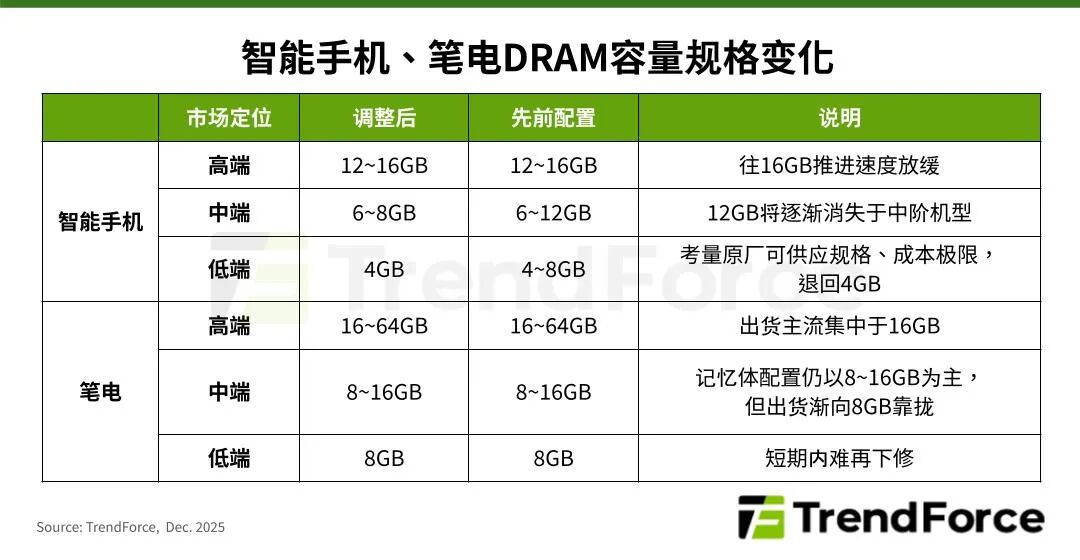
Core Insights - The global terminal products are facing significant cost challenges due to anticipated substantial increases in memory prices in Q1 2026, leading to price adjustments and reduced sales forecasts for smartphones and laptops [1] - Memory components are increasingly impacting the BOM cost of consumer electronics, prompting companies like Apple to reconsider pricing strategies for new devices [1] - The rise in memory prices will force laptop brands to adjust product mix, procurement strategies, and regional sales layouts, particularly affecting high-end lightweight laptops [1] Group 1: Smartphone Market - Memory's share in BOM cost for smartphones is expected to rise significantly, impacting pricing strategies for brands, especially in the Android market [1] - Android brands, which target the mid-to-low price segments, will likely increase new device pricing and adjust old device prices or supply cycles to mitigate losses [1] - The high-end smartphone segment will see a slowdown in the push towards higher memory configurations, with 12GB gradually disappearing from mid-range models [2][4] Group 2: Laptop Market - The consumer laptop market is currently supported by existing inventory of finished and low-cost memory, allowing for stable pricing in the short term, but significant price adjustments are expected by Q2 2026 [2] - Brands are adopting "spec reduction" or "upgrade delays" as necessary strategies to balance costs, particularly affecting DRAM configurations [2] - High-end laptops will maintain a memory configuration of 16-64GB, while mid-range products will trend towards 8GB, and low-end laptops will remain at 8GB without further reductions [4]
研报 | 预计2026年第一季度存储器涨势持续强劲,智能手机、笔电品牌启动价格上修与规格降级
TrendForce集邦· 2025-12-11 09:02
Core Insights - The article highlights the anticipated significant increase in memory prices in Q1 2026, which will lead to cost challenges for global end products, particularly in the smartphone and laptop industries. This situation is expected to result in price adjustments and specification reductions, concentrating resource advantages among a few leading brands [2][3]. Memory Price Impact on Smartphones - Memory components are increasingly affecting the BOM cost of consumer electronics like smartphones and PCs. For instance, the iPhone series will see a notable rise in memory's share of BOM cost, prompting Apple to reconsider new device pricing and potentially reduce or eliminate price cuts on older models [2][3]. - Android brands, which target the mid-to-low price market, will also face pressure to raise new device prices and adjust old device pricing or supply cycles due to the soaring memory prices [2][3]. Adjustments in Laptop Market - Laptop brands are expected to modify their product mix, procurement strategies, and regional sales layouts in response to rising memory prices. High-end lightweight laptops, which typically have mobile DRAM soldered onto the motherboard, will likely experience the most significant price pressure [3]. - The consumer laptop market may maintain existing pricing in the short term due to inventory support but is expected to enter a notable price adjustment phase by Q2 2026 [3]. Specification Adjustments - Brands are increasingly adopting "spec reduction" or "upgrade postponement" as necessary strategies to balance costs, particularly with DRAM, which has a high cost share. High-end and mid-range products will see DRAM capacity specifications converge towards the market's minimum standards, slowing down enhancement speeds [3]. - The low-end market will be the most affected price segment, with smartphones expected to revert to a predominant 4GB configuration in 2026. Low-cost laptops will face limitations in DRAM configuration adjustments due to processor and operating system requirements [3][4]. Summary of Adjusted Specifications - **Smartphones**: - High-end: 12-16GB (slower progression towards 16GB) - Mid-range: 6-8GB (12GB gradually disappearing) - Low-end: 4GB (returning to 4GB due to supply and cost limits) [4] - **Laptops**: - High-end: 16-64GB (mainstream shipments concentrated at 16GB) - Mid-range: 8-16GB (shifting towards 8GB) - Low-end: 8GB (short-term adjustments unlikely) [4]