MEMS产业

Search documents
MEMS,开启新整合
半导体行业观察· 2026-02-09 01:18
Core Insights - The global MEMS industry is entering a new phase of consolidation driven by increased technological complexity, higher capital intensity, and the need for clearer strategic positioning [2] - Recent transactions involving STMicroelectronics/NXP, Infineon/ams OSRAM, SiTime/Renesas, and Qorvo's asset divestiture illustrate a trend where semiconductor companies are actively adjusting their business portfolios by divesting non-core assets and investing in segments with long-term differentiation and scale advantages [2] Group 1: STMicroelectronics and NXP - STMicroelectronics completed the acquisition of NXP's MEMS sensor business in early 2026, positioning it as a way to expand its global sensor capabilities, focusing on automotive safety and industrial applications [5] - This acquisition is expected to enhance STMicroelectronics' scale and service range in markets with long design cycles and high customer stickiness [5] - NXP's decision to sell aligns with its cautious portfolio management strategy, concentrating investments in areas where it can achieve system-level differentiation [5] Group 2: Infineon and ams OSRAM - Infineon announced plans to acquire ams OSRAM's non-optical analog/mixed-signal sensor product portfolio for €570 million in February 2026 [6] - The acquisition will include products, R&D capabilities, intellectual property, and testing/laboratory equipment, enhancing Infineon's sensor product line and system capabilities in automotive, industrial, and medical sectors [6] - Infineon's CEO indicated that the acquisition aims to create a product portfolio that aligns well with emerging humanoid robotics, positioning the company favorably in the market [6] Group 3: SiTime and Renesas - SiTime's acquisition of Renesas' timing business for $1.5 billion highlights the consolidation trend, as timing technology is closely related to MEMS technology [7] - SiTime anticipates that the acquired business will generate approximately $300 million in revenue within 12 months post-transaction [8] - Renesas is actively simplifying its product portfolio to focus resources on core platforms that maximize strategic impact [8] Group 4: Qorvo's Strategic Shift - Qorvo has signaled a strategic shift by divesting its MEMS-based sensor solutions business, generating $21.5 million in revenue from the sale [9] - The company recognizes that certain MEMS-based activities no longer align with its long-term strategic focus, indicating a trend of asset transfer to "natural owners" with stronger strategic fit and economies of scale [9] - The ongoing consolidation wave is expected to continue, particularly in automotive, industrial, and medical sensing sectors, where scale is becoming essential due to certification, reliability, and supply chain security [9][10]



MEMS,中国势不可挡
3 6 Ke· 2025-11-07 02:56
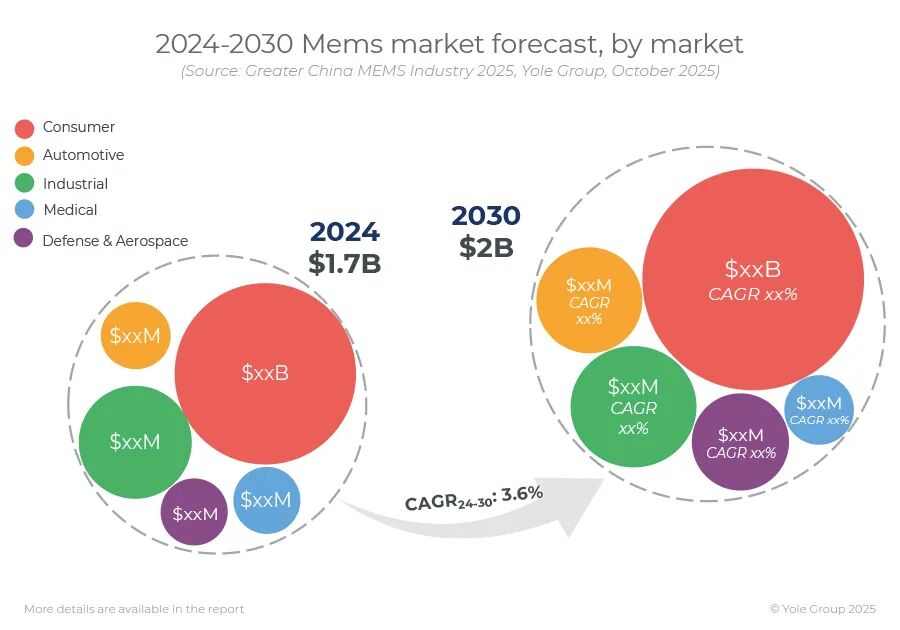
Core Insights - The MEMS industry in Greater China is projected to reach $1.7 billion in revenue in 2024, with a year-on-year growth of 8.4% and an estimated shipment of 5.4 billion units [1] - The market is expected to grow at a compound annual growth rate (CAGR) of 3.6% from 2024 to 2030, reaching $2 billion in revenue and 6.6 billion units sold by 2030 [1] - Chinese manufacturers are positioned to capitalize on this growth, particularly in the "AI + IoT + automotive electronics" wave [1] Market Dynamics - Consumer electronics remain the largest application segment for MEMS, with strong demand for inertial sensors, microphones, and pressure sensors in wearable devices like TWS headphones and smartwatches [3] - Major Chinese companies such as Silan Microelectronics, AAC Technologies, Goermicro, MiraMEMS, and MEMSensing are key players in the supply chain, leveraging performance, reliability, and cost advantages [3] - Goermicro is projected to achieve over 4.5 billion yuan in revenue in 2024, making it the largest smart sensor interaction solution provider in China [3] Revenue Growth - Silan Microelectronics reported a 10% increase in revenue for its MEMS sensor products in the first half of 2025, with a market share of 20%-30% in domestic smartphone brands [3] - AAC Technologies' sensor and semiconductor business revenue reached 608 million yuan in the first half of 2025, a 56.2% increase, driven by high signal-to-noise ratio microphones [4] - MEMSensing achieved a record revenue of 300 million yuan in the first half of 2025, a 47.82% increase, with significant upgrades in acoustic sensor technology [5] Industry Expansion - Chinese MEMS manufacturers are expanding into high-value sectors like automotive and industrial applications, with Silan Microelectronics developing high-precision inertial sensors for automotive use [6] - The automotive sector is seeing increased demand for MEMS microphones due to the rise of smart cockpits and voice control systems [6] - The industrial sector is leveraging MEMS accelerometers and microphones for equipment health monitoring, aligning with the cost and manufacturing flexibility of Chinese firms [7] Emerging Applications - The medical market is expected to be one of the fastest-growing segments for MEMS, particularly with the opening of the OTC hearing aid market in the U.S. and China [7] - MEMS technology is also being integrated into AI infrastructure, with demand for MEMS optical switches and micro-mirrors in optical communication systems [8] Device Maturity - The variety of MEMS devices includes inertial, acoustic, environmental, optical, medical, and energy-related types, with applications expanding beyond consumer electronics [9] - Chinese manufacturers have achieved near-complete domestic production of MEMS microphones, reaching international performance standards [10] Manufacturing Advancements - The MEMS foundry sector in Greater China is projected to grow by 14.3% in 2024, becoming a new growth engine for the industry [13] - Companies like Chipone Integrated Circuits and Huazhong University of Science and Technology are emerging as key players in MEMS wafer foundry [16][17] - The transition from 8-inch to 12-inch wafer production lines is underway, with Guangzhou Zengxin launching the first 12-inch MEMS sensor production line in China [18] Future Outlook - Chinese MEMS companies are expected to gain unprecedented development opportunities, benefiting from their position as a core manufacturing hub for consumer electronics, automotive, and industrial sectors [12] - The focus on manufacturing capabilities is shifting from "filling gaps" to "building advantages," enhancing China's bargaining power and technological influence in the global MEMS market [21]