MEMS微型扬声器

Search documents
MEMS,中国势不可挡
3 6 Ke· 2025-11-07 02:56
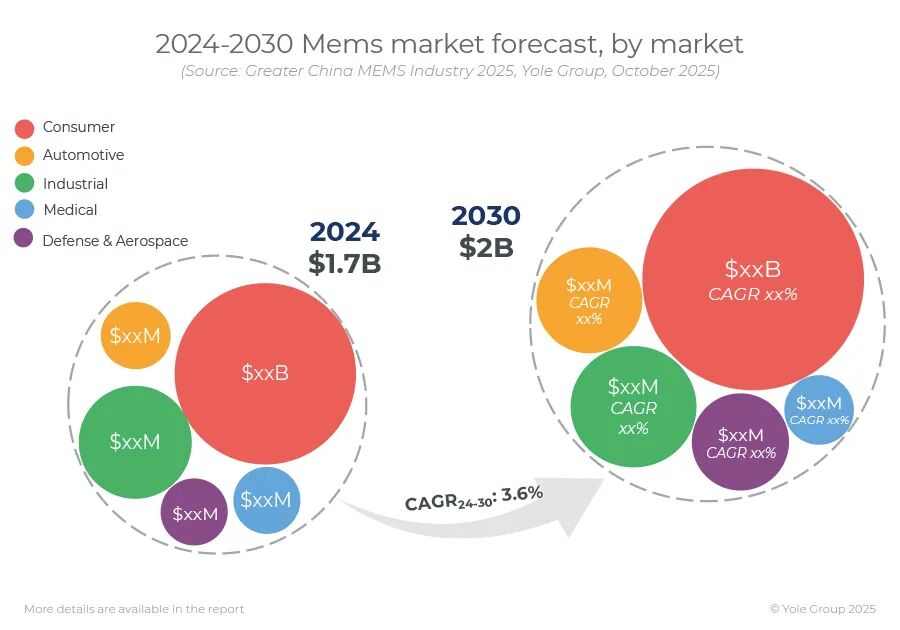
Core Insights - The MEMS industry in Greater China is projected to reach $1.7 billion in revenue in 2024, with a year-on-year growth of 8.4% and an estimated shipment of 5.4 billion units [1] - The market is expected to grow at a compound annual growth rate (CAGR) of 3.6% from 2024 to 2030, reaching $2 billion in revenue and 6.6 billion units sold by 2030 [1] - Chinese manufacturers are positioned to capitalize on this growth, particularly in the "AI + IoT + automotive electronics" wave [1] Market Dynamics - Consumer electronics remain the largest application segment for MEMS, with strong demand for inertial sensors, microphones, and pressure sensors in wearable devices like TWS headphones and smartwatches [3] - Major Chinese companies such as Silan Microelectronics, AAC Technologies, Goermicro, MiraMEMS, and MEMSensing are key players in the supply chain, leveraging performance, reliability, and cost advantages [3] - Goermicro is projected to achieve over 4.5 billion yuan in revenue in 2024, making it the largest smart sensor interaction solution provider in China [3] Revenue Growth - Silan Microelectronics reported a 10% increase in revenue for its MEMS sensor products in the first half of 2025, with a market share of 20%-30% in domestic smartphone brands [3] - AAC Technologies' sensor and semiconductor business revenue reached 608 million yuan in the first half of 2025, a 56.2% increase, driven by high signal-to-noise ratio microphones [4] - MEMSensing achieved a record revenue of 300 million yuan in the first half of 2025, a 47.82% increase, with significant upgrades in acoustic sensor technology [5] Industry Expansion - Chinese MEMS manufacturers are expanding into high-value sectors like automotive and industrial applications, with Silan Microelectronics developing high-precision inertial sensors for automotive use [6] - The automotive sector is seeing increased demand for MEMS microphones due to the rise of smart cockpits and voice control systems [6] - The industrial sector is leveraging MEMS accelerometers and microphones for equipment health monitoring, aligning with the cost and manufacturing flexibility of Chinese firms [7] Emerging Applications - The medical market is expected to be one of the fastest-growing segments for MEMS, particularly with the opening of the OTC hearing aid market in the U.S. and China [7] - MEMS technology is also being integrated into AI infrastructure, with demand for MEMS optical switches and micro-mirrors in optical communication systems [8] Device Maturity - The variety of MEMS devices includes inertial, acoustic, environmental, optical, medical, and energy-related types, with applications expanding beyond consumer electronics [9] - Chinese manufacturers have achieved near-complete domestic production of MEMS microphones, reaching international performance standards [10] Manufacturing Advancements - The MEMS foundry sector in Greater China is projected to grow by 14.3% in 2024, becoming a new growth engine for the industry [13] - Companies like Chipone Integrated Circuits and Huazhong University of Science and Technology are emerging as key players in MEMS wafer foundry [16][17] - The transition from 8-inch to 12-inch wafer production lines is underway, with Guangzhou Zengxin launching the first 12-inch MEMS sensor production line in China [18] Future Outlook - Chinese MEMS companies are expected to gain unprecedented development opportunities, benefiting from their position as a core manufacturing hub for consumer electronics, automotive, and industrial sectors [12] - The focus on manufacturing capabilities is shifting from "filling gaps" to "building advantages," enhancing China's bargaining power and technological influence in the global MEMS market [21]


MEMS,中国势不可挡
半导体行业观察· 2025-11-07 01:00
Core Viewpoint - The MEMS (Micro-Electro-Mechanical Systems) industry in the Greater China region is projected to reach a global revenue of $1.7 billion in 2024, with a year-on-year growth of 8.4%, driven by the convergence of AI, IoT, and automotive electronics [2]. Group 1: Market Dynamics - The MEMS market is expected to have a compound annual growth rate (CAGR) of 3.6% from 2024 to 2030, with sales reaching 6.6 billion units and revenue hitting $2 billion by 2030 [2]. - Consumer electronics remain the largest application segment, particularly in TWS earbuds, smartwatches, and AR glasses, where demand for inertial sensors, microphones, and pressure sensors is strong [4][5]. Group 2: Chinese Manufacturers' Role - Chinese companies such as Silan Microelectronics, AAC Technologies, Goermicro, MiraMEMS, and MEMSensing are becoming key drivers in the MEMS market, leveraging advantages in performance, reliability, and cost [5]. - The domestic MEMS microphone industry has achieved nearly complete localization, forming a complete ecosystem from wafer to packaging, with performance metrics approaching international standards [12]. Group 3: Technological Advancements - MEMS acoustic sensors are set to undergo significant upgrades in technical specifications, particularly in signal-to-noise ratio, creating new market opportunities [6]. - The automotive and industrial sectors are seeing increased demand for high-reliability MEMS products, with applications in safety-related systems and device health monitoring [7]. Group 4: Emerging Markets - The medical market is anticipated to be one of the fastest-growing segments for MEMS, especially with the opening of the OTC hearing aid market in the U.S. and China [8]. - The demand for MEMS in communication and AI infrastructure is also rising, driven by the surge in data traffic and AI training scales [8]. Group 5: Manufacturing and Supply Chain - The MEMS foundry sector in Greater China is expected to grow by 14.3% in 2024, with companies like Chipone, Silex, and Huazhong University of Science and Technology leading the charge [17]. - The transition from 8-inch to 12-inch wafer production lines is underway, which will significantly reduce costs and increase output [19][21]. Group 6: Future Outlook - Chinese MEMS companies are positioned to seize unprecedented growth opportunities, benefiting from their proximity to key markets and the ability to respond quickly to customer needs [14][15]. - The next decade will be crucial for achieving breakthroughs in high performance, intelligence, and system integration within the MEMS industry [24].

MEMS,卷土重来
半导体行业观察· 2025-06-20 00:44
Core Insights - The MEMS industry is expected to see new growth opportunities in 2024, with global revenue reaching $15.4 billion, a 5% year-over-year increase, driven by the end of the "inventory effect" in Q2 [1] - The demand for MEMS devices is anticipated to grow significantly in 2025, as markets recover to pre-COVID levels and driven by trends across various end markets [1][6] Consumer Electronics - Integration of new sensors in smartphones is expected to stagnate, while interest in MEMS devices in wearable technology, such as TWS earbuds, is on the rise [1] - The AR/VR headset market is projected to grow significantly by 2030, creating substantial demand for LBS, inertial sensors, and microphones [1] - Environmental sensors will see increased application in air purifiers, thermostats, and HVAC systems due to growing concerns about air quality [1] Automotive Sector - The automotive market remains stable, with a decline in MEMS pressure sensors used in BEVs, but growth in other automotive applications such as ADAS and safety features [2] - MEMS inertial sensors will find opportunities in battery impact detection and vehicle parking status monitoring [2] Industrial Applications - The trend towards Industry 4.0 and warehouse automation is leading to a shift from traditional vehicles to AGVs and smart factory vehicles, increasing the demand for motion sensors, microphones, and ultrasonic sensors [2] - Machine health monitoring is a key application area for MEMS inertial sensors and microphones [2] Medical Market - The emergence of OTC hearing aids is expected to drive sales growth for MEMS microphones, micro speakers, and motion sensors [3] - The use of ultrasound in diagnostics is predicted to expand, with handheld ultrasound probes being utilized in telemedicine [3] Telecommunications - The continuous growth of global data traffic and significant investments in AI will drive the use of telecom equipment such as optical MEMS and MEMS-based oscillators [3] - MEMS technology offers advantages in cooling systems due to its smaller size compared to traditional technologies [3] Defense and Aerospace - The defense and aerospace markets are expected to grow in 2024, driven by the demand for precise positioning in drones and missiles, as well as stable antennas [3] Market Trends and Projections - The MEMS industry is projected to achieve a compound annual growth rate (CAGR) of 3.7% from 2024 to 2030, with sales expected to reach 35 billion units and revenue of $19.2 billion by 2030 [3] - Major players in the MEMS sensor market include Bosch, STMicroelectronics, and TDK, with Bosch expected to generate $2 billion in revenue in 2024, a 12% increase [6] - The overall wafer foundry business is expected to remain stable, with a 3.2% year-over-year revenue growth in 2024 [6] Technological Developments - The MEMS market is evolving with a focus on smart sensors that offer various functionalities, optimizing size, power consumption, and data privacy [10][11] - The adoption of piezoelectric MEMS in applications such as PMUT, inkjet print heads, and RF MEMS is on the rise [10] - The trend towards 12-inch MEMS manufacturing is gaining traction, facilitating better integration with ICs and improved performance [10] Ecosystem Development - 2024 is seen as a transitional year for the MEMS ecosystem, with ongoing participation in 300mm MEMS manufacturing and advancements in MEMS micro-speaker production [7]