
P2P网贷

Search documents
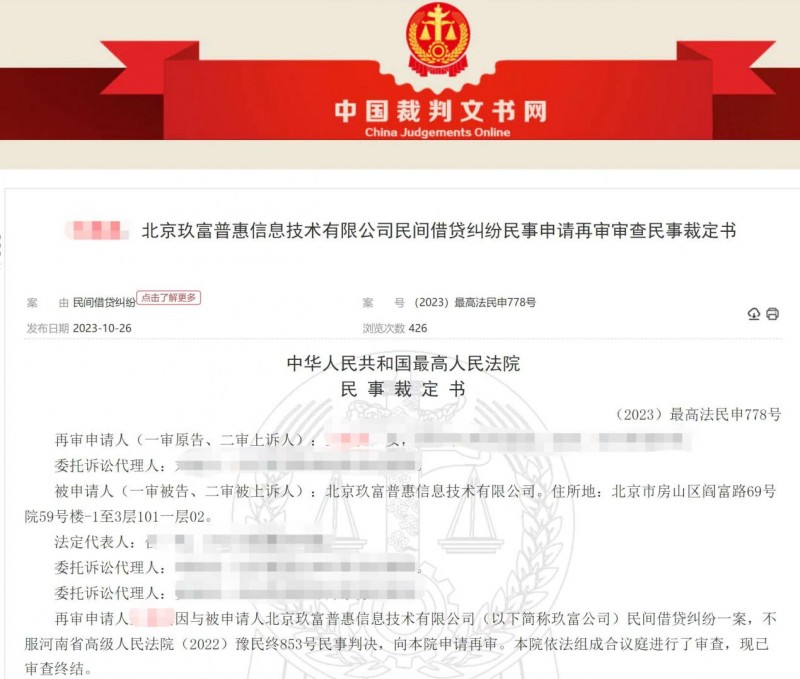
最高院明确玖富与出借人为中介合同关系 驳回出借人再审申请
Cai Fu Zai Xian· 2025-11-14 03:33
Core Viewpoint - The recent court ruling highlights that P2P lending platforms, such as Jiufu Puhui, are classified as information intermediaries and are not liable for repayment to lenders, as they do not engage in direct lending relationships [1][3]. Group 1: Legal Context - According to Chinese laws and regulations regarding private lending and online lending management, P2P platforms are not considered actual borrowers [1]. - In a case involving a lender named Wang, the court ruled that there was no established private lending contract between Wang and Jiufu Puhui, affirming the platform's role as an intermediary [1]. Group 2: Court Ruling Details - The Supreme Court determined that Wang did not actually lend money to Jiufu Puhui, nor did Jiufu Puhui lend money to borrowers, thus establishing a contractual relationship based on intermediary services [1]. - The court rejected Wang's claim for repayment, stating that Jiufu Puhui is not legally obligated to repay the loan amount [1]. Group 3: Industry Practices - P2P lending platforms utilize big data and artificial intelligence to effectively match funding supply and demand, addressing the challenges faced by small enterprises and individual borrowers [3]. - Some platforms are now implementing localized collection lawsuits to enhance recovery efforts from overdue borrowers, which is seen as a positive development for lenders [3].

获刑12年!原金融办主任大搞P2P,非法集资超10亿
Jing Ji Wang· 2025-10-20 02:27
Core Points - The case involves a Ponzi scheme operated by a P2P platform called "Caishen Online," which illegally raised over 1 billion yuan from the public [1][2][3] - The actual controller of the platform, Luo, was previously a high-ranking official in local financial regulation, which adds a layer of complexity to the case [1][7] - The Chongqing First Intermediate People's Court upheld the original ruling, sentencing Luo to 12 years in prison for fundraising fraud, along with significant fines for him and his core team members [6][7] Company Overview - "Caishen Online" was established in 2013 and launched its platform in 2014, primarily facilitating loans through internet-based information dissemination [2][3] - The platform's business model involved creating financing products based on loan requests from businesses, often using fictitious borrowers and shell companies to mislead investors [2][3] Financial Details - The fraudulent activities led to the illegal collection of approximately 1.067 billion yuan from over 1,000 investors, with actual losses amounting to around 679.9 million yuan after accounting for interest payments [3][4] - The scheme involved the use of over 100 shell companies to fabricate loan requests and misrepresent the financial health of the platform [2][3] Legal Proceedings - The court found that Luo and his associates had the intent to illegally occupy funds, constituting fundraising fraud rather than merely illegal public fundraising [6] - The court's final ruling included the confiscation of assets and a structured repayment plan for the affected investors [6]